The Midterms Are Over. The Garbage They Generate Is Forever
Who’s supposed to take down campaign signs? We investigated — and ended up with plans to turn them into vivarium insulation, soap molds, and goose decoys.


Who’s supposed to take down campaign signs? We investigated — and ended up with plans to turn them into vivarium insulation, soap molds, and goose decoys.

For artists who planned to sell at the Oakland arts hub’s Gifty market next month, the abrupt closure represents a major revenue loss — and for most, it’s too late to regroup.

This week we've got justice for witches, horny horses, a Scooby-Doo themed dinner, tempting holiday markets, and more.

Who’s supposed to take down campaign signs? We investigated — and ended up with plans to turn them into vivarium insulation, soap molds, and goose decoys.

We’re three days into recovering from a very intense election season — and chances are, you’re ready to be done with it. The relentless text messages and mailers have stopped, and we’re no longer hit over the head with campaign messaging every time we leave the house. Right?
Wrong! Remnants of campaigns still litter the Bay Area, quite literally. Hundreds of the plastic signs stuck into the ground on street corners and medians are going to hang around, maybe even for months.
In addition to the environmental impact, this is an eyesore with a psychic toll: For nearly a year after the 2024 election I drove past signs for a candidate I deeply disliked (who lost, yay). It drove me out of my mind. I did not want to be reminded of their anti-homeless, punishment-heavy, backwards support of broken carceral systems every time I went to the store. I tried to ignore them — who cares, they’re just stupid signs! — but failed. The day they disappeared I felt free. Their campaign was really, truly, finally over.
Still, it left me with questions. Namely, who the hell is supposed to clean these signs up?
So, this year, I set out to find if any rules exist for campaign signs. And, oh boy, do they! Problem is, they vary enormously across the Bay Area, and trying to find your local rules means diving down a city ordinance rabbit hole (unless you’re in Fremont, which wins the Transparency Award). With so little clarity on exactly where, when, and how the signs are supposed to be posted and removed, it’s no wonder they slouch uselessly on the side of the road until springtime.
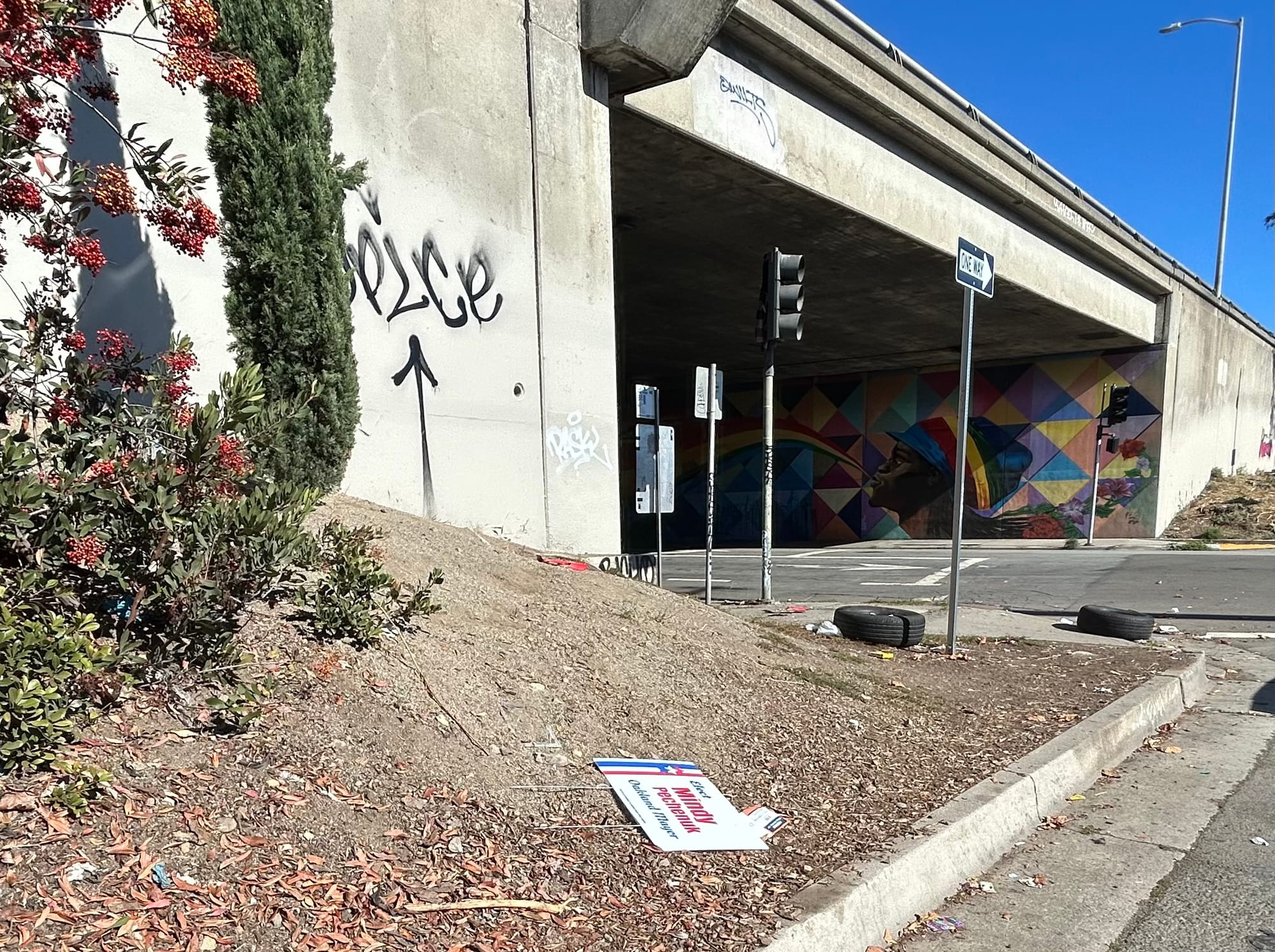
First off, there’s the question of where it’s OK to post them in the first place. If you’ve ever seen a campaign sign posted 10 feet up a telephone pole and wondered if that’s allowed, the answer is an unsatisfying “maybe.” Not every town bans this. In Oakland, local ordinance 5.06.020 states signs are strictly forbidden on public property, including street lamps, trash cans, trees, telephone posts, bridges, medians and “public ornamental fountains.”
But in San Francisco, you can do it as long as the sign isn’t posted higher than 12 feet, conforms to the shape of the pole, is attached by a non-adhesive material “like twine,” includes the posting date in the bottom right-hand corner, and isn’t on a historic light post — such as those that run along Market Street from the Embarcadero to the Castro. You’d better get it right: According to State Penal Code 556, you can be charged with a misdemeanor for placing signs in the wrong public spot.
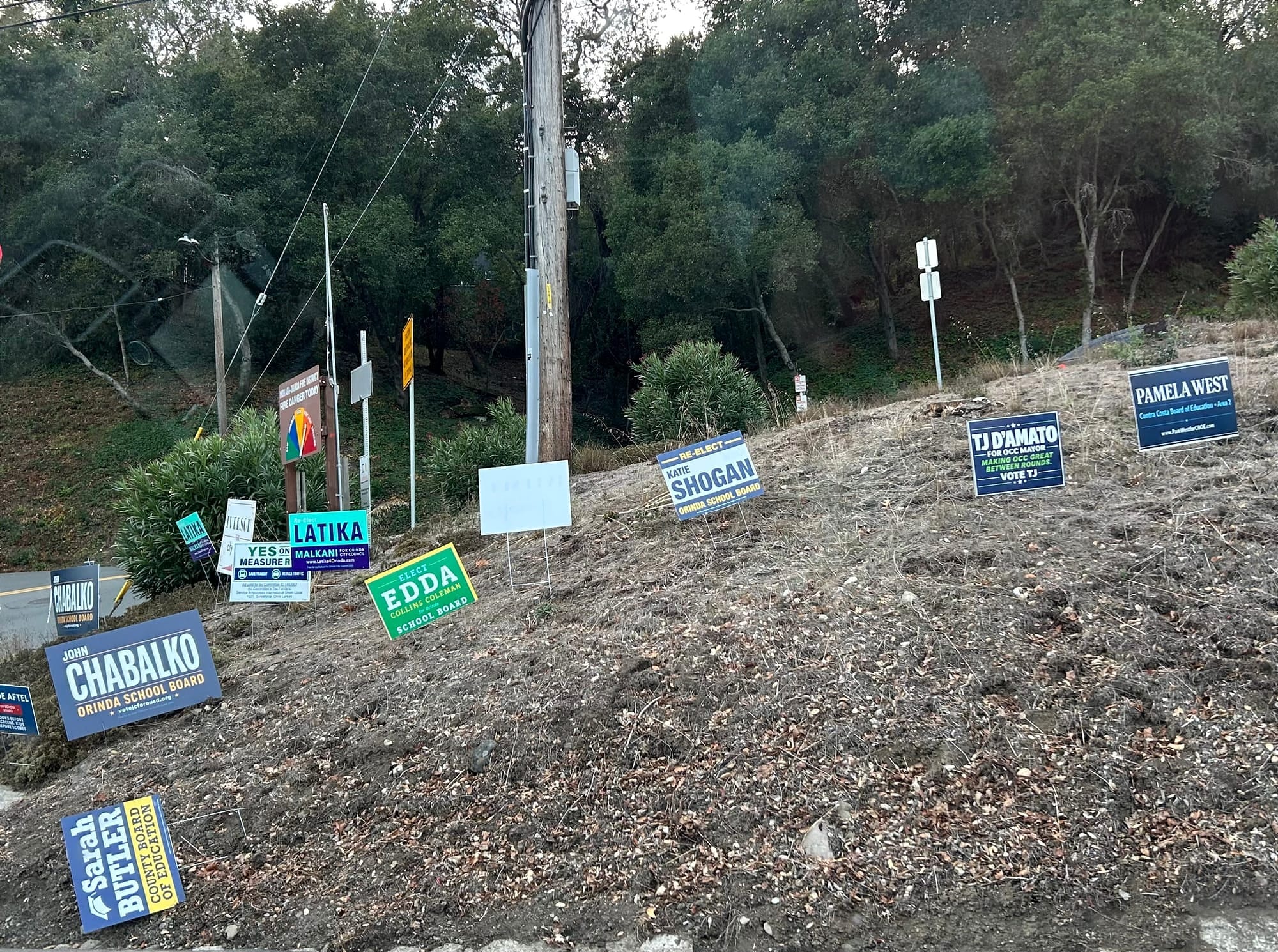
Orinda has made it easy. Here’s a short list of public places where campaigns are allowed to put up signs. Everywhere else is off the table.
How long can signs be left up after an election? That’s also decided on a city-by-city basis. Berkeley and Fremont say 15 days; San Leandro, Piedmont, San Jose, San Mateo, Millbrae, Marin, Orinda, and San Ramon tighten that number to 10.
In San Francisco, the 10-day deadline is specifically for signs on utility poles or lamp posts. For signs in merchant windows, individual shop owners are responsible for taking them down, and homeowners are responsible for yard signs on private property. Campaigns are generally responsible for removing any signs up in public spaces (permitted or not).
But this is easier said than done. One candidate who ran for office in San Francisco told me that it’s a courtesy for campaigns to take down their own signs, but sometimes they run out of money to pay people to do so. Volunteers, she said, don’t usually want to do anything after the campaign — regardless of whether the candidate they backed won or lost.
So are there ever ramifications for breaking these rules? If sore losers ignore their trash, and winners celebrate by already reneging on their campaign promises, who actually gets in trouble?
Some cities, like Berkeley, will fine candidates and committees if signs aren’t removed from public places within 15 days of an election — but it’s unlikely city officials will be driving around logging who’s broken the rules. Instead, the city puts the impetus on residents: “Report sign locations to the campaign committees,” it suggests, which again raises the question of whether the campaign has anyone left to respond.
In the end, let’s be honest, it’ll be Public Works slowly taking all these lingering signs down. And in Oakland, which is neck-deep in a chronic dumping crisis, clearing election signs has to be at the bottom of their to-do list — and if they did pick them up, they’d just chuck them in the trash.
Which brings us to another issue: The signs are weatherproof, colorful, don’t fade, and are absolutely terrible for the environment. Made out of Coroplast, or corrugated plastic, they can’t be recycled, nor can their metal wire stands. If candidates don’t print a year on them, they can theoretically be used again. But surely there’s some other way to repurpose these things?
Here, the internet delivers. Things I’ve learned people have done with their old signs:
Clearly, I was a dummy for letting those lingering yard signs piss me off every time I passed them. Their prolonged presence was an opportunity: I should have pulled over and yanked them out of the ground.
Please let me know what other creative reuses you’ve found for these monstrosities. I’ll read your responses while making “What is the point of Gavin Newsom?” protest signs and building a house for my neighborhood’s feral cats.