The Ultimate Guide to Spring Sports in the Bay Area
Popular or niche, big or small, quiet or loud, there is a spring sport for everyone. Let us help you find yours.


Popular or niche, big or small, quiet or loud, there is a spring sport for everyone. Let us help you find yours.

It’s baby cat season in the Bay Area! Here’s our guide on what to do if you encounter a litter of purrfect miniature panthers in your yard.

On a chilly Saturday afternoon under the inescapable sound of the BART train, a group of community members took apart the facade of Esther’s Orbit Room.

It’s not every day that you see a septuagenarian blues singer put on a hard hat and take a chisel to a wall. But on Dec. 6, Oakland’s Miss Mechelle LaChaux made sure she was first in line to have a crack at taking off a stone from the facade of Esther’s Orbit Room.
LaChaux was 13 when she first sang at Esther’s Orbit Room, West Oakland’s storied blues and jazz club, with her band The Soul Takers. “Miss Esther did not know I was 13 at the time,” she said with a laugh, addressing the crowd gathered on Saturday afternoon to witness what was dubbed a “community rock breaking ceremony.”
“We were opening for Charles Brown and many other wonderful blues majors,” she added. ”I was in the hood right here, and this,” she said, motioning to the space behind her,” is ours.” She then sang a rendition of Billie Holiday’s “God Bless the Child.”
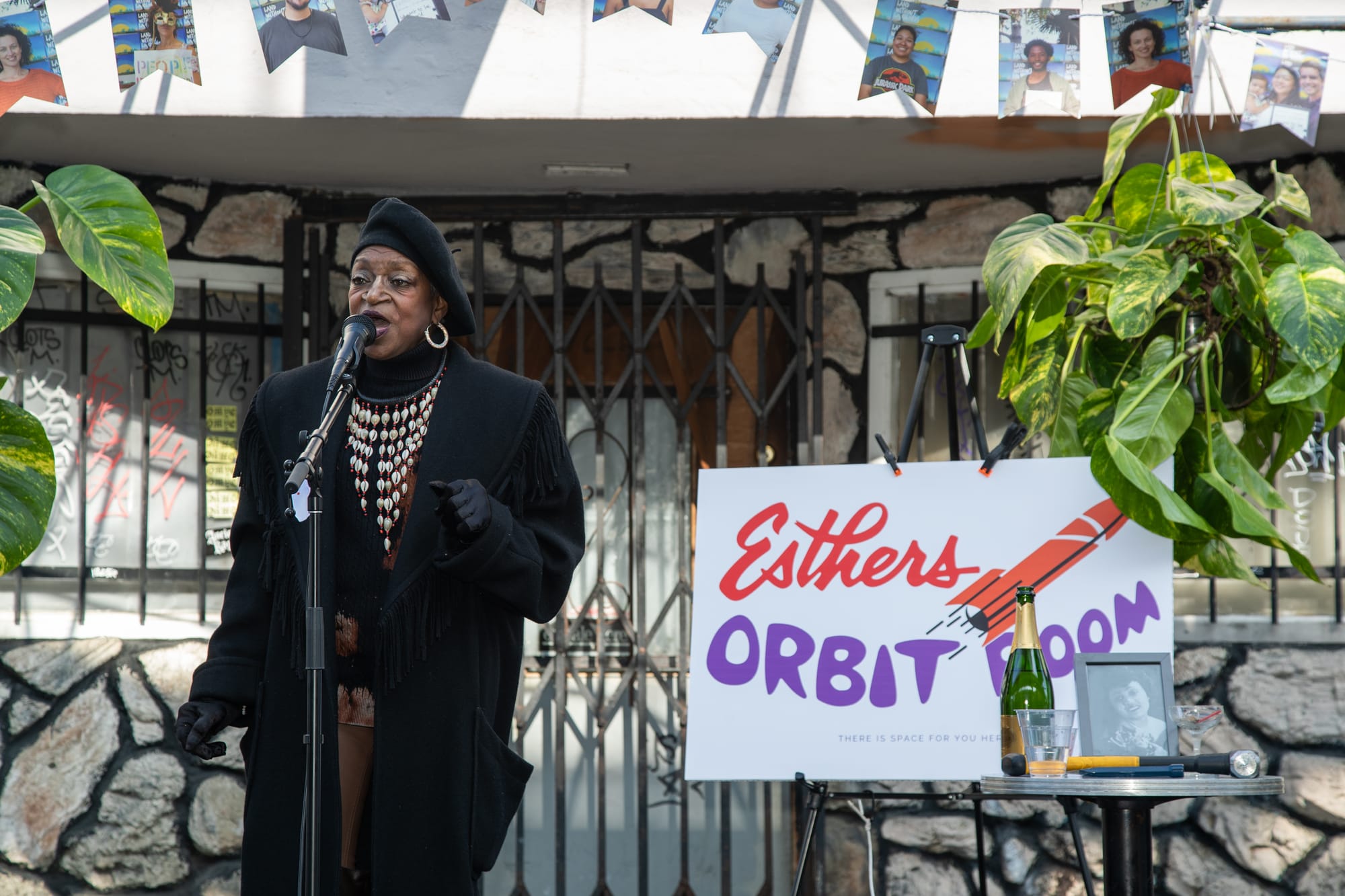
LaChaux wasn’t the only local with deep ties to Esther’s in attendance at Saturday’s event, which marked the beginning of a process to remove concrete stones from the imperiled facade in an effort to preserve them.
Paul Cobb was born just a few hundred yards away, on the basement floor of a hotel on Pine and 7th Street. He grew up shining shoes across the street, before Esther’s had to be relocated to its current location due to eminent domain. Now, he’s the publisher of The Oakland Post. Michauxnée Olier — now the chef at Willows & Pine, a restaurant in East Oakland — got emotional as she told the crowd that she had grown up watching her grandmother cook at The Barn, a restaurant that once sat next to Esther’s Orbit Room, but that this was her first time ever serving food in the club. In the crowd were several more locals whose parents and grandparents had grown up right there, on that block. Esther’s nephew, Danny Collier, sat in the front row.
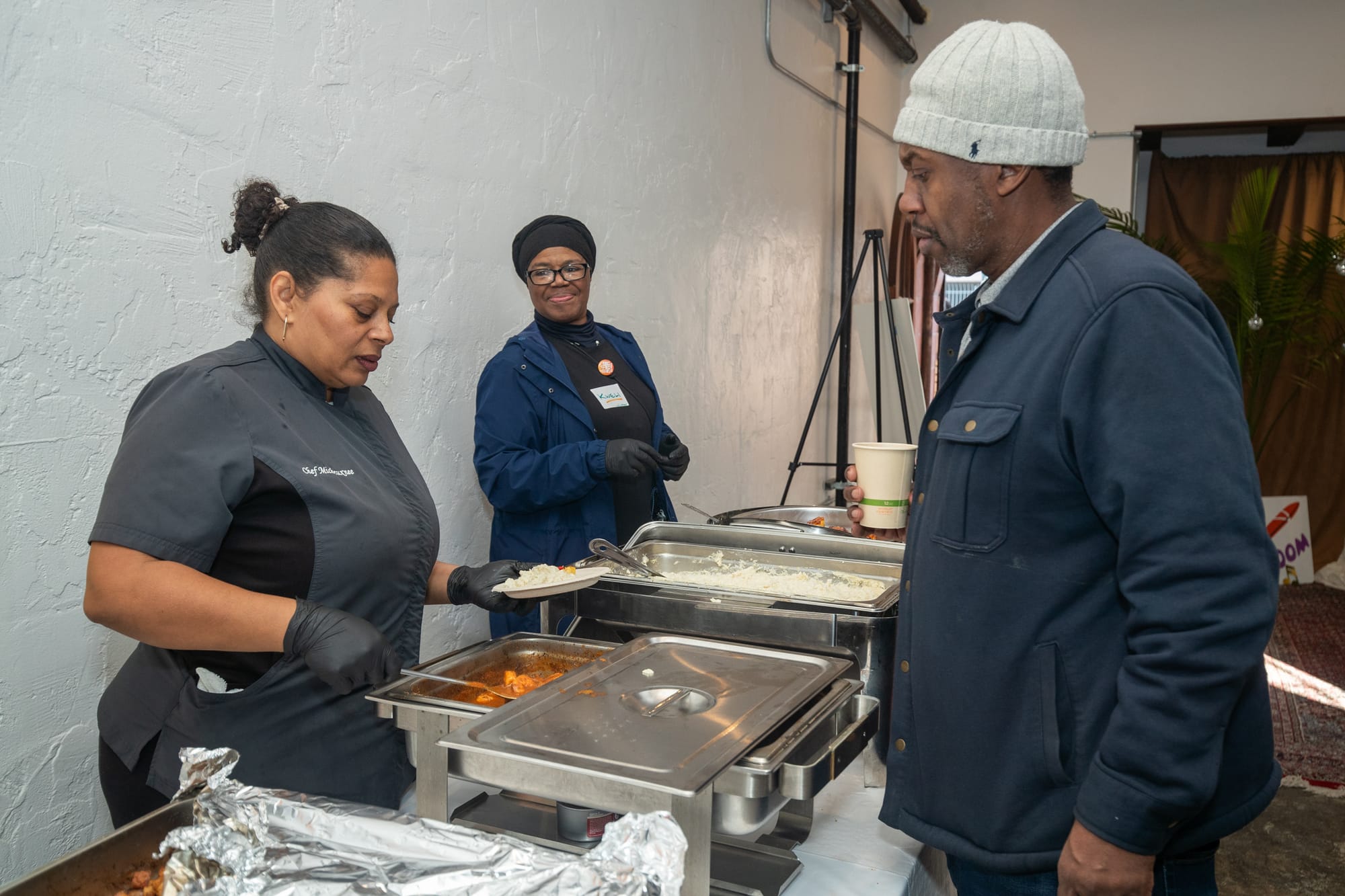
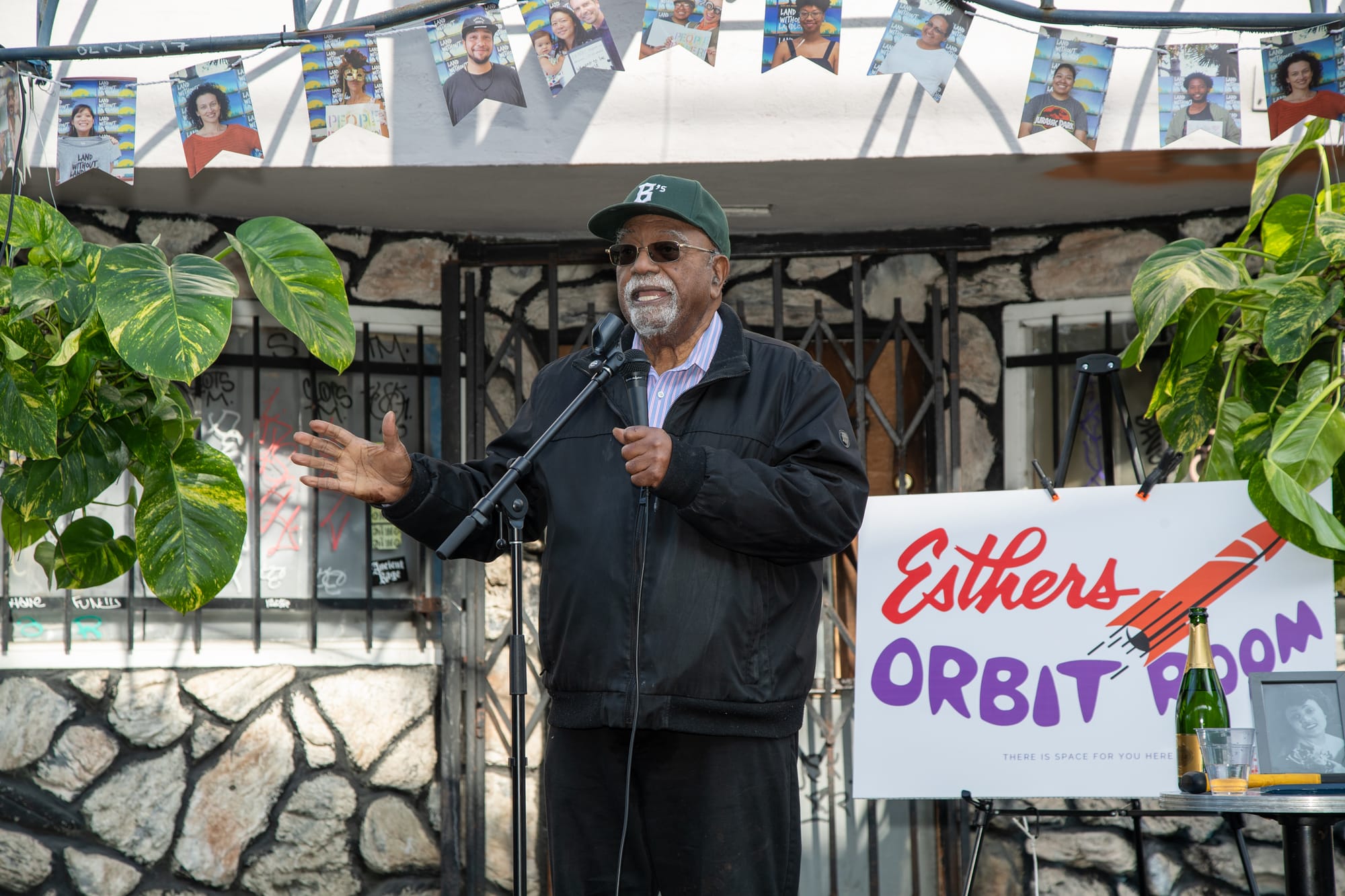
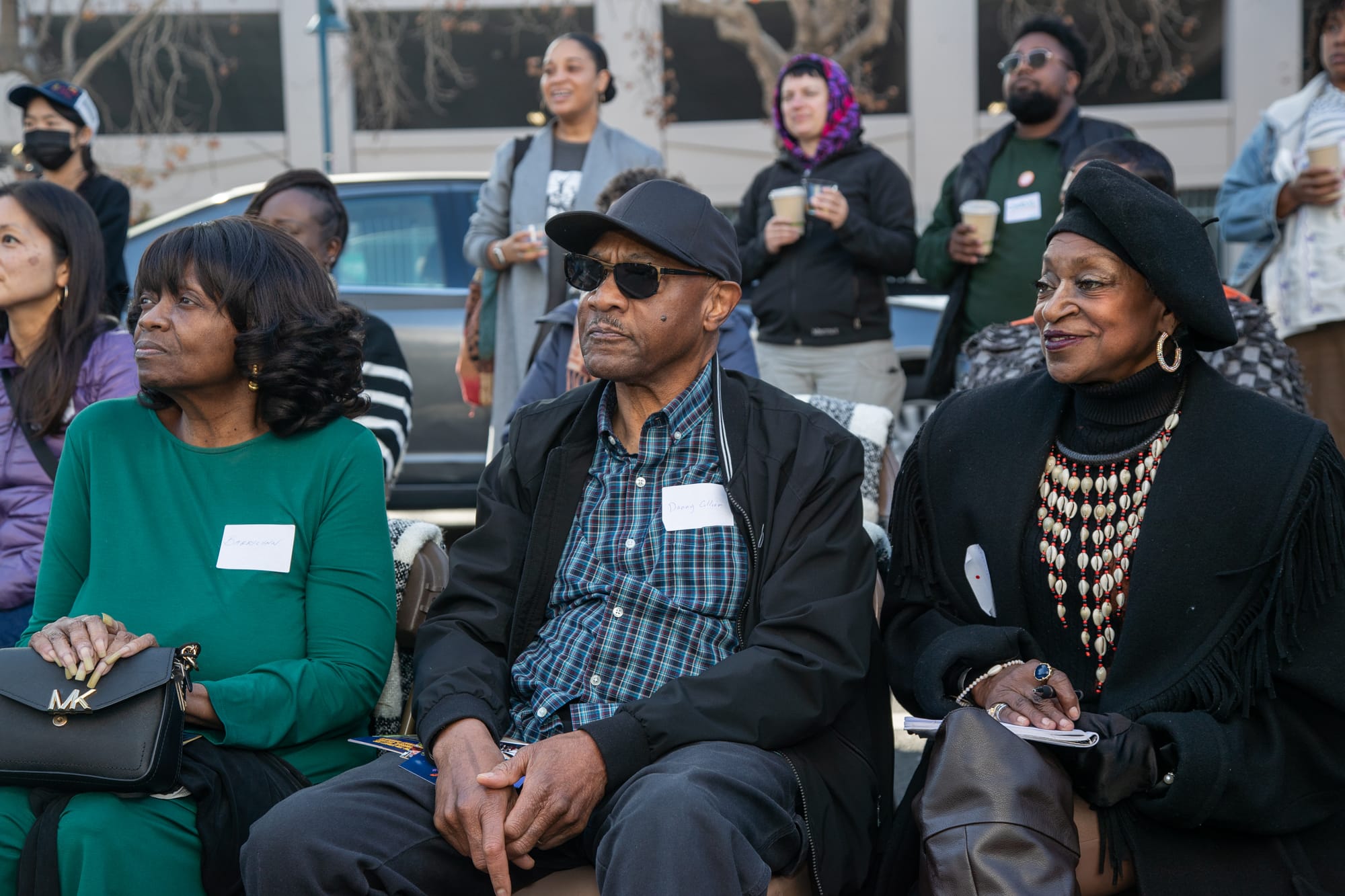
Top: Chef Michauxnée Olier serves soul food to attendees. Bottom left: Paul Cobb, publisher and editor of the Oakland Post, speaks to the crowd. Bottom right: Ether’s nephew, Danny Collier, sits beside Miss MeChelle during the speeches. (Amir Aziz/COYOTE Media Collective)
Every couple of minutes, a BART train’s two-beat bang-bang sound crashed through the ceremony, forcing speakers to pause — an inescapable reminder of the history of this place, and decisions the City of Oakland made that nearly destroyed the corridor. Some people made the best of it, dancing to the rhythm offered by the cars. Cobb paused his speech, and then noted that he had lobbied to put this section of the BART line underground, the way they did in Berkeley. The city ignored their requests, and Cobb and his family were one of thousands of Black people displaced by the construction.
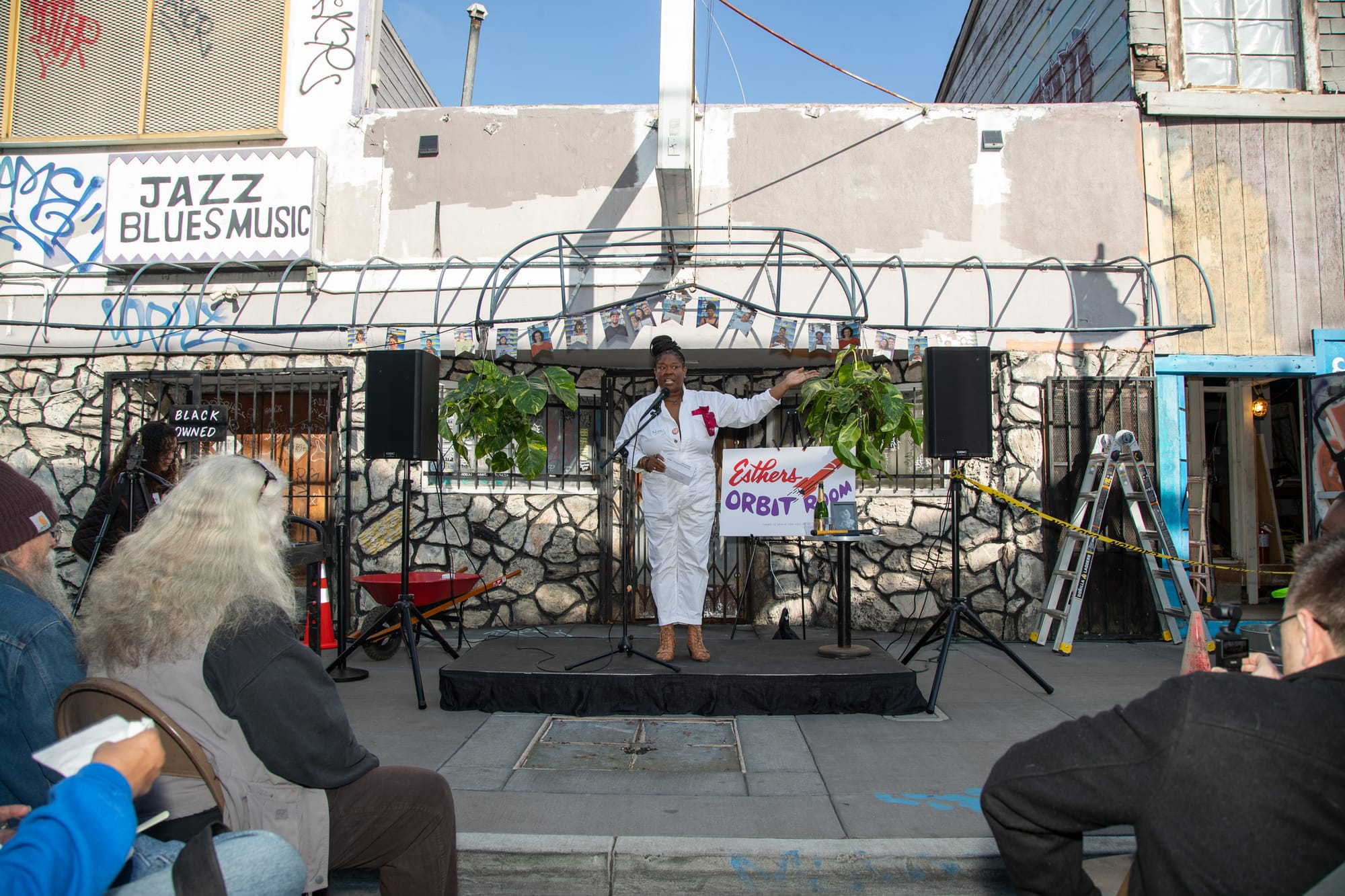
Noni Session, the executive director of East Bay Permanent Cooperative (EB PREC) and ringleader of the restoration of Esther’s Orbit Room, is a local too. (Several elders at the ceremony told me they watched her grow up right there along 7th Street.) And Saturday’s event was one more step in EB PREC’s plan to revitalize not just Esther’s, but the whole area. That plan includes turning the space that previously housed The Barn into a museum and community center. And last week the organization received a two-year option that would allow them to purchase the empty 26,000-square-foot lot next door. Staff are already thinking about how to raise funds to buy the lot, and gathering ideas for the space — “it’s going to be community-led and community-owned, just like the rest of the block,” said Ojan Mobedshahi, EB PREC’s finance director.
When the speeches were done, Mobedshahi invited people up to take a crack at the wall, using provided hardhats, chisels, and hammers. Several in attendance jumped at the chance, including LaChaux, EB PREC investors, and local community members. “People with desk jobs love to hit things,” Mobedshahi joked. When the public had their fill, the work was taken up by a smaller group of volunteers with demolition experience.
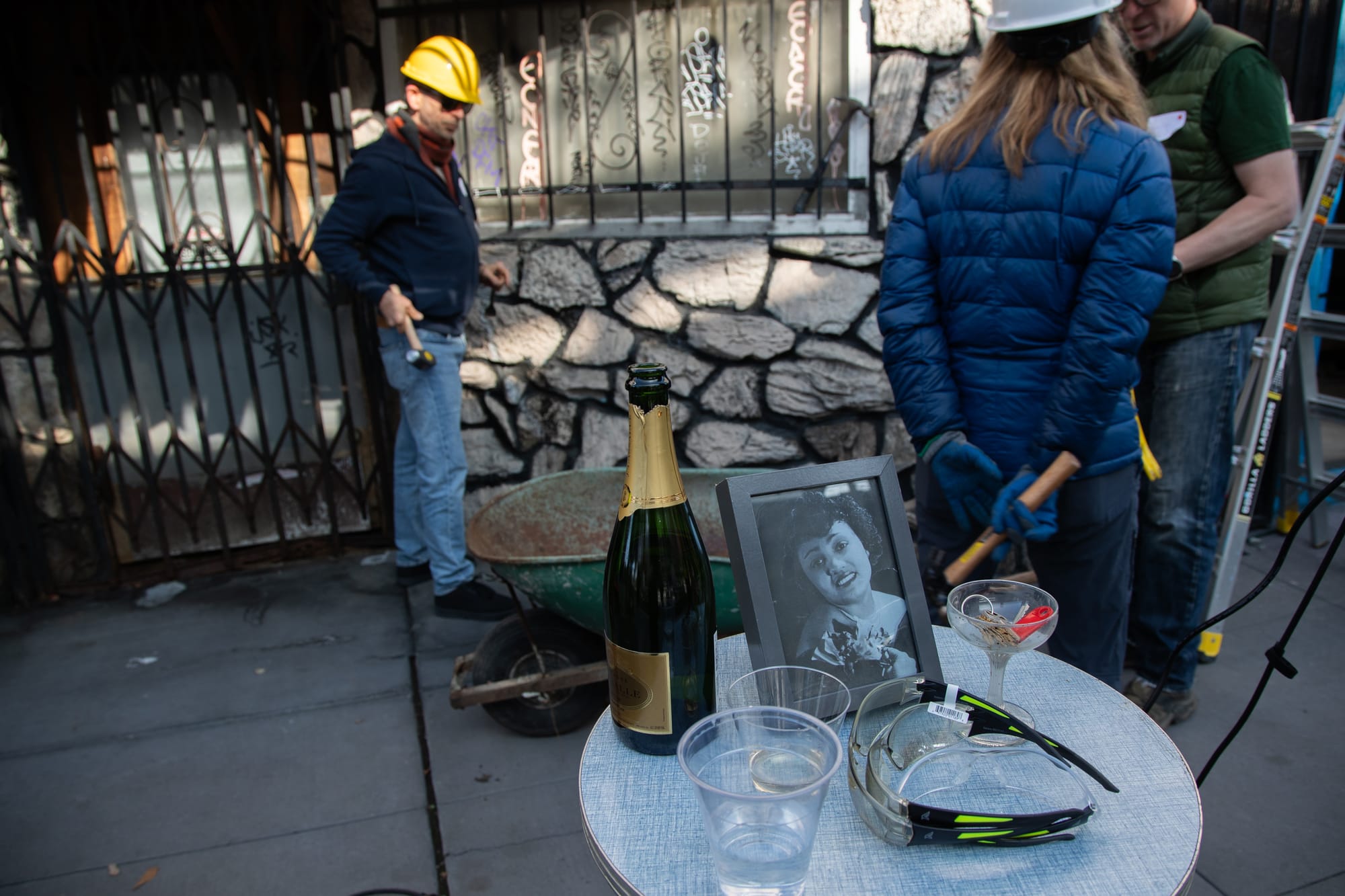
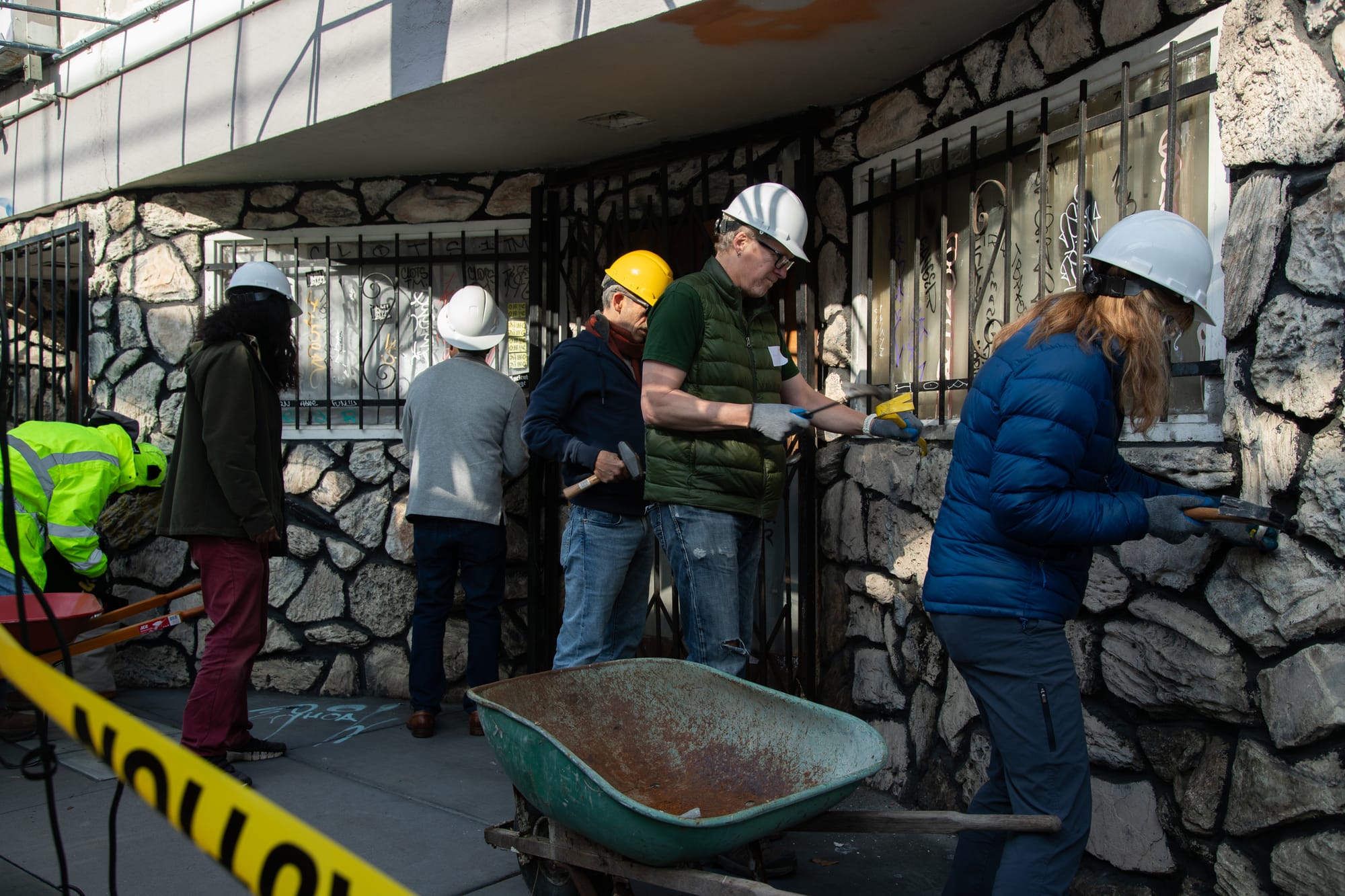
Left: A photo of Esther is propped in front of the venue as crews and volunteers begin the renovation. Right: Volunteers start the process of removing stones. (Amir Aziz/COYOTE Media Collective)
Over the next few weeks, they’ll take every single stone off the front of the building and store them in the lot next door. The Esther’s team will break ground on the project in earnest in January 2026, and eventually plan to hire a mason to place the stones back on the facade. Session hopes to have Esther’s re-opened to the public in January 2027.
Watching the volunteers demolish the wall, dust and debris raining down onto the sidewalk, Session let out an anxious laugh.
“Nervous,” she said, when I asked how she felt about reaching this stage. “But the more nervous I am, the better things are going.”