’Horror Movie Love Eggs’: COYOTE Watches ‘You Can See Everything’
(It all depends on how you define the word "can.")


(It all depends on how you define the word "can.")


En Redwood City, un medio independiente en español informa al público con conversaciones cara a cara y un títere llamado Ramiro.

In Redwood City, an indie Spanish-language news outlet is informing the public with face-to-face conversations and a puppet named Ramiro.
In Redwood City, an indie Spanish-language news outlet is informing the public with face-to-face conversations and a puppet named Ramiro.

Manuel Ortiz Escámez’s backyard in Redwood City hums with the flowing water of his koi fish pond. The pond is directly adjacent to his writing area, a smallish wooden desk set within the corner of a tall square room full of books on all topics. Parked not a stone’s throw away in his driveway is a massive metal caravan with “Península 360” printed in pink and black letters – their “cabina de radio,” or radio cabin.
In 2020, Ortiz co-founded Península 360 Press as a bilingual multiplatform nonprofit news outlet. It was born from informal community Zoom meetings held during the pandemic to help spread certified information on COVID-19, including updates on the latest strains.
“We started in the middle of the pandemic to inform people about COVID, but since day one we were interested in local democracy," Ortiz says. "We want to cover not only local propositions, but we want to also gauge what the community interest is in national topics too.”
Five years after those Zoom calls, Península 360 is the only outlet reporting in Spanish on the Peninsula, where around 25% of the residents identify as Hispanic or Latino, and it’s doing so with just a handful of staffers, a freelance pool, and funding that sometimes comes from Ortiz’s own bank account. As the November midterms and Redwood City’s contentious rent control Measure E loom on the horizon, the outlet, aimed at cutting through misinformation and social media noise, is betting on AM and FM radio signals, a puppet reporter, and face-to-face conversations with Latinx residents.
According to Ortiz, Redwood City was chosen as Península 360’s home because of its central location, his own familial ties to the area, and because of the area’s high Latinx population. “I am convinced that media outlets contribute to democracy wherever you live,” Ortiz says. “I live here. I feel that I am Mexican, I was born there, but I also feel that I am a part of Redwood City.”
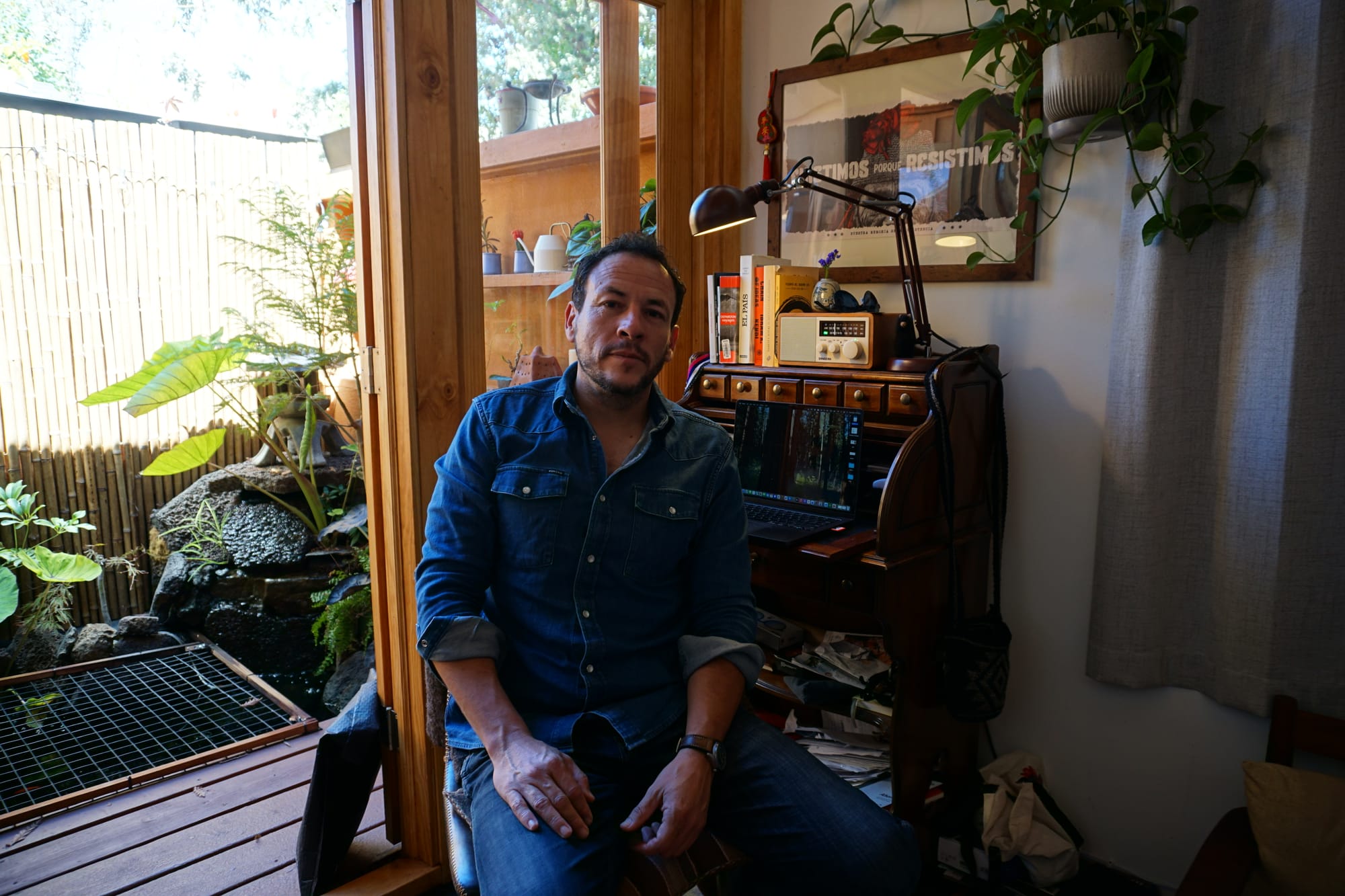
In the beginning, Península 360 was just Ortiz, co-founder Anna Lee Mraz, and a repertoire of coming and going freelance journalists, as they didn't have the funds for full-time staff.
In the five or so years since those first informal meetings, Península 360 has grown to cover local, state, and international news — all bilingually. It often collaborates with other nonprofits or grassroots organizations in the region. In doing so, it provides a critical resource for Spanish-speaking readers in a region that doesn’t have many — leaving an enormous population in the Bay Area without culturally competent local news.
Around 36% of Redwood City’s 84,292 populace identify as Hispanic or Latino in 2020, according to Bay Area Census. The National Association of Latino Elected and Appointed Officials and the Brookings Institution found, in a 2022 study, that around 48% of Spanish-speaking households in the United States were reliant on platforms like YouTube for news. According to a 2022 study conducted by the University of Houston in collaboration with The Washington Post, more than 40% of Latinx people believe in unfounded conspiracy theories – including that the 2020 election was stolen.
Fighting this information requires reliable news sources. The San Francisco Peninsula is currently served by five local newspapers: The Almanac, Foster City Islander, Half Moon Bay Review, Pacifica Tribune, and the San Mateo County Journal. In the past few years, Redwood City has seen a number of other digital outlets arise.
“I like that we have a growing media landscape here with the rise of places like the Redwood City Pulse,” Ortiz says. “But we continue to be the only outlet reporting in Spanish on the Peninsula. Sometimes the two giants, Univision and Telemundo, make their presence known here too."
So Península 360 is taking a creative approach with their online presence. Their socials feature puppet reporter Ramiro Mirón covering a wide range of local issues — including rent control Measure E in Redwood City, a ballot measure aimed at capping annual rent increases to a maximum of 5% for qualified units built before 1995 and would establish broader renter protections in the city.
Mirón, an original muppet-style character, delivers local news on camera and interviews community members, man-on-the-street style. The community has really taken to him, and he now has 3,631 followers on his personal Instagram account. Ortiz says that Mirón is a useful and memorable tool, in combination with traditional AM radio and print, to break down complicated or serious local issues in a bite-sized and palpable way.
“The idea has always been to bring news to people where they are because, as you may know, Latinos are really on social media but not the whole world is on there," Ortiz says. "So we are always looking for new or old forms to bring news to where people already are.”
But covering the Peninsula as a newsroom of only a few staffers, fellows, and freelancers presents its challenges.
“It's been difficult to maintain because sometimes we have the funds, and other times we do not,” Ortiz said. “Sometimes the funds come out of work that I do, reports I make — or part of my own income will be used to pay the team. Other times it's coming out of grants we've applied for.”
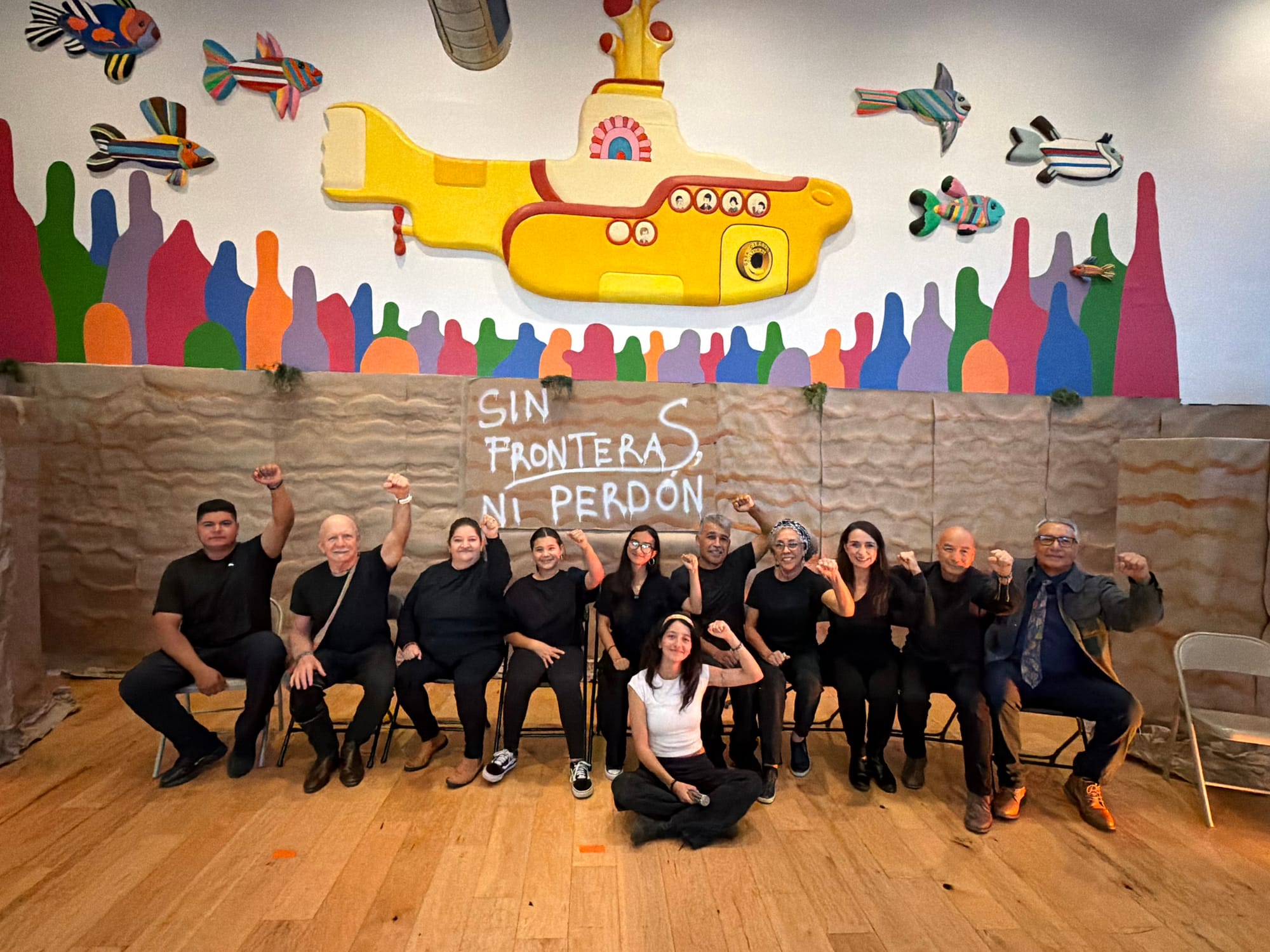
Collaborating with other news publications and local organizations has been key to survival. Ortiz goes as far as saying that without it, “we would not exist if it weren’t for collaboration.”
"For example, we united with Casa Círculo Cultural and we made a theatrical documentary,” he says. “We created a theater workshop with a group of locals who attend Casa Círculo so they could share their stories — how they migrated, what life is like for them here, and so on — and that evolved into a play; it’s an experiment that’s a bit like reporting the news, but through theater.”
Challenges aside, Ortiz says he and his team are eager to bring as much local and state election content to their audience as they can. To start, Measure E and housing-related issues will be center focus in their coverage. And the way they intend to do that is by keeping it deliberately “cara a cara,” or “face to face.”
He points to their recent acquisition of a new office and prospective radio space just outside of incorporated Redwood City. Ortiz says they’re planning several community events centered around the midterms.
“We’re going to serve coffee and invite people to sit down; we’ll be speaking live about what is happening between now and the elections,” Ortiz says.
These events wouldn’t be the first time Península 360 has invited the Latinx community to come share their questions. The metal trailer just outside in the driveway is a testament to that. Península 360’s “cabina de radio” is used for community events, like Día de los Muertos celebrations, as an audio base to interview and introduce themselves to residents.
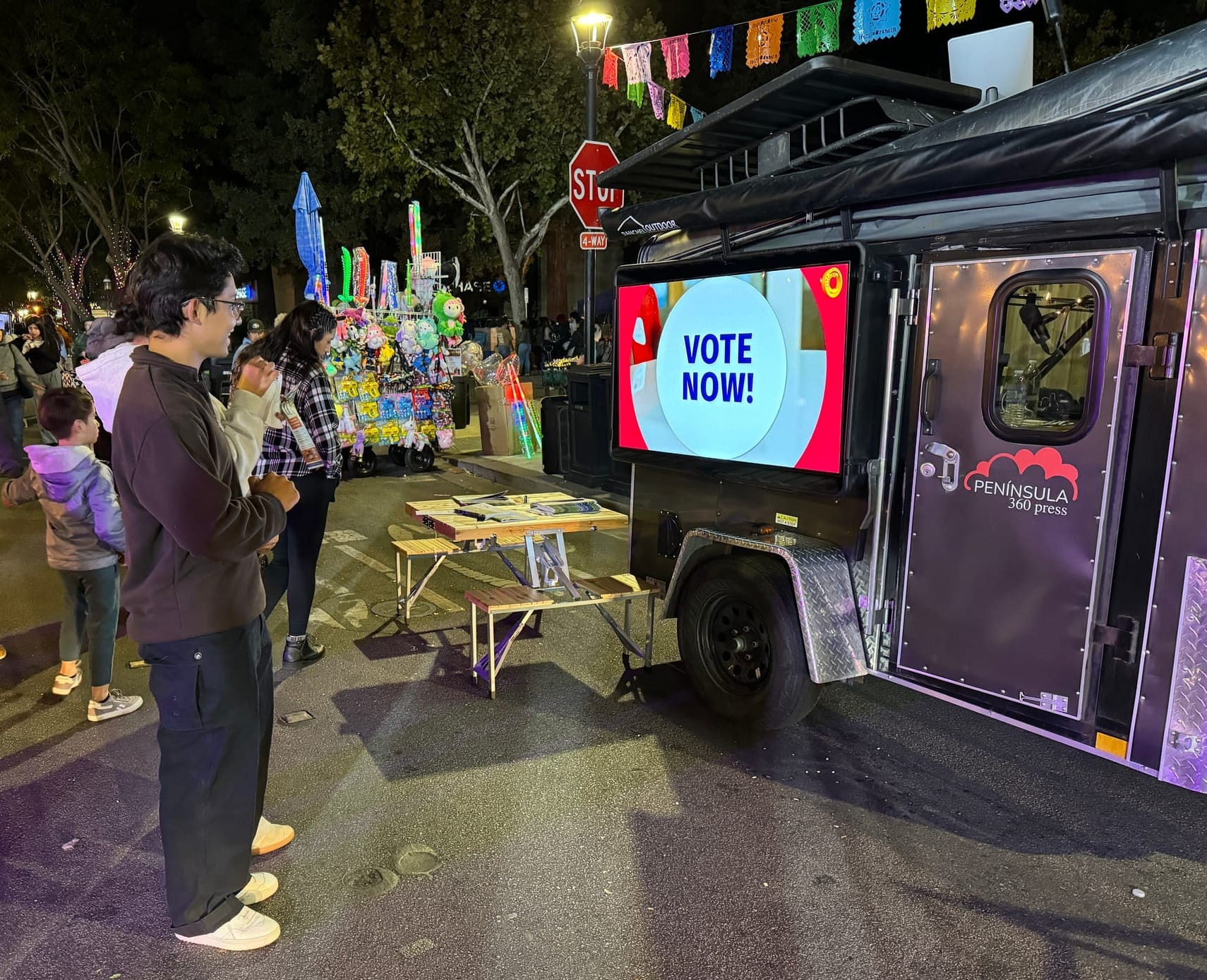
With only a few more weeks until the November midterms, Ortiz and Península 360 will be doing all they can to stay plugged in with the community. And beyond talking with local candidates and continuing to follow Measure E and other housing measures, he said that they want to come out of this election cycle with a better understanding of what democracy and voting even means for the Peninsula’s Latinx people.
“We are currently finalizing the details to gauge the level of participation and track how perceptions regarding state and national issues are shifting,” he says.
Despite the hurdles, Ortiz and his team feel that the importance of what they do is what keeps them fueled.
“Obviously, we would love to have more journalists — and full-time ones at that — and not having them has, at times, been discouraging for me,” says Ortiz. “But when we consider the other side of the coin — how Península 360 contributes at the hyper-local level and the important role it plays in our local democracy, civic participation, and community building — we realize that all that effort is truly worthwhile, and that is what drives us to keep doing what we do.”