For Lalin St. Juste, Death Is a Creative Rebirth
With a new solo album and a mission to transform end-of-life care for Black families, the Seshen frontwoman contemplates impermanence as the ultimate call to live.


With a new solo album and a mission to transform end-of-life care for Black families, the Seshen frontwoman contemplates impermanence as the ultimate call to live.

This week we've got horse appreciation, gems, queer soup, prison letter writing, mysterious limewood, and more.

A group of students inherited a classical painting atelier from their legendary teacher. Its three worker-owners preserve old-school technique while rethinking the rest of the model.

With a new solo album and a mission to transform end-of-life care for Black families, the Seshen frontwoman contemplates impermanence as the ultimate call to live.

Draped in black chiffon under purple stage lights, Lalin St. Juste gazed out at the packed crowd at San Francisco’s Bottom of the Hill. Longtime fans and loved ones had gathered on a Friday night in October to celebrate the 10th anniversary of Flames and Figures, the 2016 album by her band The Seshen.
“It’s been very nostalgic for us to reflect back on this album,” St. Juste told the crowd between songs. “It’s so strange because in some ways time is nonlinear, but then it can also be cyclical … we’re dealing with some of the same terrors that we were dealing with in 2016, and yet at the same time, we’re also holding a new imagination.”
That tension was likely tangible for many there that night, as most of the country braced for the upcoming midterms — before we knew a defiant blue wave was about to wash over the country.
But St. Juste was also referring to a personal kind of reimagining. The Seshen show took place a month before the release of ATA, her first full-length solo record, out Nov. 11. The record marks a creative evolution for the artist, something that has been quietly unfolding over the last couple of years. Musically, it’s lush yet intimate, a bit of a departure from the collaborative, full-band nature of the Seshen’s danceable, electro-tinged R&B. But it has also led the artist into an unexpected discipline: deathwork.
“I’ve been on this journey for a while, but it feels like I’m at the very beginning,” St. Juste told me in an interview a day before the show.
Broadly, deathwork refers to labor surrounding dying and bereavement. In the West, people are likely more familiar with birth doulas or midwives, who help shepherd new life into the world. But death doulas — workers who help people through the transition out of it — are a centuries-old tradition in many cultures. The work includes holistic rituals to provide comfort to those dying. It can also include practical guidance, like assisting with advance directives or grief counseling.
For St. Juste, deathwork is a bridge that connects her art to end-of-life care. It’s an intersection that can be found in ATA, an album released via Redtone Records and 7000 Coils, the arts incubator St. Juste co-founded in 2021. Named for a midwife who helped St. Juste’s grandmother, Vertulie, deliver her son (St. Juste’s uncle) after years of pregnancy loss, the project symbolizes St. Juste’s return to her Haitian American heritage. It weaves improvisations of traditional vodou prayers and songs together with hypnotic and ethereal melodies. Vibey and vulnerable, ATA reflects a period of personal reinvention around love, art, and mortality.
Born in Los Angeles to Haitian immigrant parents, St. Juste says the origins of ATA trace back to her earliest years of living in the Bay Area, nearly two decades ago. She started performing with the local Rara Tou Limen Haitian Dance Company, where she began exploring Haitian music. It became a portal for St. Juste — to both new possibilities and to a type of deep remembering.
“This music, for me, is like medicine, and as I’m engaging in this medicine … pathways are opening up, and that’s where deathwork comes in,” she said. “In Haitian spirituality, there is a spirit that you first call on who you have to communicate with in order to communicate with any of the other spirits … that was the impetus for this work.”
St. Juste poured much of her early creative energy into The Seshen, the band she co-leads with bassist and producer Akiyoshi Ehara. The East Bay group formed in 2010, and quickly earned both local and national accolades for their genre-blending records and their dynamic live show — but the theme of grief as healing remained a constant in St. Juste’s songwriting.
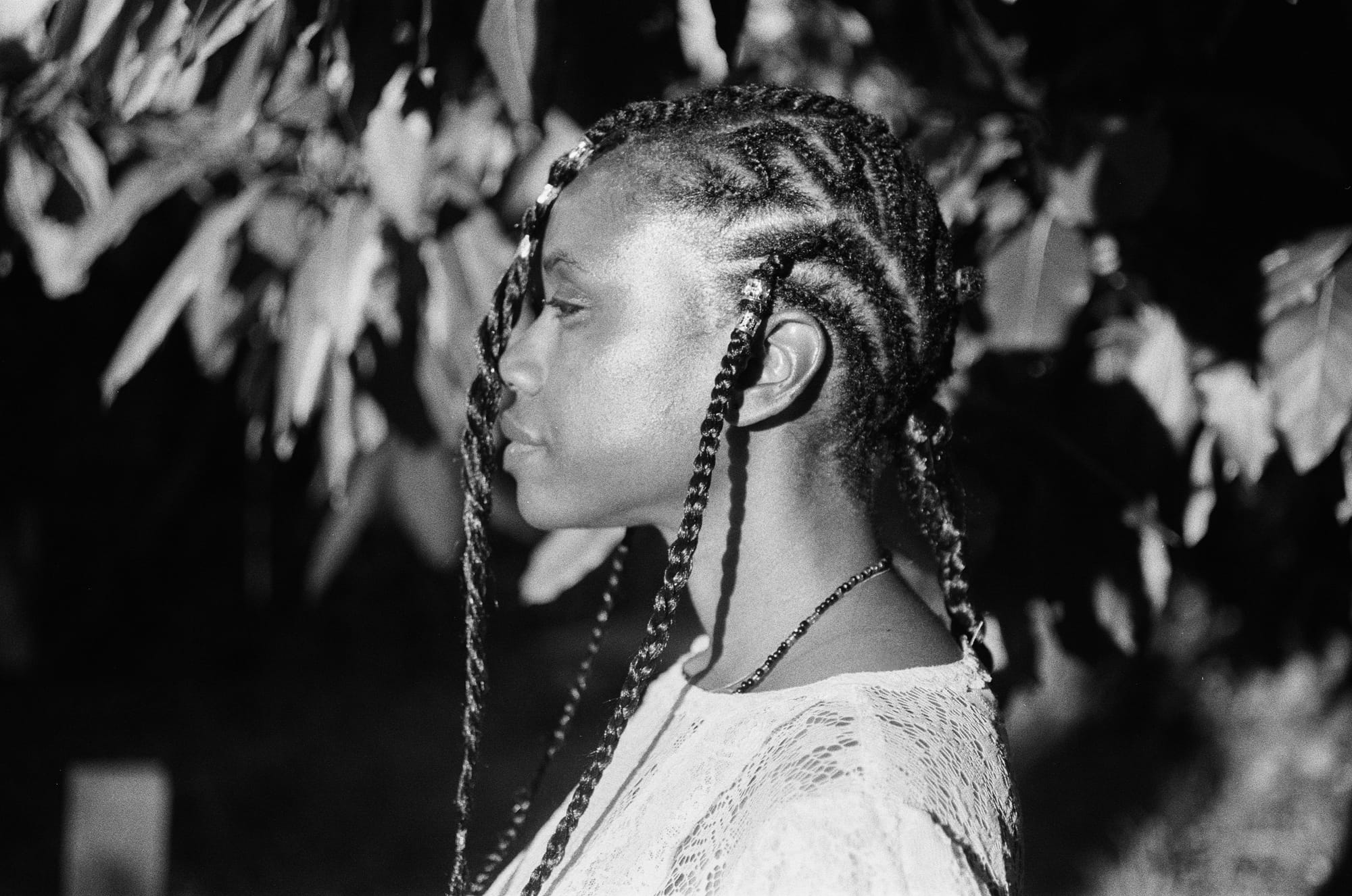
In 2024, St. Juste, who has a background in social work, met her partner Tiffani Marie, an artist and death doula. The pair collaborated on a short film called Joshua Tree Part 2, which portrays what Marie called “a beautiful Black death” by centering a conversation between two Black queer lovers. The pair’s relationship compelled St. Juste to think about end-of-life without fear.
“Death has been something I’ve always ran from … and now I can reflect on the deaths in my life differently.”
Inspired by their work together, Marie and St. Juste launched the Death Education Project earlier this year, a small collective of about nine people who meet regularly to learn and share practices around dying, and offer services to families who need support, including “threshold practices” like singing and meditation, and providing end-of-life care and planning.
Last fall, St. Juste began working at a Bay Area hospice, and she recently picked up another job at a second hospice organization. Some of the songs that St. Juste sings at the bedsides of terminally ill patients appear on ATA, filled out by a backing band that includes Daniel Brevil, musical director of Rara Tou Limen Haitian Dance Company, on percussion.
Her hospice work has also naturally informed the creation of the Death Education Project. St. Juste recalls a conversation with one 92-year-old hospice patient, in particular, which has helped define the project’s main theme: a surrender to vulnerability.
“She was in tears one day because her grandson had to [manage] personal care for her and felt embarrassed by it. And that stood out to me, it’s something that comes up quite often,” she said. “And I thought, at that age, ideally, you can rest assured that you are deserving of being cared for … now it’s our turn to care for you … what does it mean to practice that surrender, to allow for that vulnerability?”
The Death Education Project is in its early stages, but St. Juste has already seen how powerful it is to provide a space for uncomfortable conversations and sentiments surrounding death. Members of the project practice working through difficult themes through care tasks and rituals, like washing each other’s feet, in order to build skills for future clients.
“What does it mean to have a beautiful death?” St. Juste wonders. Deathwork has made her reflect on her own past griefs, including the death of her beloved grandmother, and confront death head-on, as she did earlier this year when her uncle died. She was at his side, caressing his head while he laid in his death bed. “I don’t know if I would have done those things without the proximity that I have now. I was so scared in the past. And now, it’s like, this gives me an opportunity for an intimacy we’ve never had before.”

St. Juste is especially motivated to share the benefits of deathwork with Black families and other communities of color. In her hospice work, she has largely seen white patients access end-of-life care and doula support; she wants families to know there are death doulas that look like them. To that end, the Death Education Project, centers African Indigenous practices, reframing death as a “practiced, communal skill.”
“This society has been very individualist, and we have to remember our roots and where we come from, and practice being together, leaning on each other, caring for each other,” St. Juste said. “That's how it all works the best. And what I'm seeing day after day is you cannot do this alone. We're not built this way, we are built collectively.”
At the crossroads of ATA, the Death Education Project, and her other callings, St. Juste has found clarity. It’s given her own grief context and purpose, revealing gifts even amid profound losses. But most importantly, she says it’s offered her an anchor, a sacred vulnerability that she’s happy to share with the world. She sees deathwork as an invitation to embrace uncertainty, love more intentionally, and deepen our sense of self.
“There’s something about contemplating death that also can allow you to sit with the present,” St. Juste said. “What does it mean to constantly be between life and death? The goal is to take on these practices and these lessons, and allow them to let you live bigger and wider.”
Lalin St. Juste’s ‘ATA’ is out on streaming platforms now.