Yap Zone: Valkyries Beat 🤝 COYOTE
We talk to women's sports reporter Marisa Ingemi about the Valkyries and the stories she's planning for COYOTE.


We talk to women's sports reporter Marisa Ingemi about the Valkyries and the stories she's planning for COYOTE.

For Valkyries fans, the inclusiveness of Ballhalla is sacred — even moreso as the culture war comes for the WNBA.

You can’t build a movement around a person whose only commitment is staying uncommitted.
Take your small dog into the wilderness, all the way to the trail's end.


It was 5:30am in Kanab, Utah when I unzipped my tent and slid on my sandals. My chihuahua terrier mix, Kazu, hopped out happily into the morning. It was the middle of August, and temperatures were going to hit 105 degrees that day. We were halfway through our road trip from California to New Mexico, and with a six-hour drive ahead of us, we needed to get some exercise in before the sun came up.
I drove to an empty trailhead, parked on the side of the road, and loaded up my backpack with water. We began to climb through the dusty, desert scrubland, Kazu trotting ahead of me on the trail. The red sandstone glowed as the sun rose, and the sagebrush cast long shadows.
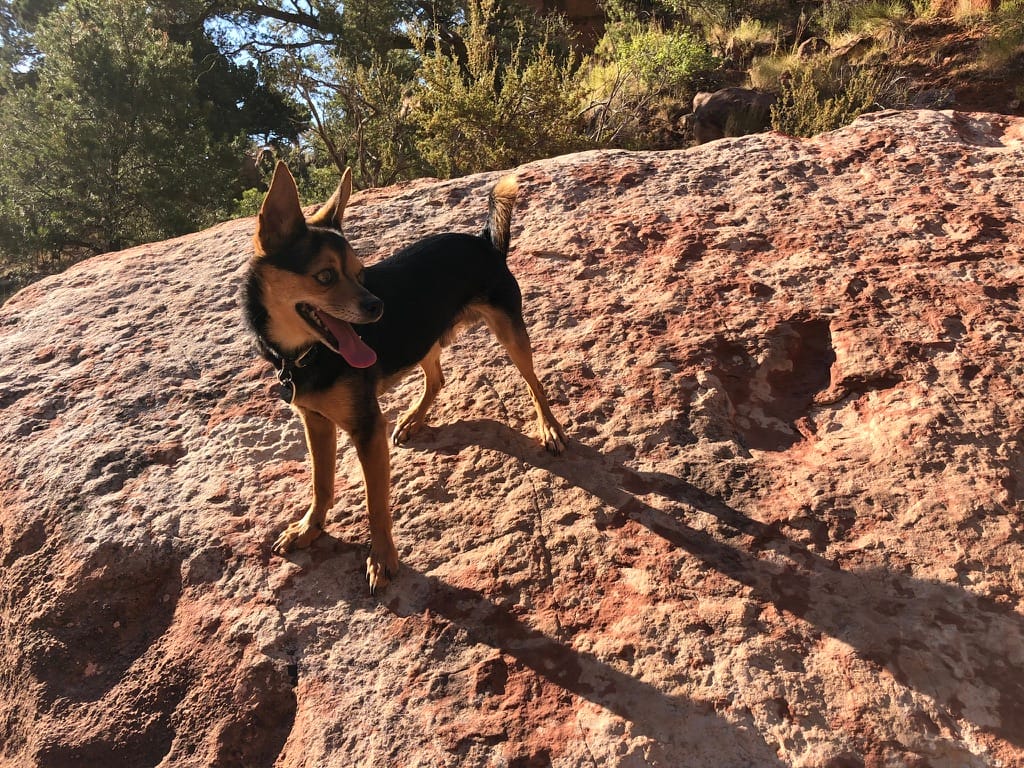
Half an hour in, I stopped to get a snack and paused. The trail description had promised dinosaur tracks, but I’d yet to come across any. I turned in a circle, looking for my dog, and found him perched on the side of a boulder, taking in the view next to an enormous footprint.
Here was the impression of a Kayentapus — a two-ton dinosaur which left its mark on that stone 200 million years ago — and my 10-pound dog. They’d walked the exact same path.
There’s a common misconception that adventure dogs must be large: huskies wearing backpacks as they follow their owners into the woods, a pointer mutt perched on a raft as it floats down a river, a shepherd mix keeping pace with its owner on a mountain bike.
So uncommon are tiny dogs in these places that I’m often stopped mid-hike as people marvel, somewhat condescendingly, over my dog. “Wow, he can keep up with you?” “Good thing you could carry him, right?” “Aren’t you worried about him getting eaten?” “I can’t believe he made that climb on such short legs.”
I laugh along, knowing they have absolutely no idea what this dog is capable of. He is small in stature, yes, but also races up the sides of mountains, navigates fallen trees with ease, and has endurance for days. Any dog can be an adventure dog, if you only start taking them on adventures.
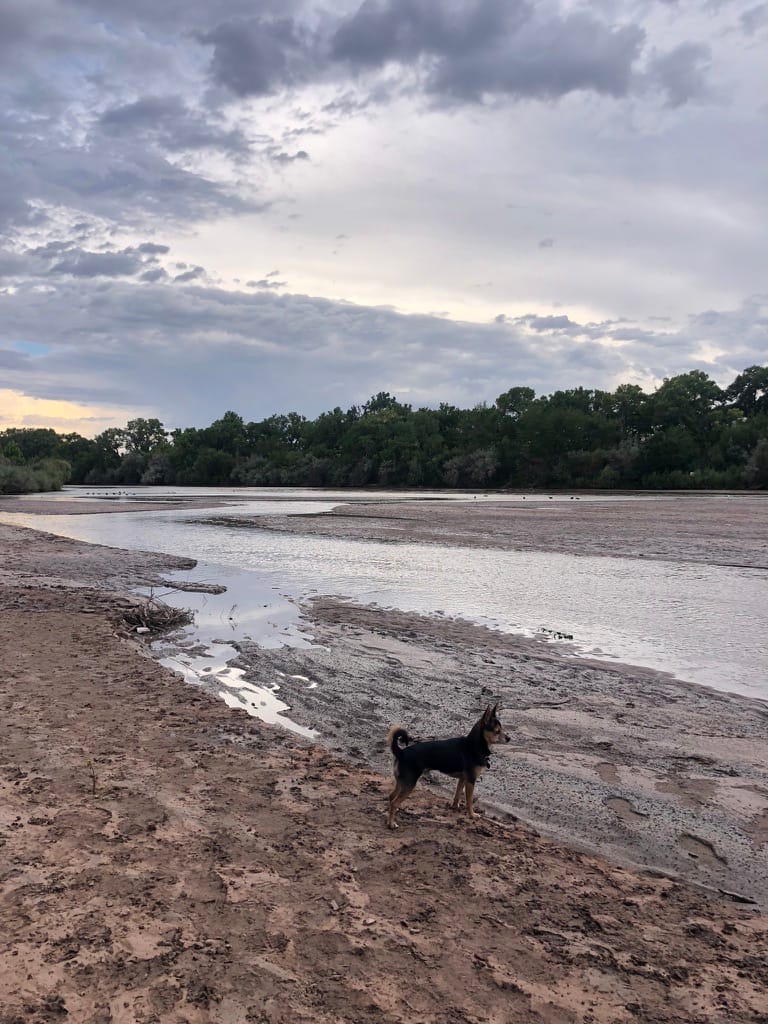
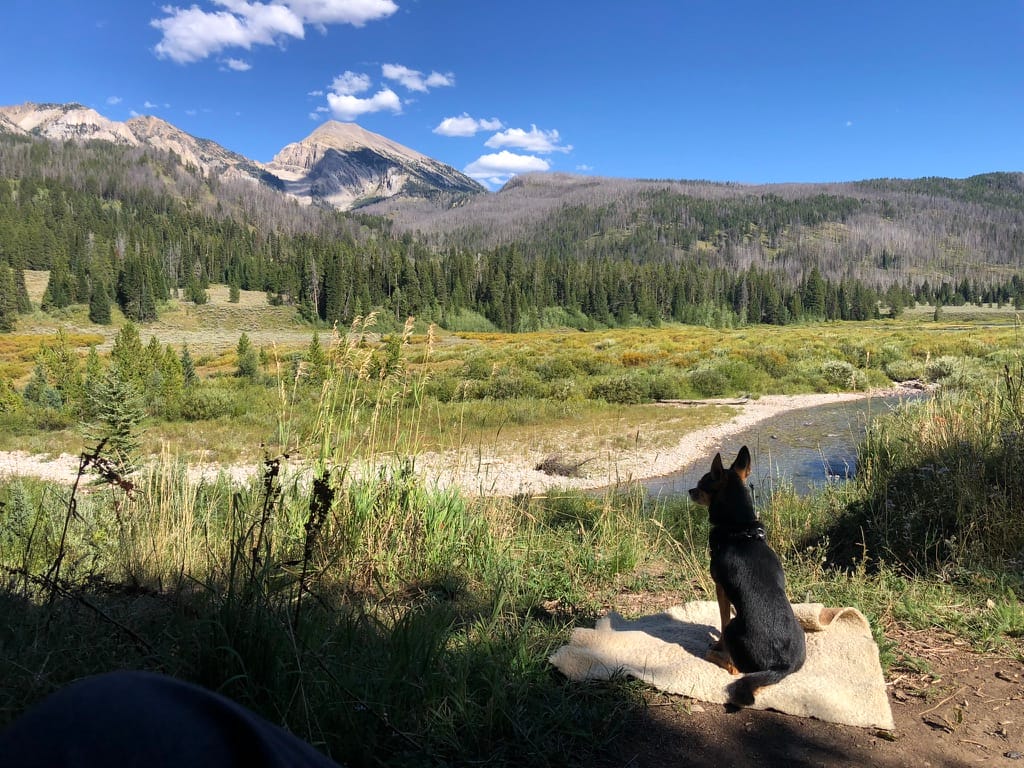
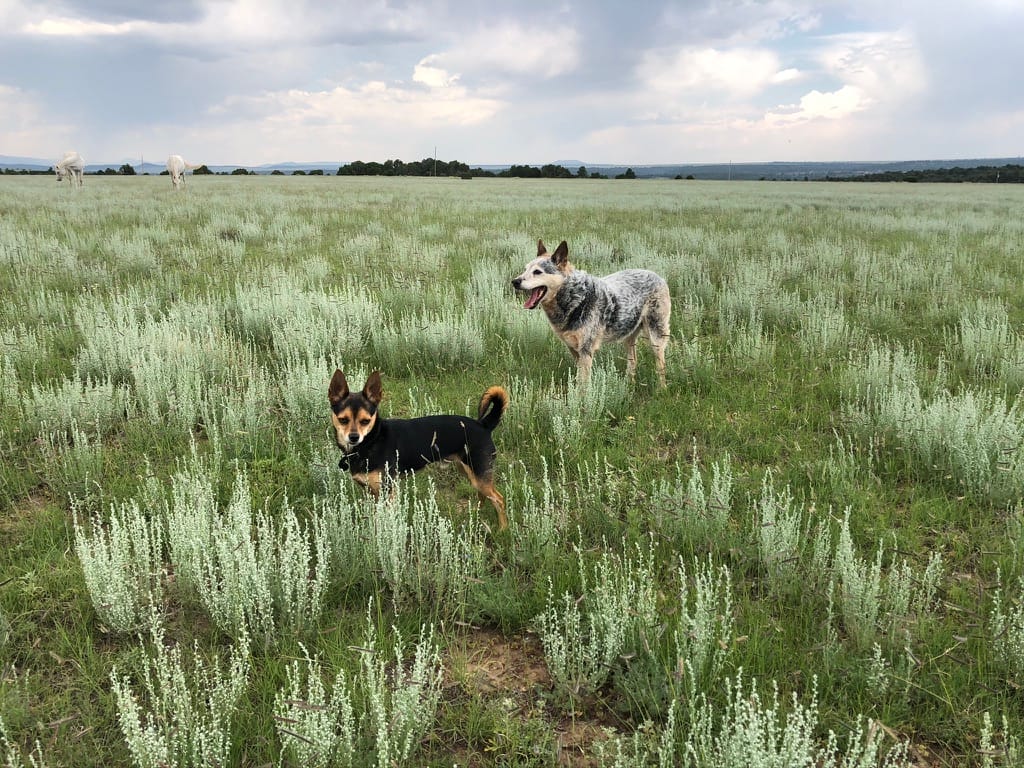
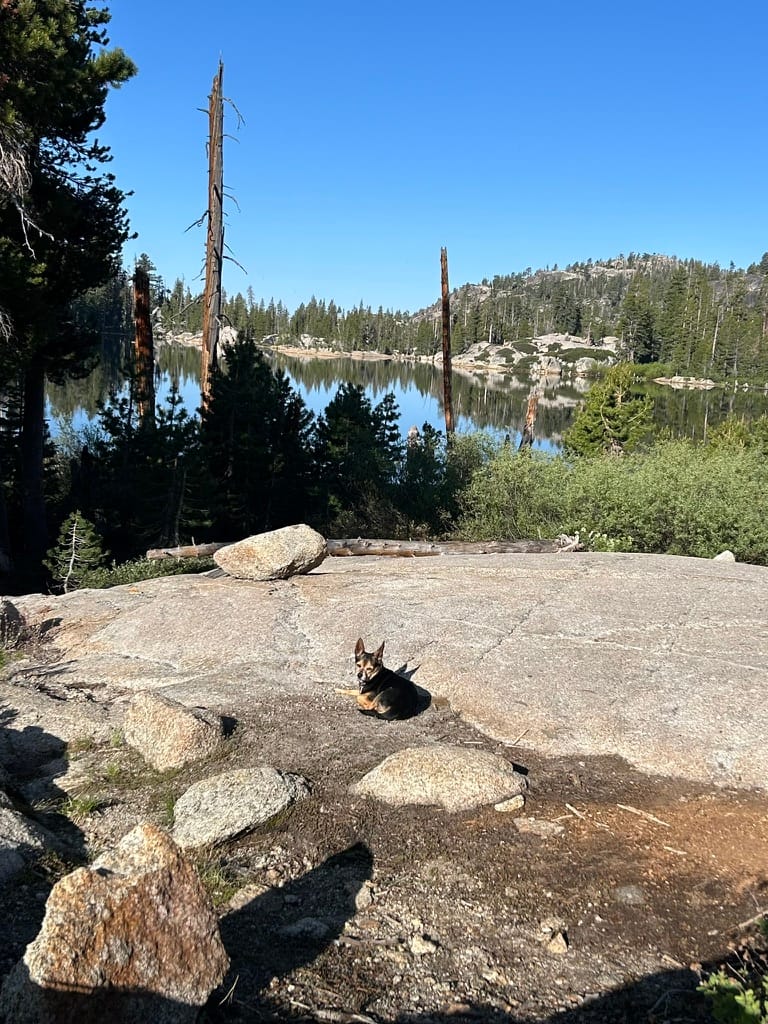
(Clockwise from top left) Kazu at the Rio Grande River in Albuquerque, NM, 2022; camping in Wyoming, 2022; backpacking in Emigrant Wilderness, 2025; at home in Watrous, NM in 2020 (Nuala Bishari/COYOTE Media Collective)
I grew up in rural New Mexico with working dogs: blue heelers, who could keep up with horses and handle the tough spiky footing of the desert. When I decided I was ready for a canine companion of my own in 2014, I was living in an apartment in San Francisco with a bike as my main form of transportation. I needed a dog that matched my lifestyle, one that I could fit into a backpack or under a plane seat. Something small.
When I first met Kazu, he was sitting in a large plastic bin in the Berkeley Animal Care Services parking lot. His siblings all looked completely different from one another — one large and orange, another small and fluffy. He was tiny, a small handful of a dog with flopped ears that hadn’t popped up straight yet. I took him home.
Thus began adventure training. He quickly learned how to ride in a backpack while I biked around the city, sliding around until he grew into it. We rode through Golden Gate Park to Ocean Beach, to bike races in the East Bay, in crowds of partying cyclists in the city. At five months, I flew with him to visit my mom’s ranch in New Mexico; at 10 months, we went backpacking in Trinity Alps. As he grew, he became fit, and brave, and eager for whatever was around the next turn on the trail.
Soon, the idea of leaving him at home felt impossible. His desire for adventure, and mine for his company, led to creative ways to bring him along. I rigged him a raft so he could float with me down the Russian River. I used that same tactic when backpacking with my best friend in Arroyo Seco. It was springtime after a wet winter, and the water level was still fairly high in the Salinas River. In many spots there was no bank to traverse, just the river itself. So, I ordered him a pineapple raft, looped rope around the crown, and we towed him upstream in pursuit of deep pools to swim in.
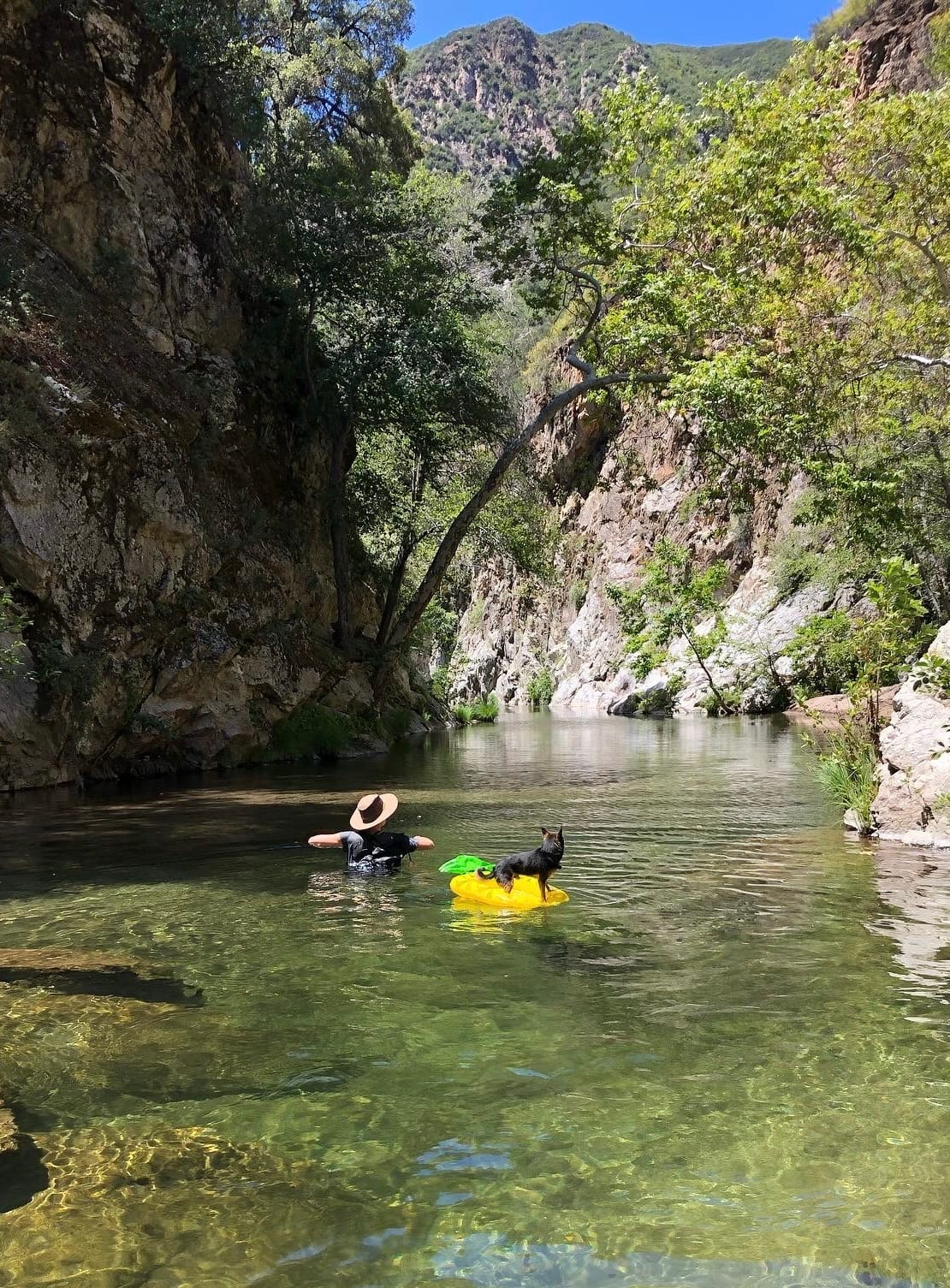
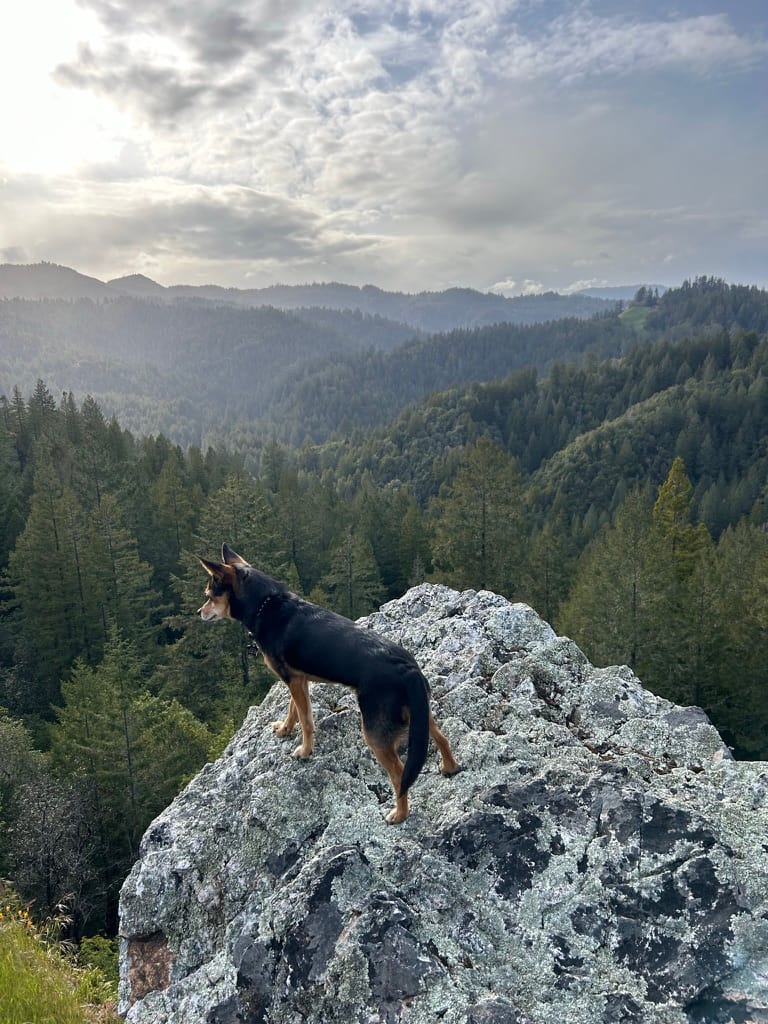
(Left) Kazu being towed up Arroyo Seco on a floating pineapple in 2022, (Right) in Cazadero in 2023 (Nuala Bishari/COYOTE Media Collective)
Over the years, my expeditions into nature have been dictated in large part by what is dog-friendly. I haven’t gone on a single camping or backpacking trip without him in a decade — why would I? This means I’ve spent an enormous amount of time in national parks and on Bureau of Land Management property, and nearly none in state parks. There is less joy for me in nature without a dog. I need his bouncing tail ahead of me on the trail, to slow down and see the forest through his eyes, to share in those moments of winded victory atop a mountain.
There is a particular partnership that is built between a dog and their person when faced with the challenges of the wild. Connections are formed waiting out a wind storm in a tent together or figuring out how to clamber over debris blocking a trail. The “owner” title disappears, and the “you and I” relationship becomes a “we.” So many times over the years, Kazu and I have stopped and looked at each other mid-adventure, trying to figure out which direction to head in, whether it’s time to take a break, and at what point we should turn around and head home. Often, these are decisions we make together.
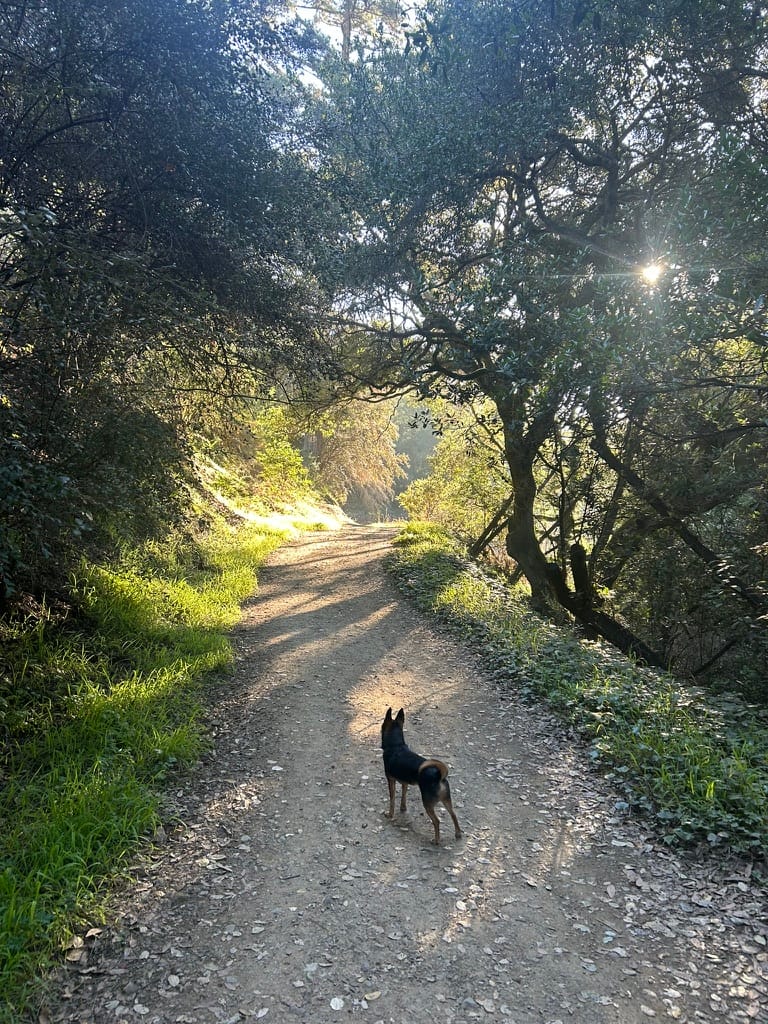
But as Kazu approaches his 12th birthday, our path ahead is getting shorter. The cruelty of loving a dog is that at some point, the trail ends.
Last month, Kazu was diagnosed with end-stage congestive heart failure. It came as a huge shock — aside from some coughing and lethargy, he was fine. The cardiologist says that if he’s lucky, he’ll have a year. Sudden death is possible. He’s on medication to keep his lungs clear of fluid, to keep his heart pumping and his blood pressure low.
“Less than 20 minutes of mild, non-strenuous activity one to three times daily,” the cardiologist’s notes state. Somehow that, more than anything, knocked my knees out from under me. The backpacking trips I’d been planning for the summer evaporated. The trip to New Mexico a year ago was his last. My assumption that he would live to be one of those resilient 15-year-old chihuahuas with no teeth and his tongue hanging out was wrong.
The grief has swallowed me. I’m sleepless, forgetful, grouchy, sobbing in traffic. I genuinely can’t imagine my life without this friendship, my little copilot through life and the wilderness. Who even am I without Kazu? What will get me to the woods every day if not the joy of my dog?
There is a complete full-heartedness in the way we love animals. With people, there is always a little bit of reserve, a small withholding out of self-preservation, a big love but not an absolute one. Not so with dogs, who get all of us.
Last week, as I lay in bed depressed, Kazu stood on my chest, his whole body shaking in anticipation of a walk. He stared into my eyes with deep urgency; if I shifted at all he began leaping into the air. “Take me out!” his whole body screamed. I dragged myself up and laced up my hiking shoes. It was time to pull myself together. If I knew every hour-long dog-friendly hike in the East Bay by memory, I could certainly come up with a dozen flat, 20-minute routes.
We’ve hiked every day since. We go early in the morning, before it gets hot, and prioritize routes with creeks so he can stay cool and hydrated. I bought him a carrier that I can scoop him into if he gets tired (an embarrassing proposition for him, no doubt, but better than being left behind).
We’ve decided the adventure isn’t over quite yet. In the meantime, you’ll find us in the woods.