Yap Zone: Valkyries Beat 🤝 COYOTE
We talk to women's sports reporter Marisa Ingemi about the Valkyries and the stories she's planning for COYOTE.


We talk to women's sports reporter Marisa Ingemi about the Valkyries and the stories she's planning for COYOTE.

For Valkyries fans, the inclusiveness of Ballhalla is sacred — even moreso as the culture war comes for the WNBA.

You can’t build a movement around a person whose only commitment is staying uncommitted.
The author of the forthcoming book "All My Dead Cats" talks about disenfranchised grief, the politics of mourning, and why a dead cat is the perfect gateway into one of our most avoided conversations.

Writer, author, and Flytrap co-founder s.e. smith has spent nearly two decades writing about pet loss, disability, labor, and politics. Their new book, All My Dead Cats and Other Losses, is nominally about the cats they’ve loved and lost, but it’s really about something much bigger: how American culture decides whose grief counts. And their new newsletter, "Tell Your Cat I Said..." is all about giving advice for people feeling uncertain about how to handle end-of-life decisions for their pets.
Soleil Ho spoke with smith about disenfranchised grief, the politics of mourning, and why a dead cat is the perfect gateway into one of our most avoided conversations.
Following the interview you’ll find an excerpt from their book, which publishes July 28, 2026 with HarperOne.
Soleil Ho: What was the birthing point of this book?
s.e. smith: I've been covering pet loss for almost 20 years, and I kept having these conversations where I'd run an article and get this outpouring of really lovely, sad responses — people feeling like they couldn't talk about this at all. So I started thinking about disenfranchised grief, and then these larger themes of what it is to be human and grieve, especially around losses that are politicized or taken out of your control.
I wrote an article for Bitch that ran April 6, 2020, did a ton of research for it, and afterward thought I have so much more to do here. There was really a lot going on around grief and loss that year, if you recall. (Laughs bitterly.) But the more I worked on it, the more I felt this was a necessary contribution to the discourse. There are a lot of self-help books about “how to grieve in 10 days,” and memoirs about losing someone beloved, but I didn't see cultural criticism specifically examining how we mourn, how different communities mourn, and what kinds of grief people think are acceptable.
Pet loss is a great gateway drug into that conversation. Many people have had the experience, so you can start there and expand out. You had this terminally ill cat whose last three months were just rough, and you started to feel resentful, and then guilty, and there was a part of you that felt like your cat was already dead. Have you ever had relationships like that with people? Can you imagine what anticipatory mourning might feel like?
The keystone example of why I wrote the book, though, was the summer of 2020. Black men being murdered by police, huge protests shutting down city blocks. And this theme kept coming up: We understand you're upset, but that's not an OK way to express your feelings. You're blocking a freeway. I can't go visit my sister in Poughkeepsie. But when a president dies and half the nation shuts down and the motorcade locks up the whole city, that's totally fine. I want readers thinking about why we react so differently to those two scenarios.

SH: What unmet needs have people expressed when they reach out after you write about loss?
ss: The number one thing is just wanting to be heard. Sometimes someone will literally write, I don't expect you to respond, but I felt like I had to tell someone. That stems from a culture of toxic positivity where everything needs to have a fix — and grief makes people uncomfortable because you can't fix it. Sometimes you just have to sit with someone and say, yeah, this fucking sucks. I'm really sorry. People feel unheard because no one is willing to do that.
The other thing that came up again and again, especially in 2020, was bereavement leave, which hooks into so much about labor and capitalism. Most states have no protections for it, and there's certainly none for pets. But people were starting to connect not being given time at work to this larger question of whose lives have value. Animals are seen as unimportant not just because they're non-human, but because What is their value under capitalism? You're either a meat or dairy animal — a literal product — or you're a pet. How do you justify your existence? And why do we have to come up with that justification at all? Why can't we just find intrinsic value in sharing our lives with other beings?
SH: What do you hope people absorb from this book?
ss: People need to understand death as a social and cultural phenomenon, not just a personal private one. The circumstances of a death, how people react to it — all of that interacts with society and culture. You see marginalized communities struggling with grief in ways that go beyond literal death: what it means to be raised in a culture where people with bodies like yours are maligned.
I want people to understand that grief is complicated, that it's more than literal death, that it's cultural, and that pretending loss hasn't happened is not going to work for you. Working on the early drafts during the pandemic, I kept thinking if everyone knows someone who died of COVID, this is our moment to reform how we talk about grief. And then it was just… the pandemic is over, don't talk about it. We see this pattern again and again — moments where a culture shift could happen, and then people get scared and back away. I'm really trying to reach the non-grief nerds and scare the horses a little.
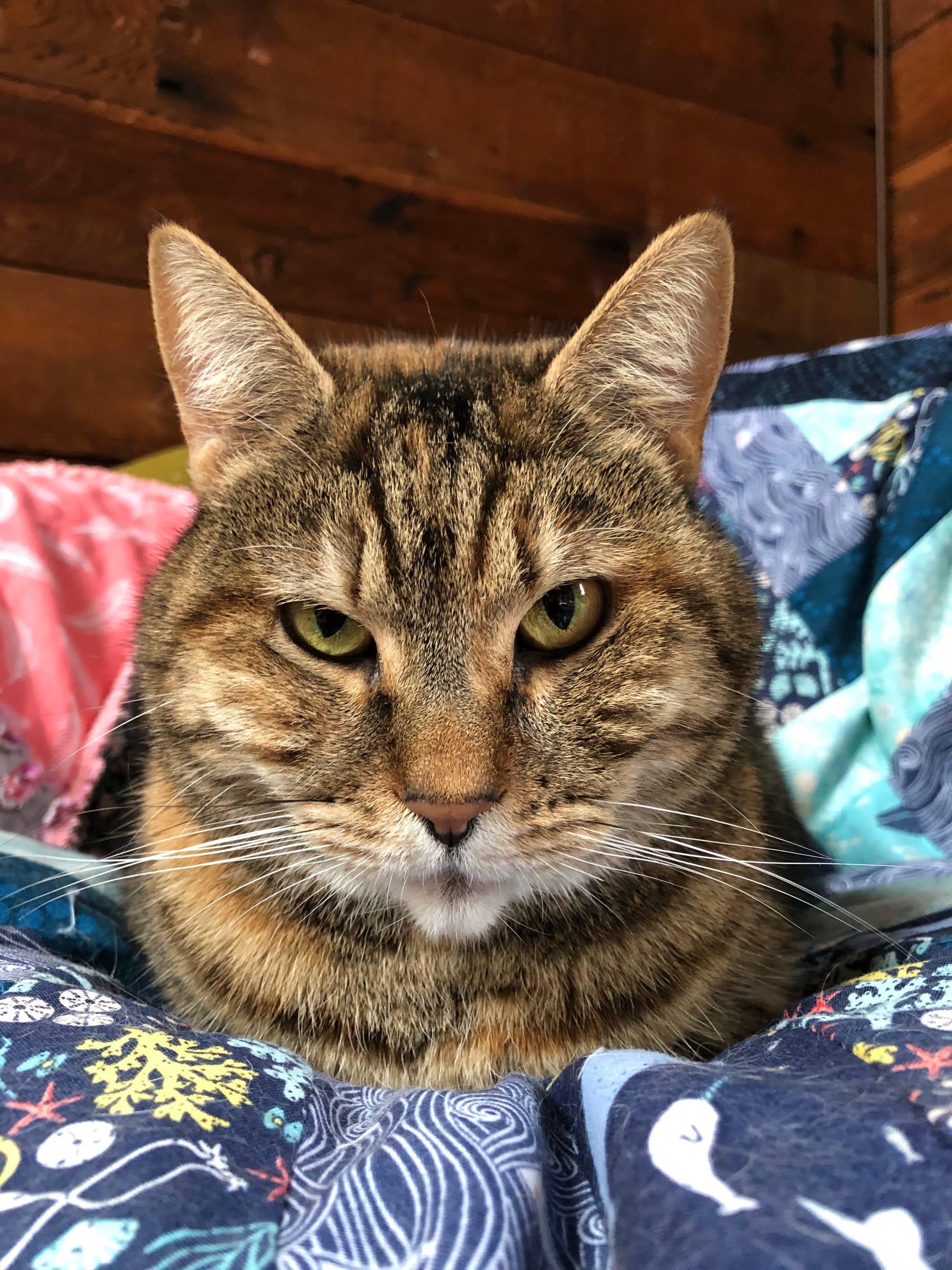
Ember, a polydactyl tortie with quick, soft paws, died in a night of chaos and unpleasantries in early June 2021, the windows still open to capture the cooling breeze after the heat of the day. She had been “doing poorly,” as the unhelpful diagnosis goes, and I had been in and out of work dealing with her health problems over the previous month, fighting a shortage of veterinary care affecting the entire country that made it nearly impossible, at times, to access what she needed, with the emergency vet two hours away focusing on urgent cases, not a cat who simply wasn’t herself.
Ember died at a highly unfortunate moment on the global scale, in the midst of the early COVID-19 pandemic, when mourning the death of a pet seemed disrespectful, even frivolous. According to a diligently maintained and very popular COVID-19 dashboard hosted by Johns Hopkins, 600,000 people had died in the United States by the time Ember jumped out of her bed, seeking a place to hide, a place I wish she had found so that the last few hours of her life were not pain and terror, trapped in a car, her least favorite place in the entire world.
In the face of such human devastation, how could I be sad about a cat?
I was hit by a double minimization of my grief: the sensation that I inherently wasn’t allowed to be sad about the death of a pet—a common feeling in the aftermath of pet loss—compounded by feeling as though this small death didn’t matter in the context of what everyone else was going through at that particular moment. I also felt a tinge of guilt over my close connection to an animal, deeper than some of my human connections, with a loss that felt more intense, perhaps disproportionate to outsiders, and, therefore, something suspect, possibly even unacceptable, like something that shouldn’t be mourned at all.
I am not alone in feeling like a bad person, or a cold one, for being more affected by the death of an animal than that of a human. In a striking 2019 essay for Gen3 that captured many of my own feelings about the divide between pet and human loss, Meghan Daum wrote about the contrast between mourning her father and her dog, Phoebe, and the guilt and discomfort that came with feeling like perhaps she mourned her canine companion more than her father in a world where expressing such a thing is very difficult.
“My father’s death makes me feel like the ceiling of the world has been lowered,” she explained. “I’ve learned to get by in that constricted space, constantly ducking my head to avoid hitting that ceiling. But Phoebe’s death is a different proposition somehow. Phoebe’s death makes me feel like someone has come along with a giant eraser and rubbed out my face.”
What she describes is a tale of two griefs, but it is fundamentally the tale of a grief denied: The being she is most connected to in the world, who has accompanied her and comforted her through huge life changes—who, critically, was a more constant companion in recent years than perhaps anyone else—is dead. Her father, an independent adult with his own feelings and agenda who played a huge role in her life and helped shape who she was, died after a short illness, following the expectation that beloved parents grow old and die before us. It’s not that she didn’t mourn her father, but she had a framework for it, as well as social supports that acknowledged the death as meaningful.
That description of being utterly poleaxed and undone by a loss and unable to convey that without sounding like a horrible person is highly relatable.
With animals like Ember and Phoebe, pressure to keep your grief in the corner, to “take care of things,” is overwhelming. In my series of 2023 interviews with pet guardians about nontraditional memorials, many expressed feelings of disenfranchised grief; those interviews turned into confessionals as people felt like they finally had someone who listened to, and cared about, their grief—a grief they hadn’t been able to speak aloud, in some cases for years or even decades.
These feelings, the pressure to button grief away quickly, resolve any outstanding threads, and not discuss it, are not limited to pet loss. Many deaths, as well as other kinds of losses, are accompanied by a dictate: Do not acknowledge your grief, do not expect others to do that either, do whatever it is you need to do quietly and in a place where it will not bother anyone. Do not become the kind of person who cries on the subway because you are so overwhelmed by this horrible thing that has happened to you that you cannot contain it, must cry out so the world can witness you. Do not, under any circumstances, look the animal that is grief in the eye. Do not let it chase you. And if that loss is one that society doesn’t view as significant, those dictates are even more forceful.
What I went through that summer, what Meghan went through, is what’s known as “disenfranchised grief,” a term introduced by Dr. Kenneth J. Doka in 1989. It is more or less exactly what it says on the tin: grief that feels unacknowledged or lesser, sometimes even taboo, something to be held close, privately and in secret, not talked about and certainly not publicly mourned. Any kinds of deeply personal losses behind closed doors are more likely to tip into disenfranchised grief because people around the griever might not even be aware of it.
Because no one talks about them, they can become stigmatized. It is often grief that cannot be adequately processed or confronted for a variety of reasons, ranging from feelings of conflict about the decedent to being a loss that other people don’t register as a loss within the context of their own beliefs about what constitutes “loss”—because it isn’t a death, or it isn’t a death that you should be close to, such as the death of a celebrity you didn’t know personally. It can also be grief for a loss that people are unable to simply mourn because it has become politicized and taken out of their control, no longer theirs to experience for what it is.
Even as someone who knew what disenfranchised grief was at the time, I still felt mired in it, and through the looking glass, I was struck by the way in which my own grief mirrored that of those disenfranchised by the pandemic who felt like they were unable to mourn. It does not go without notice that Doka framed the concept at the height of the HIV/AIDS crisis, when for some communities grief was a constant, aggressive, unrelenting part of daily life, while the world spun on by without them—and sometimes even spat in the face of their grief, minimizing it even further. Deaths in these instances were haunted by a pressure to keep grief silent, private, to avoid upsetting others and live instead in secrecy and shame.
The reflections sparked by the alienation I felt around Ember’s death gave me a deeper opportunity to think about who has access to which kinds of grief, and how disenfranchisement takes many forms, whether people are grieving human or animal loved ones or more abstract losses. To live through loss during mass mortality events like HIV/AIDS and COVID is to be carried on a wave of disenfranchised grief that also offers a little window into other people’s worlds, a thin sliver of opportunity: If you relate to this on a deep, cellular level, what other kinds of losses around you are disenfranchised? Who else is suffering in silence? How can you ease—or intensify—their experiences of loss?
Excerpt from All My Dead Cats and Other Losses: Practicing Good Grief in a Culture That Fears Mourning by s.e. smith. Published by HarperOne. Copyright © 2026 HarperCollins.