An Oakland Record Label Aims to Highlight ‘Queer Imagination’
Names to Love You By, a new DIY imprint for experimental music, kicks off with a Sept. 25 show at Wyldflowr Arts.


Names to Love You By, a new DIY imprint for experimental music, kicks off with a Sept. 25 show at Wyldflowr Arts.

While the mayor boasts about Vogue World as a win for the local “creative community,” one thing’s never been more clear: A healthy art scene can’t depend on politicians or wealthy donors.

This week we've got piracy, several forms of trash, cake, Sappho, texting, and more.

Coyotes have become a Bay Area icon. In ‘Trickster at the End of a World,’ author and artist Helen Shewolfe Tseng shares what they could teach us.


I went to the San Francisco Art Book Fair for the first time a couple of weeks ago and wondered why I hadn’t been sooner. First: Damn, what a vibe. As you weave through the maze of vendors, it’s intoxicating to be surrounded by artists proudly hawking their ideas and obsessions. Second: Basically, everyone’s hot. You could just lean against a wall and watch people strut around in their “I don’t give a fuck but I really do give a fuck” outfits and still have a great time. (Note to self: Step up your style game next year.).
One of the pieces that I walked away with was a gorgeous book that I stumbled upon and immediately purchased. It felt kind of meant to be, and I wondered why I hadn’t met Helen Shewolfe Tseng sooner. She’s the author of Trickster at the End of a World, which was published in June. In it, the San Francisco-based artist and designer reflects on her obsession with coyotes and her quest to find them. She also explores the stories we've been told about them, like how they're clever: “Tricksters trespass and infiltrate the realms of the divine and powerful. They steal secrets, unsettle authority, and expose imbalance.” And how they're pathfinders: "Tricksters rearrange and recontextualize. They seek loopholes and new ways to travel existing paths."
Naturally, those descriptors reminded me of our humble-yet-mighty newsroom. When the team was figuring out what we would name our publication, a few great ideas were thrown around. Yet ultimately, Soleil’s inclination towards landing on “COYOTE” felt right (as do so many of their inclinations!). Coyotes are curious; they’re playful yet mysterious, and while they’re our local neighbors, they’re also largely misunderstood.
So I slid into my fellow coyote enthusiast’s DMs right after reading her book and asked if we could wax poetic on why we love coyotes, why she devotes time each week to find them in San Francisco, and what it means to chase something that’s both elusive and everywhere.
The interview below has been condensed and edited for clarity.
Cecilia Lei: What was it about coyotes that captured your imagination?
Helen Shewolfe Tseng: For many years I had been really interested in the folklore, mythology, and culture around wild canids, especially in relation to human civilization.
I'm thinking of animals like foxes, wolves, jackals, wild dogs, and coyotes. Stories about them reveal a lot about a culture's values and beliefs around things like power or land or gender or spiritual traditions: Are they helpers or are they tricksters? Or are they villains? Are they related to some change in a food source or a bottom line, or are they related to some breach of safety? In some places, they were just villains, and in others, it was kind of ambiguous.
When I learned about coyotes and how they’re frequently spotted in the Bay, I wanted to see if this was something that I could observe or study out in the field. This book reveals the sort of naivete I had, thinking I could just go out there and see this thing, just like I can pull up a browser and search for something. It turned out to be a big learning process for me and coyotes sort of just sunk their fangs in me.
CL: It sounds like you leaned into something that you were both curious about, but also didn’t know a whole lot about — it’s that intersection where obsession can kind of start, right?
HT: Yeah, and at the same time, I'd been reading about coyotes and their adaptability. I was starting to see these parallels: bits of story that I recognized from thinking about immigration, or the sort of persistence and resourcefulness and adventurousness that a lot of immigrants have moving to America, and being so far away but also making it work.
[Coyotes are] also our neighbors, and once I got interested in them, there was no shortage of people who had stories to offer or experiences that they were really excited to talk about.
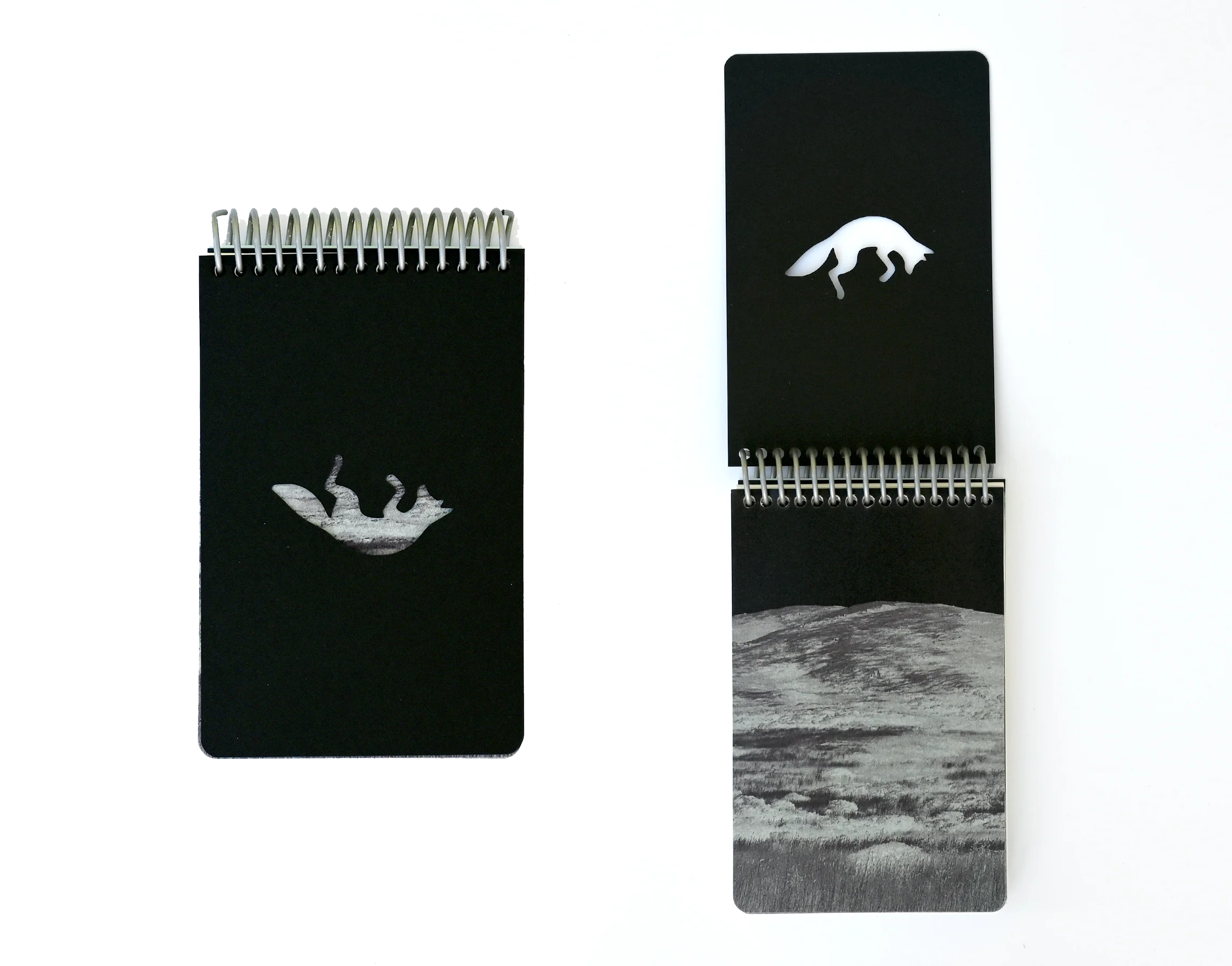
CL: The physical structure of the book felt very familiar: The top spiral binding and the flip pad style of it reminded me of a reporter's notebook, which we take out into the field with us. Was that intentional when you were thinking about design and format?
HT: Yeah, a lot of the book takes place in the Marin Headlands, where I was designer-in-residence in 2019. That was my first foray into attempting to observe coyotes in the wild. We were inspired by field notebooks that naturalists use, as well as reporters. The top binding was actually an idea that Vivian Sming of Sming Sming Books had, and it really changed the way I thought about structuring the book, because it would be read from top to bottom and it's hand-held. It made me think about the pacing of the words and the images. It's the size of something that you can throw in your bag and take to the park and read outside. I’ve been told that it has encouraged readers to slow down and spend time with the book, which I think feels right.
CL: Now you observe coyotes in the urban environment of San Francisco. How do you go about doing that? Where do you go?
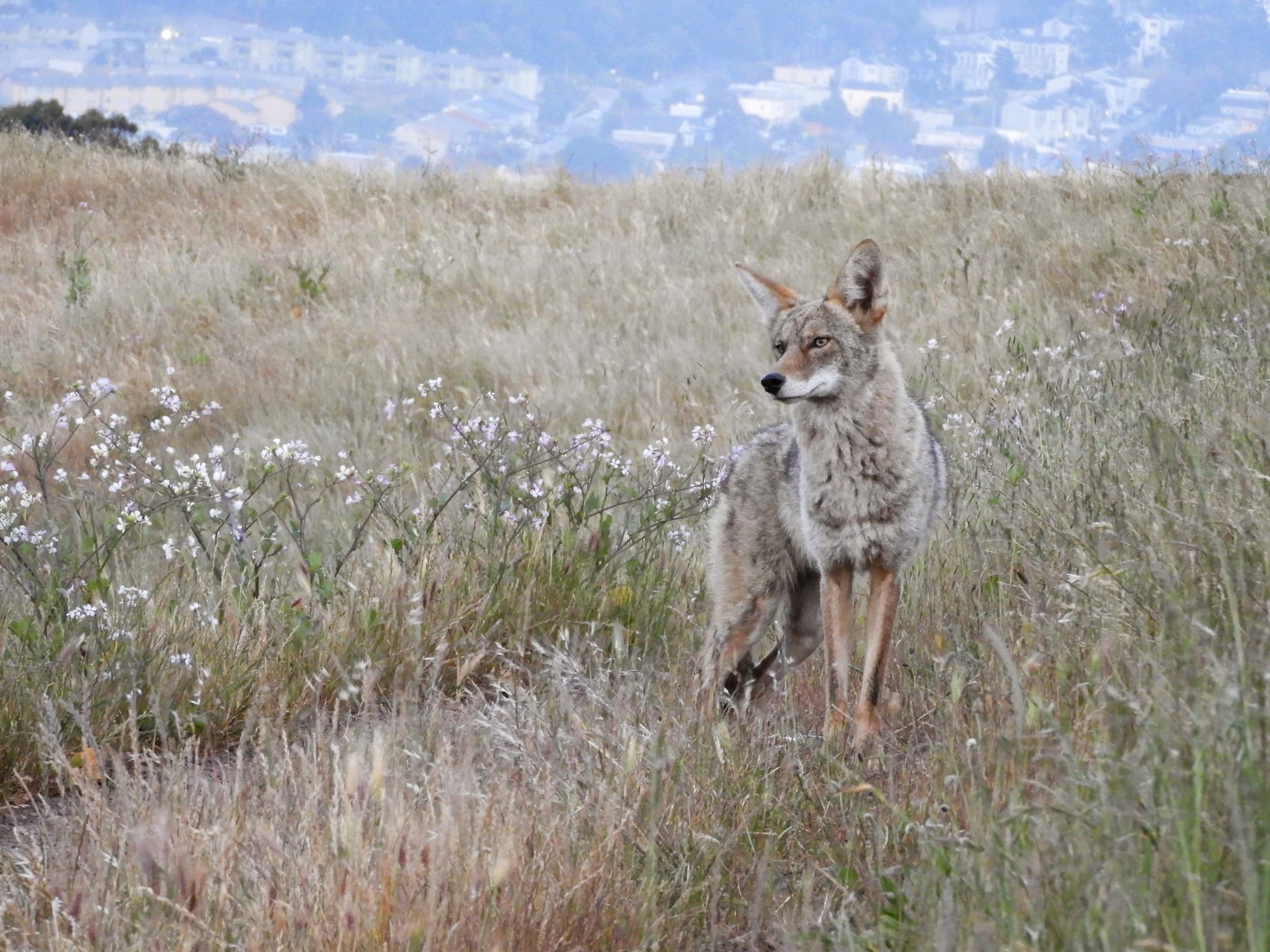
HT: I won't reveal any locations or details just out of respect for the coyotes and also the people I've learned from who've asked that of me. It involves a lot of time and repetition and patience and also a lot of luck. If I am having a lucky day, I might get to observe one or a few. And if I'm really lucky, I'll get to see a new behavior. But there's a lot of striking out. There are a lot of days where I am waiting and walking and they don't show up — and that's OK. I've learned a lot about the plants and the birds and the trees in that time.
I use a camera with a telephoto lens and I usually try to keep a good distance from [the animals]. I've been taught by some very kind and generous naturalists, including Janet Kessler, who has been documenting her fieldwork on the website, Coyote Yipps. She's my friend and mentor, and she's taught me a lot about being cognizant of coyotes’ body language and knowing when you've overstayed your welcome and when it's time to call it a day. They’re very clever and also very affected by our behaviors. If they can't see me, even if I'm hiding, they might be able to smell me or hear me.
CL: After spending so much time observing them, do you think this “trickster” narrative is true? We used that word in the description of our newsroom. In your book, you also called them “playful questioners,” “edge dwellers,” and “boundary crossers.” I love those labels for our publication, too.
HT: Folklore and narratives are ultimately human constructs we have to make sense of things, and I think the trickster is a really useful narrative tool. The coyote is a really, really adaptable animal. And I think that highly adaptive animals are often associated with tricksters in part because they can outsmart us. I'm thinking of urban animals: raccoons, for instance, or rats, weasels, crows. They can survive in a variety of habitats and social structures. They can move to a new place and find places to roost or to hide or things to feed on. Sometimes it's trash. And I think tricksters are often associated with these animals that can get a little bit too close to us, right? They're taking advantage of our built environment in ways that are often surprising.
CL: In your book you point out that even though coyotes have had to survive many risks, including being hunted and trapped, their populations are thriving. What’s their secret? At COYOTE, we talk about our survival often. How do we stay alive in this challenging and complicated media ecosystem? Is there anything to be learned from coyotes?
HT: Yeah, I think about this a lot too. What can we learn from adaptable animals? I’ve also become tangentially interested in what we learn from invasive species. Coyotes are not an invasive species, but I think you can argue that people are. With coyotes, there are a few theories. There's one I mentioned in the book, which is that they are a fission-fusion society, or they use fission-fusion adaptation, which means they have flexible social groups. So, an example of that is being able to feed yourself, whether you're a solitary animal or if you're in a big group. Coyotes and a lot of animals fall under the fission-fusion society category, including humans and primates. I've drawn the parallel between fission-fusion societies and immigrants.
There's also a lot to be said about coyotes being generalists, in a sense: They have a very broad palate for food. They've been very successful in cities in part because of that. There's a lot to eat, they’re good at camouflaging, and they can navigate the world when we're asleep. They can navigate through darkness. And they use their vocalizations in order to communicate.
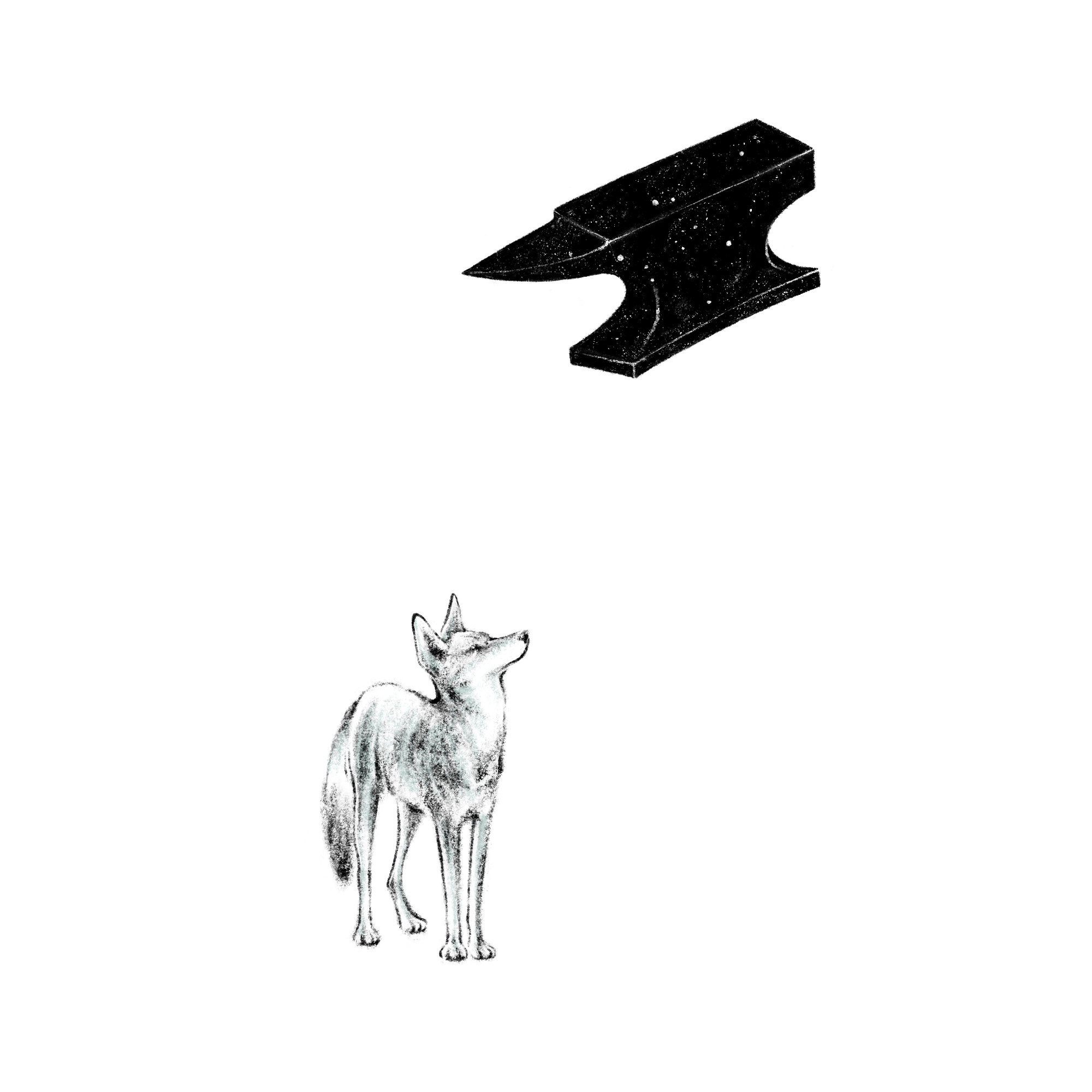
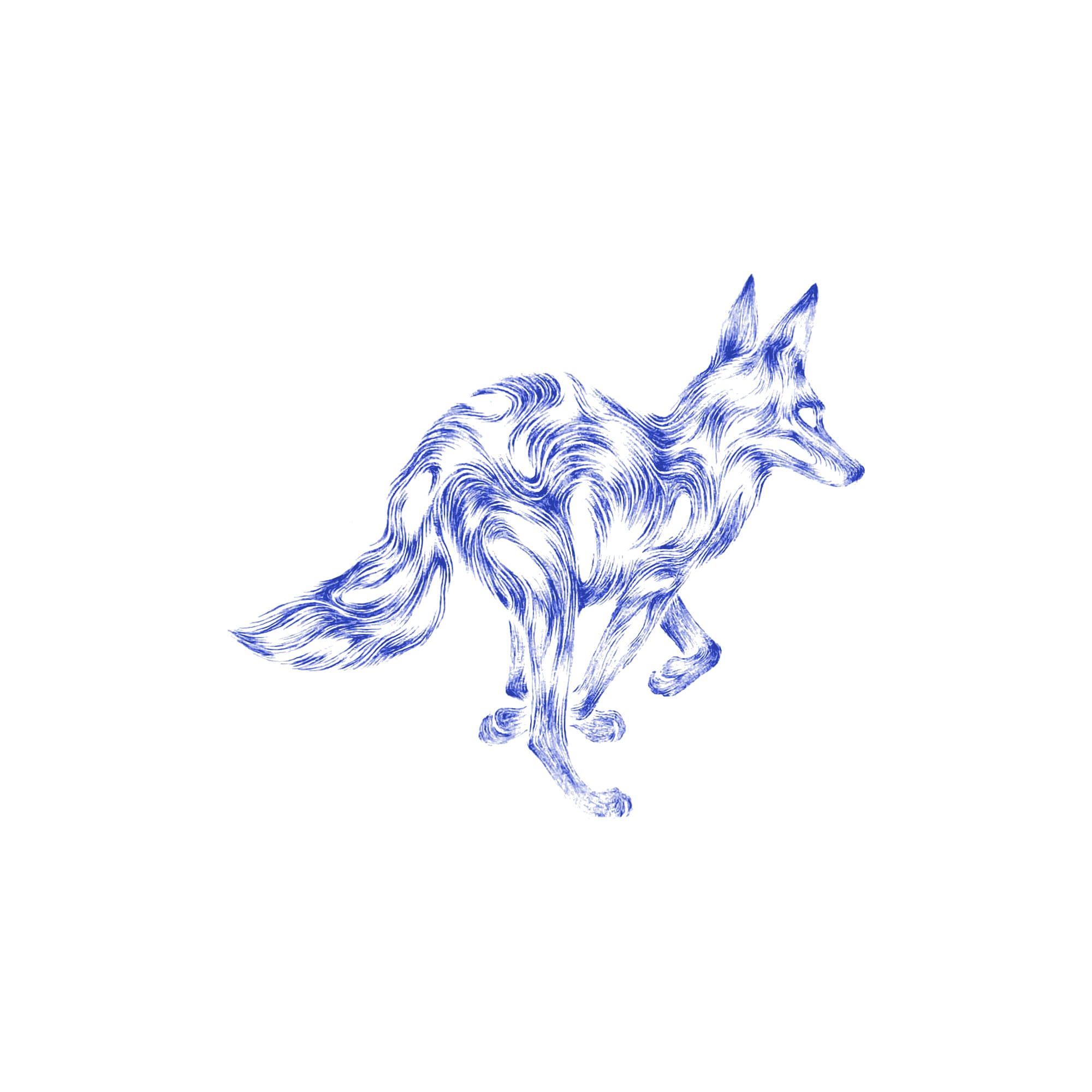
Left: An illustration by Tseng from Trickster at the End of a World. Right: One of Tseng's Field Studies ballpoint drawings of coyotes.
CL: Does it seem like coyotes are having a bit of a moment right now? There was that lone coyote that swam to Alcatraz. They've got a Bay Area publication named after them. They've got your book.
HT: There does seem to be an influx of sightings and footage. The Alcatraz Coyote feels like an icon of the Bay. And I've been seeing footage of an incomplete construction site in L.A. that is stalled, and coyotes have moved in and are being really noisy. But also maybe they're like a freelance security service or something.
CL: What do you think is next for you in this fascination with coyotes? Or is the book a culmination of your interest?
HT: The book is a beginning, not an end. Coyotes have opened the portal for me. I've become very interested in ecosystems and also [thinking] about people as an animal in the ecosystem. I'd like to kind of blur that boundary, of thinking about us as members of the ecosystem, whether that is something that is a bit antagonistic and invasive, versus thinking about being more harmoniously a part of the ecosystem.
I've started a little bit of a deep dive into invasive species because it turns out that even the idea of an invasive species is a very cultural one. Like, is it about preserving biodiversity, which is a very common and noble pursuit, or is it something that's maybe more akin to, say, xenophobia, or to controlling or curating an environment where some species take precedence over others? It’s become an interesting thing to think about.
Learn more about Helen Shewolfe Tseng’s work on her website. ‘Trickster at the End of a World’ is out now on Sming Sming Books.