COYOTE Calendar: November 5-November 11
This week we've got justice for witches, horny horses, a Scooby-Doo themed dinner, tempting holiday markets, and more.


This week we've got justice for witches, horny horses, a Scooby-Doo themed dinner, tempting holiday markets, and more.

Campbell’s Habibi Ceramics transformed clay from the Oakland Coliseum into a vase laden with 24-karat gold and the hopes of a city.

Delicate steamed rice rolls and deep-fried water spinach with a side of star rating discourse.

Campbell’s Habibi Ceramics transformed clay from the Oakland Coliseum into a vase laden with 24-karat gold and the hopes of a city.

Nadia Elgan just wanted a bucket of dirt. Namely, dirt from beneath the Oakland Coliseum’s field. Usually, only select fans or investors can get it, though one might still find some dubious samples on eBay. But Elgan was paid to take a few buckets — to fine-tune it into a vase befitting a scene from Disney’s Hercules. Now, that vase, imbued with one of the Bay Area’s most sacred sporting destinations, is in Paris, which is currently aflame in protests against the government as of reporting.
Elgan runs Habibi Ceramics, a pottery studio in the South Bay. She’s worked with restaurants, brands, and chefs throughout the region including Nelson German’s Meski in Nob Hill and Reem Assil’s eponymous restaurant in Oakland. For the Coliseum project, she was invited to collaborate with Oakland’s soccer team, the Roots, and create multiple pieces honoring the fans and the legacy at the Coliseum before it is demolished. Her first iteration was an artsier piece that the community could take home, the aforementioned vase. But the vase also found a much bigger audience, sitting on display in a huge international art event: Paris’s Art Basel.
Elgan’s work would have run from Oct. 23 to Oct. 25. Instead, the festival was cut short, ending on Oct. 23 due to country-wide protests inflamed by economic grievances and government austerity measures. Elgan says she believes in the right to protest, and understands the safety considerations. Still, the closures were “disappointing as an independent artist who had invested so much in being there.”
“To be able to go as a Palestinian, Filipina, American artist and represent my roots is a big deal,” Elgan says. “It continues the efforts of celebrating all the different parts of who we are.”
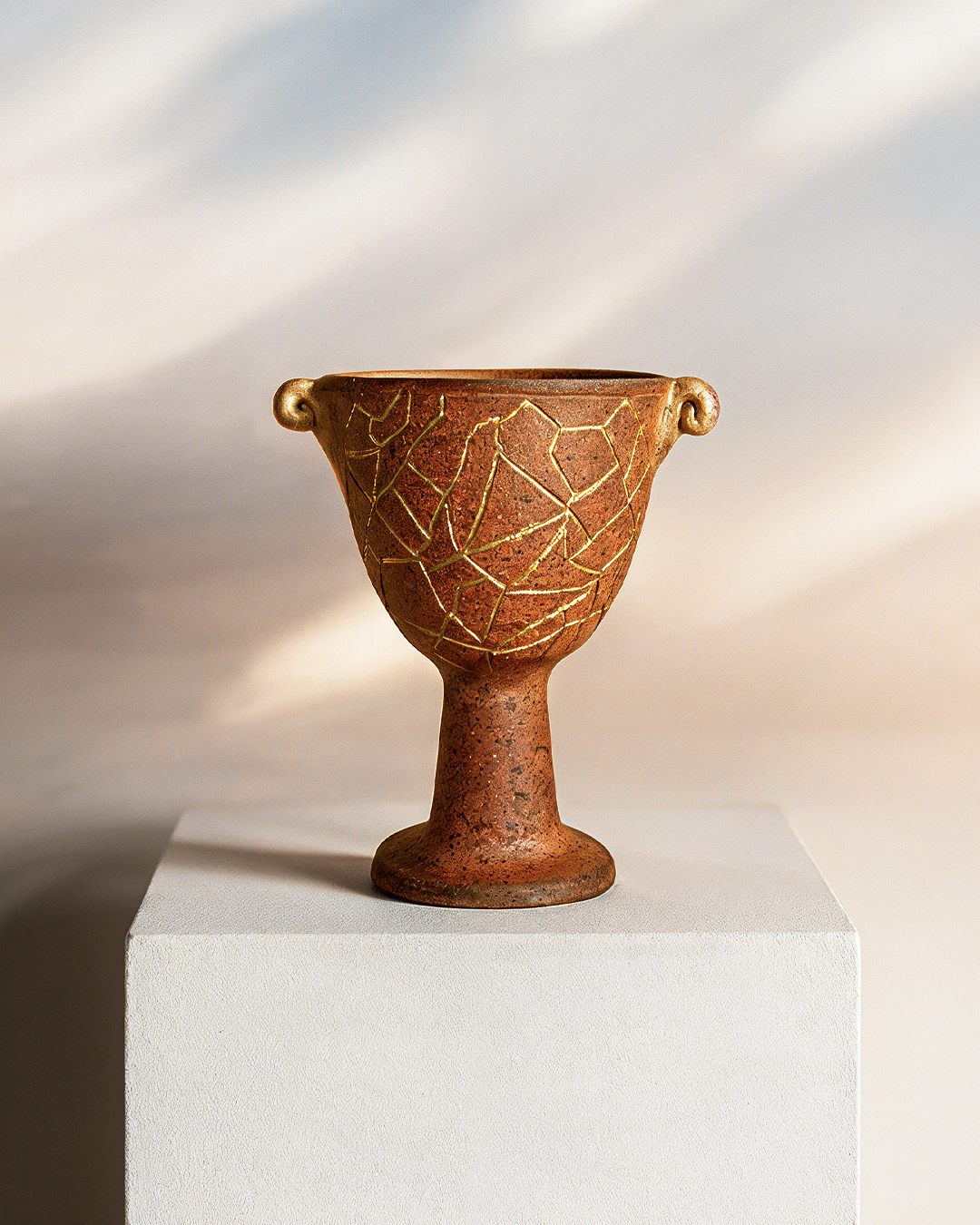
The vase, which is shaped like a trophy, is a one-of-one that is available for purchase in France. That one, six-and-a-half inches wide and seven inches tall, boasts 24-karat gold threading through the piece. Honoring the logo of the Roots’ tree and mosaic, a similar web runs along the trophy, outlining pieces including one shaped like the current borders of Palestine. It will retail for €2,500.
Beyond the big shindig abroad, replicas of the trophy sans gold were sold to fans here in the Bay at $220 a pop; it sold out within five days. Edreece Arghandiwal, co-founder and chief marketing officer for the Roots, said in a statement he’s proud Elgan alchemized a part of the Coliseum into art representing Oakland’s diverse landscape.
“Now it’s headed to Paris,” the statement reads in-part. “Not bad for some dirt from East Oakland. Oakland to the Universe.”
“The Coliseum means so much to people because of what happened there: the games they went to as kids, the people they went with, the memories their families share. The dirt matters because it comes from a place that holds those connections.”
It began when Elgan was first invited to a Roots game, where she felt the beauty of the team’s fans, the powerful support. After the game, she, her daughter, and a sea of fans came to the field to talk to players, and that meeting sealed the deal for her and Arghandiwal. She says that after experimenting with the clay and the ratios of water and colors, the piece started to take shape on its own.
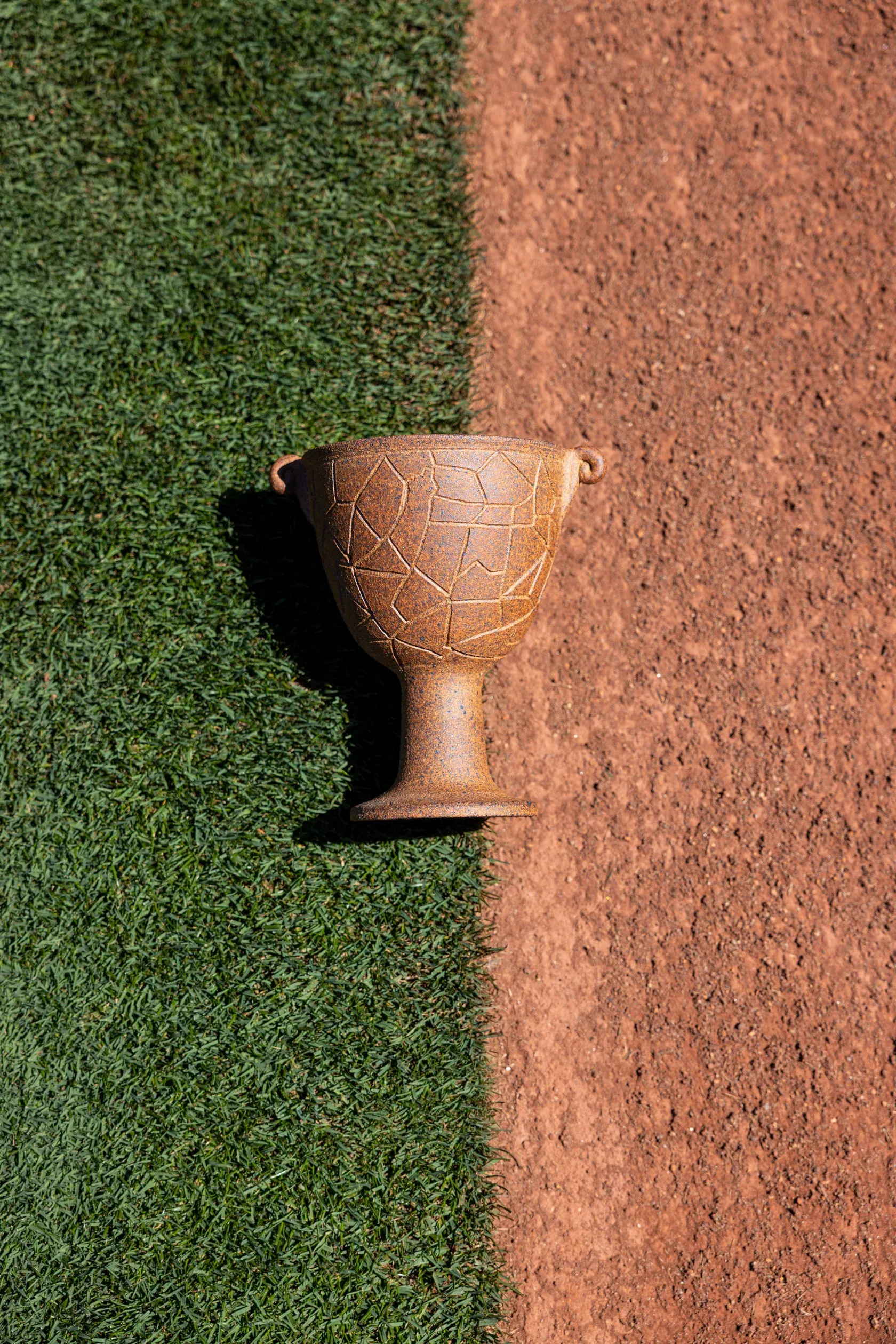
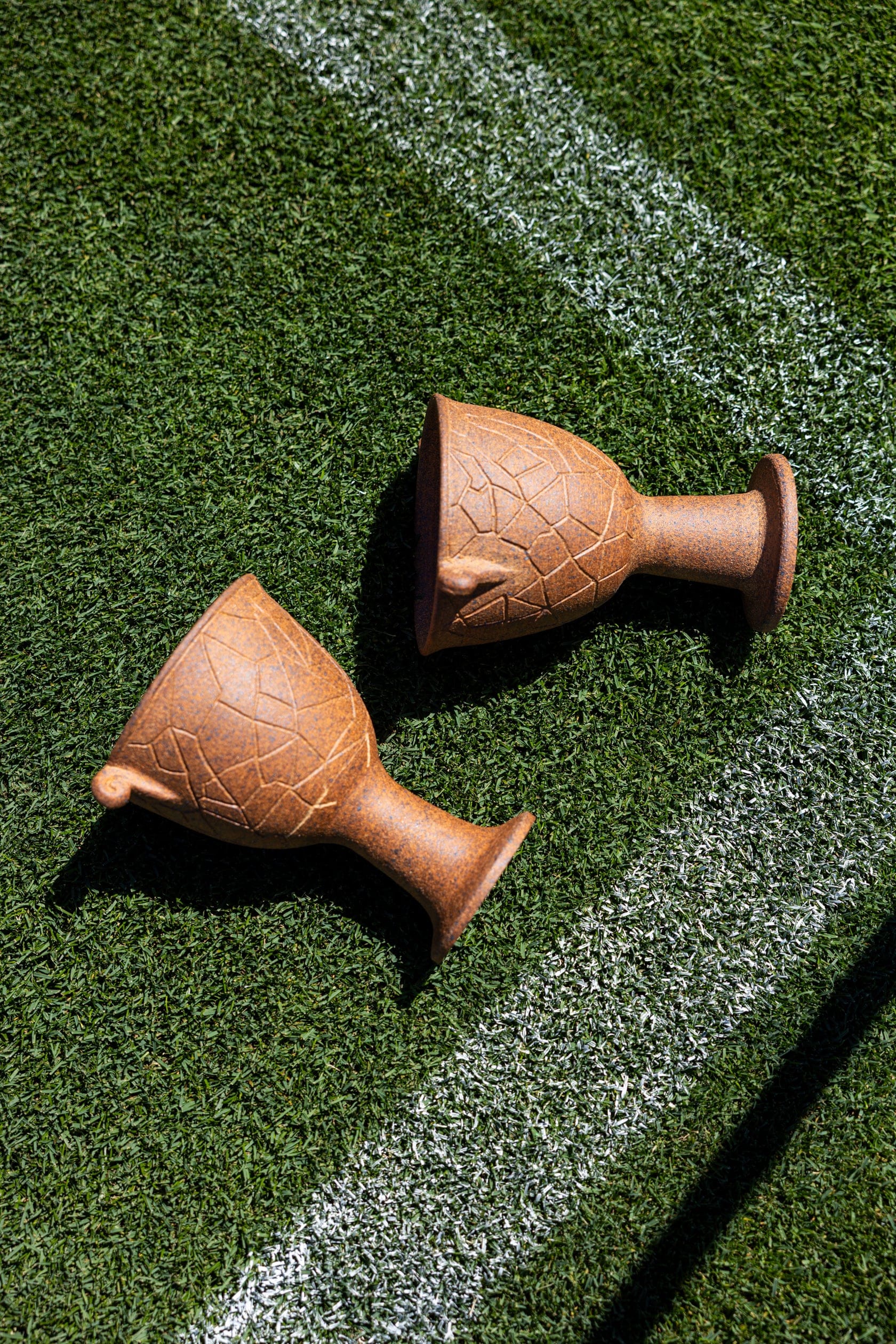
Vessels made from Oakland Coliseum's dirt sold out in days. (Courtesy Azael Garcia)
“To Palestinians, land is not just land,” Elgan says. “It holds memories, and connections, and it felt like I needed to have the piece have a physical piece of the land.”
After a trip to Italy, she felt inspired to submit the vase for galleries. Her first try went really well: Designer Jean-Christophe Vaillant of Hermès styled and set the piece for Art Basel, working his sceneography in the Espace Commines in Le Marais. She decided to outline the border of Palestine as a way to weave her own roots into that tapestry. It wasn’t intentional at first; she says it just felt like it fit, a way to follow through with the energy of the World Cup and the international camaraderie on display. In a time when the commitments and myths of the global village have been strained by increasingly frayed forever wars, Elgan felt more compelled to make a statement.
Art Basel is one of the most significant international art fairs, where leading galleries decamp to various exhibits all over the world to put their best foot forward — in Miami, Hong Kong, Paris, and many other locales. Since 2018, the 1,000 Vases project has put on yearly shows in Paris and Milan, each time selecting hundreds of artists from around the world to represent their country or region. Rather than an actual 1,000, this year’s collection featured some 100 pieces from 60 countries, Elgan says.
Elgan submitted and was selected quickly this summer. Before she knew it, she was booking arrangements for a show overseas and hoping she was up to snuff for the swanky affair.
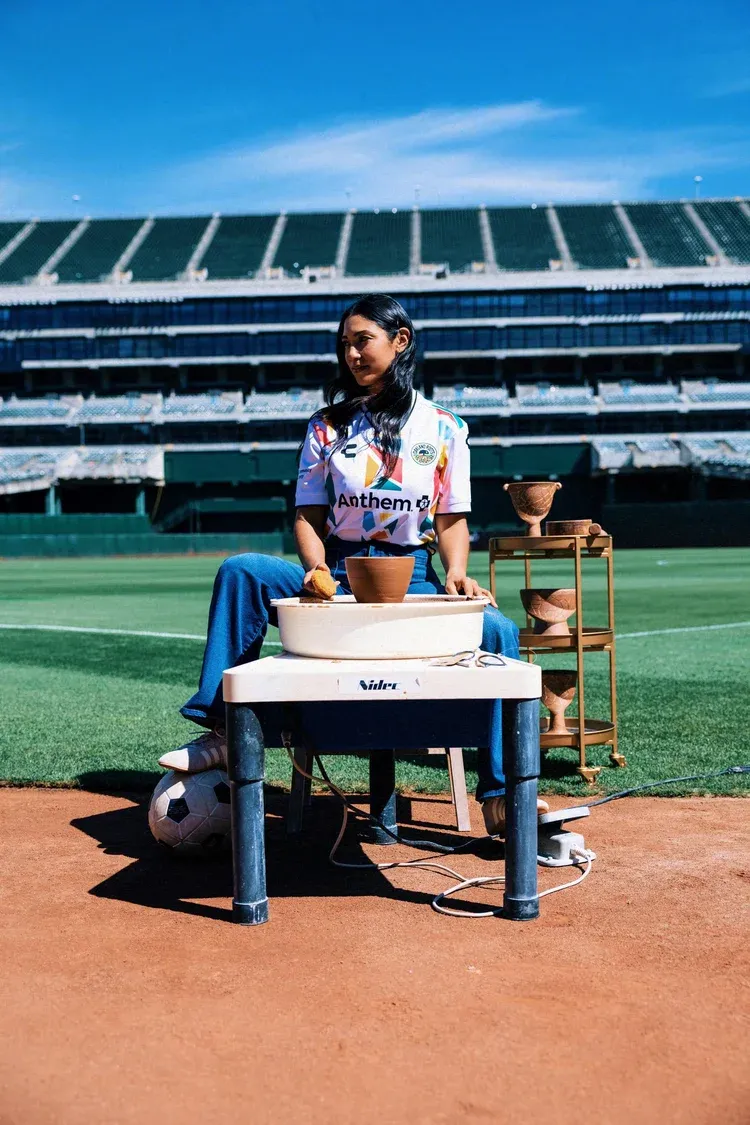
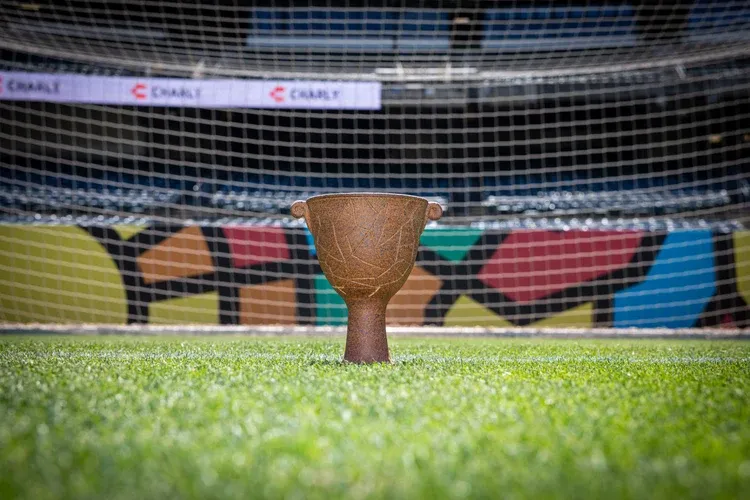
Artist Nadia Elgan's collaboration with the Oakland Roots will involve making cups and dishware as well as the initial drop of trophy-shaped vessels. (Courtesy Azael Garcia)
Back home, there’ll be new drops throughout the next Roots season, most likely two everyday pieces such as cups and plates. Art Basel’s suspension and the limiting of 1,000 Vases hampered her spirits, but not her commitment to the craft. She said she made the most of the experience, connected with other artists, and had meaningful conversations around the work. The streets were moody, she said. Parisians told her it was like COVID, wild and momentous.
The ironic thing to her and other artists was recognizing their work was the subject of some protesters’ ire. Their complaint seemed to be that only billionaires and high-end collectors frequent these events. But to Elgan, they’re chances for artists of all stripes, without major backing, to showcase their work, maybe for the only time. What happened, though, was that only the VIP day was kept open, where Elgan believes the minimum to enter was $1,400. Still, sales on the one day were higher than the previous year’s entire weekend combined. There may have been an air of desperate consumption about.
“It was so heartbreaking to see those opportunities cut short, knowing how much everyone had invested. I can’t quantify the impact, but losing that time definitely affected everyone,” Elgan says. “But stepping back, the experience made me think more deeply about why I made this piece in the first place. The Coliseum means so much to people because of what happened there: the games they went to as kids, the people they went with, the memories their families share. The dirt matters because it comes from a place that holds those connections.”
As an outsider, Elgan isn’t comfortable equating the struggles of Parisian youth with her experiences in Oakland. “But it made me think about how much people everywhere care about their communities, what they’re afraid of losing, and what they hope for…. Bringing a piece of Oakland to Paris opened up those conversations, and that meant so much to me.”
Editorial note: Elgan has worked with Bicchieri on his Kitchen Table project by appearing in a workshop and providing ceramics for events.