The Best Dishes Our Food Critic Ate in October
Delicate steamed rice rolls and deep-fried water spinach with a side of star rating discourse.


Delicate steamed rice rolls and deep-fried water spinach with a side of star rating discourse.

We catch up with the East Bay songwriter on the eve of her nationwide tour to support Show Me, her first studio album in six years.
Delicate steamed rice rolls and deep-fried water spinach with a side of star rating discourse.

A month ago, the San Francisco Chronicle’s Food & Wine section decided to revive starred restaurant reviews — reportedly to give readers a better sense of whether a place is worth their while (and hard-earned cash). Furthermore, the stars would “help give diners a common language for comparing restaurants across styles, cuisines and price points,” from the $500/pop tasting menu to the humbler end of the culinary spectrum.
The unspoken part is that, historically, the awarding of stars has often been treated as news in itself, all but guaranteeing a bigger splash on publication day than if the story were just a regular ol’ feature.
But as the no-good demon who personally took the stars away back when I was the Chronicle’s restaurant critic in 2019, I’m not convinced. I still stand by my 2019-era assessment that a standardized rating system is rife with structural flaws, much like standardized tests, which mainly assess how much money a given student’s family was able to pump into test prep.
Take Michelin, for example. The popular Michelin Guide evaluates restaurants on a 1- to 3-star scale, plus its Bib Gourmand list for notable, but starless recommendations. There’s plenty of gravitas here, and having starred restaurants is seen by many cities as a mark of pride.
“If we want to be a world-class city, then we have to compete on the world stage, and there's no higher league, so to speak, than Michelin,” one tourism board CEO told Food & Wine. Why else would cities pay millions of dollars to get Michelin inspectors to look their way? Incidentally, isn’t it interesting that the Michelin Guide, despite being concentrated in Europe, has no recommended restaurants in the whole of Africa, which is just a quick flight away?
I don’t mean to place the sins of the Michelin guide on the shoulders of the Chronicle’s restaurant critics, here. I really enjoy their work! But in this era of hot takes and pay-to-play influencers who make their bread by declaring a restaurant “mid” or whatever, I just hope that the establishment critic’s most important function — that of providing the why and how of the way we eat now — doesn’t get drowned out by all the noise of whether a place got one star or two.
Anyway, these are my favorite meals from the past month of eating around the Bay Area. No stars, though. You’ll have to get those somewhere else.
Rice rolls at King Kitchen
King Kitchen is a Toishanese-style restaurant that serves claypot rice, double-boiled soups, and steamed rice rolls made from freshly ground rice flour. The perfect rice roll, to me, wobbles in that textural zone between rubbery and fragile — and god forbid an oily roll, lubed up to make up for subpar technique. The rolls at King Kitchen, which opened on Oct. 6 in Oakland’s Chinatown, land squarely in the middle. I might even go so far as to call them perfect. Depending on the filling, you could go vegetarian or all-out with a diverse zoo of meats. The prices range from $6.99 to $9.99. Pair the rolls with the restaurant’s excellent goji berry-scented tea.
King Kitchen. 366 8th St., Oakland. Open 10am–4pm Wednesday through Monday.
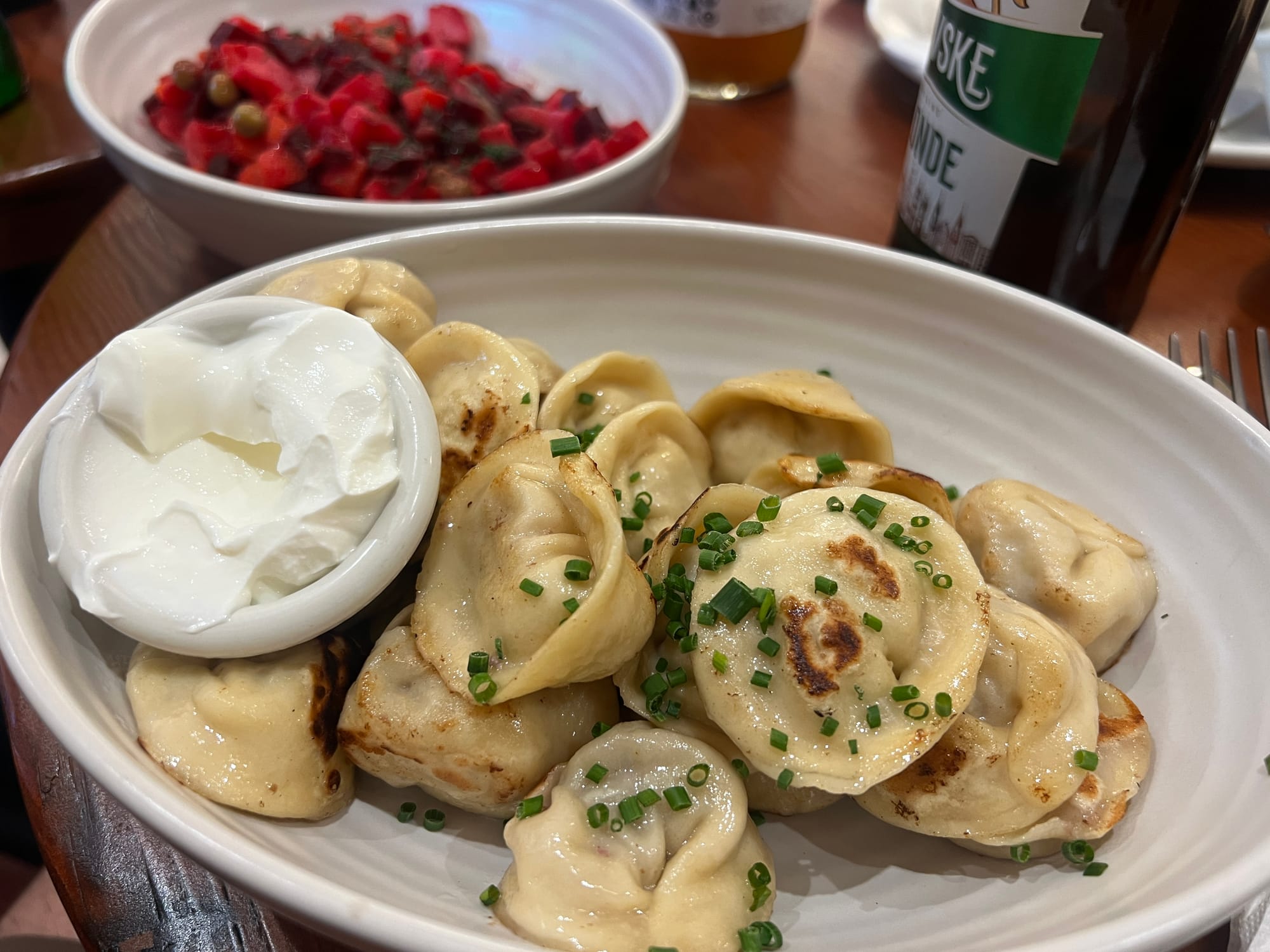
Pan-fried pelmeni at Cinderella Russian Bakery & Cafe
What is this Russian dish ($16) if not gyoza by another name? Here, little pockets of dough are stuffed with minced meat, boiled, then seared on one side in a hot pan. The pelmeni are meant to be eaten with sour cream, which the dumplings’ radiating heat melts into a slinky, silken sheet of dairy. I’m all-in on best-of-both-worlds dishes where the appeal lies in the yin-yang of soft and crisp: like Thailand’s kanom krok, or the famous (as I like to believe) bánh khọt of my family’s village in Vietnam, upon which a steamed shrimp lies curled like a napping dragon on its hoard of gold. You’ll want something vinegary with this, like the pickle-and-beet “vinaigrette” salad ($14).
Cinderella Russian Bakery & Cafe. 2937 24th St., San Francisco. Open 8am–6pm daily.
Cranberry beans and pan con tomate at 20 Spot
With just a few quiet minutes to spare before COYOTE’s LitCrawl event on Oct. 24, I managed to grab a seat at the bar here, tucked between some adorable twenty-somethings and a couple on a date. In my opinion, 20 Spot is great for that kind of outing. The vinyl collection is fun and sexy; plus, the menu of small plates is fairly noncommittal, giving you flexibility to cut out early if you get the ick from your potential suitor. But that night, the romance was all in tripartite union between myself, some thick slabs of sourdough bread smeared with grated ripe tomatoes, and a big bowl of plump cranberry beans ($21) bathing in their own starchy liquid. Beans love a little acid, and they sung with the addition of the tomato and some supplementary sips of Chenin Blanc.
20 Spot. 3565 20th St., San Francisco. Open for dinner daily.
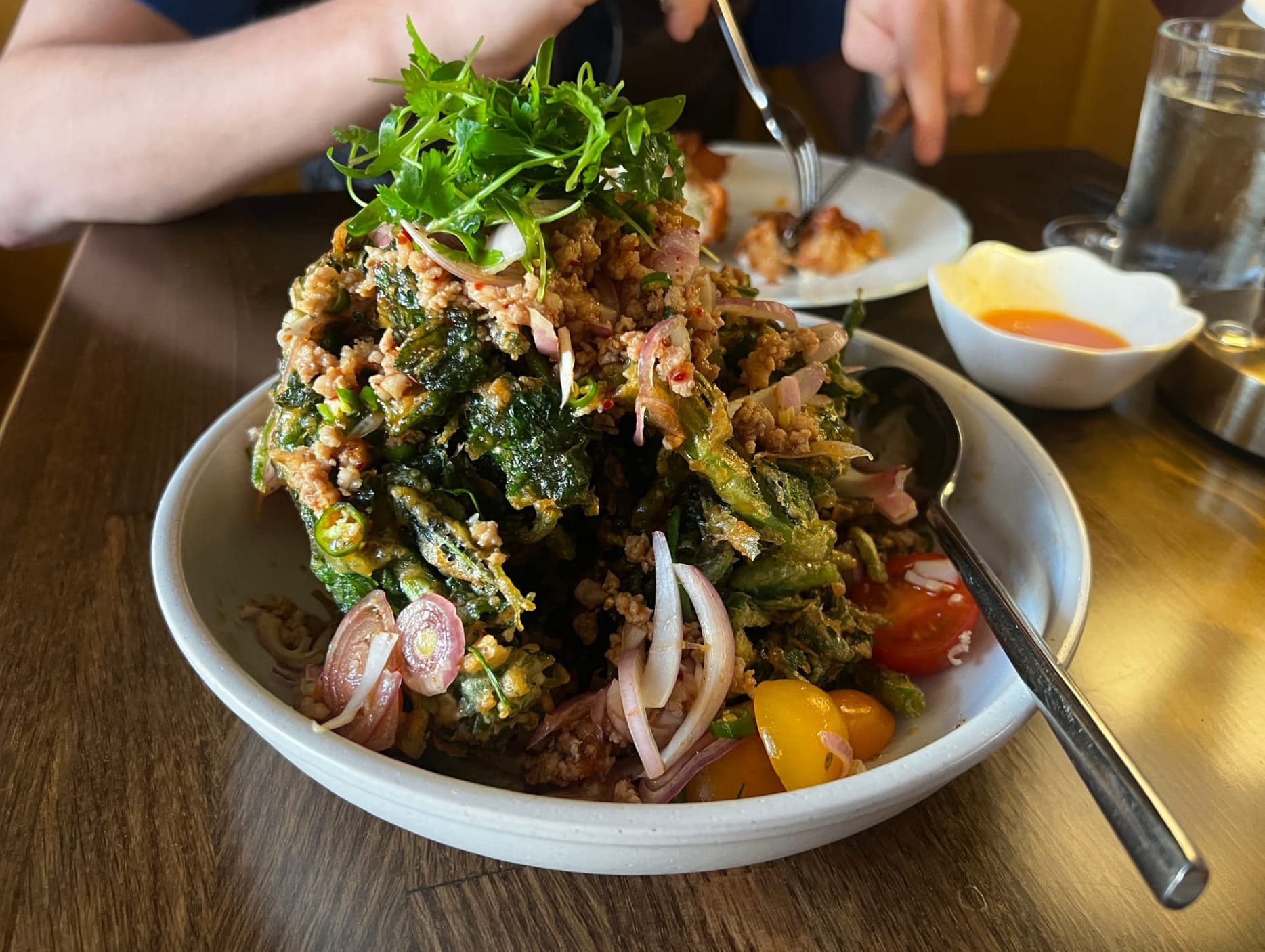
Crispy morning glory salad at Glom Thai
As my colleague Cesar Hernandez wrote recently at the San Francisco Chronicle, the Bay Area’s Thai food scene has changed a lot in the past few years, with a ton of notable openings, especially at the “finer” end of the culinary spectrum. I’ve checked out a lot of the newer spots that followed in the footsteps of restaurateur Pim Techamuanvivit’s acclaimed San Francisco restaurants, Kin Khao and Nari, and, like Cesar, the thing I keep chasing is surprise — because to me, that’s the lifeblood of high-end cuisine. Not gimmicks, but showcases of finesse, technique, the courage of being counter-intuitive! That spirit is embodied in this dish ($22), a tangle of morning glory (AKA water spinach, kangkong, or rau muống), is fried like tempura in the style of kakiage, a similar dish of battered julienned vegetables. A sour lime dressing soaks into all the crevices of the vegetables, lightening up the deep-fried feel. Ground pork, tomato, and cashews provide more textural interest, but they’re bit players compared to the revelatory impact of the morning glory’s hollow stems and leaves, given new life as a tempura. This is the dish that made me really excited about how far Thai cuisine is poised to go in the East Bay.
Glom Thai. 1233 San Pablo Ave., Berkeley. Open for dinner Wednesday through Monday, plus lunch on Saturday and Sunday.
