After Manny Yekutiel’s Campaign Implodes, Who Holds S.F. Leaders Accountable?
After fumbling accusations of sexual assault, S.F. politicians deserve a reckoning.


After fumbling accusations of sexual assault, S.F. politicians deserve a reckoning.

This week we've got polyamorous condors, cardboard costumes, sapphic vampires, and more.

Living in San Francisco means being a guinea pig for the tech industry — but I draw the line at my second-grader.

After fumbling accusations of sexual assault, S.F. politicians deserve a reckoning.

When it comes to supporting survivors of sexual assault, even the most “progressive” corners of this country have a ways to go — and last week’s news cycle offered a few painfully pointed examples.
There’s the case at Cornell University, which continues to roil academia and politics in New York. And locally, we’ve just seen Civic Joy Fund co-founder and political aspirant Manny Yekutiel’s campaign for District 8 supervisor reach an ignominious conclusion, after a pair of new on-the-record allegations of sexual assault surfaced in coverage by the San Francisco Standard. These followed an earlier allegation by another man, though that first one ultimately had few consequences: San Francisco’s moderate Democrats, including the mayor and the local Democratic County Central Committee (DCCC), chose to endorse Yekutiel.
Apparently, three accusations of this nature is too many. Yekutiel’s allies peeled off with a quickness, leaving a handful of mea culpas in their wake. Now some, including Supervisor Connie Chan, are calling for the resignation of SF DCCC chair Nancy Tung. A group of supervisors have pulled together a special hearing on sexual assault for this coming Thursday, Oct. 8. While the topic is not explicitly the Yekutiel case, it’s likely to be a recurring theme during public comment.
When the latest allegations against Yekutiel came out, so did the revelation that Board of Supervisors President Rafael Mandelman had defended his political ally to colleagues and the press with exculpatory statements that there’s a “different threshold” for sexual misconduct in the gay community.
That same day, a group of LGBTQ elected officials decried Mandelman’s words in a statement, writing, “[We] are sickened by, furious with, and ashamed of those that seek or claim to represent the gay community while denying, dismissing, or defending sexual abuse and assault… Gay men do not need a ‘different threshold’ for sexual assault. We need a higher standard of leadership for our community and city.”
The backdrop for this local dumpster fire has been national discourse about the relitigation of a seemingly botched case of gang rape at Cornell. According to case documentation, Doe visited a frat house to visit a friend after becoming inebriated. She was allegedly pressured into consuming drugs and more liquor and her friend invited 55 other men in a group chat to engage in intercourse with her — which some did for hours while she was intoxicated. The local district attorney declined to charge any of the men involved. Instead, punishments ranged from expulsion from Cornell to writing reflective essays about the concept of sexual assault and consent. Adding to the fires are those focused on victim-blaming and doxxing Jane Doe, the anonymous plaintiff.
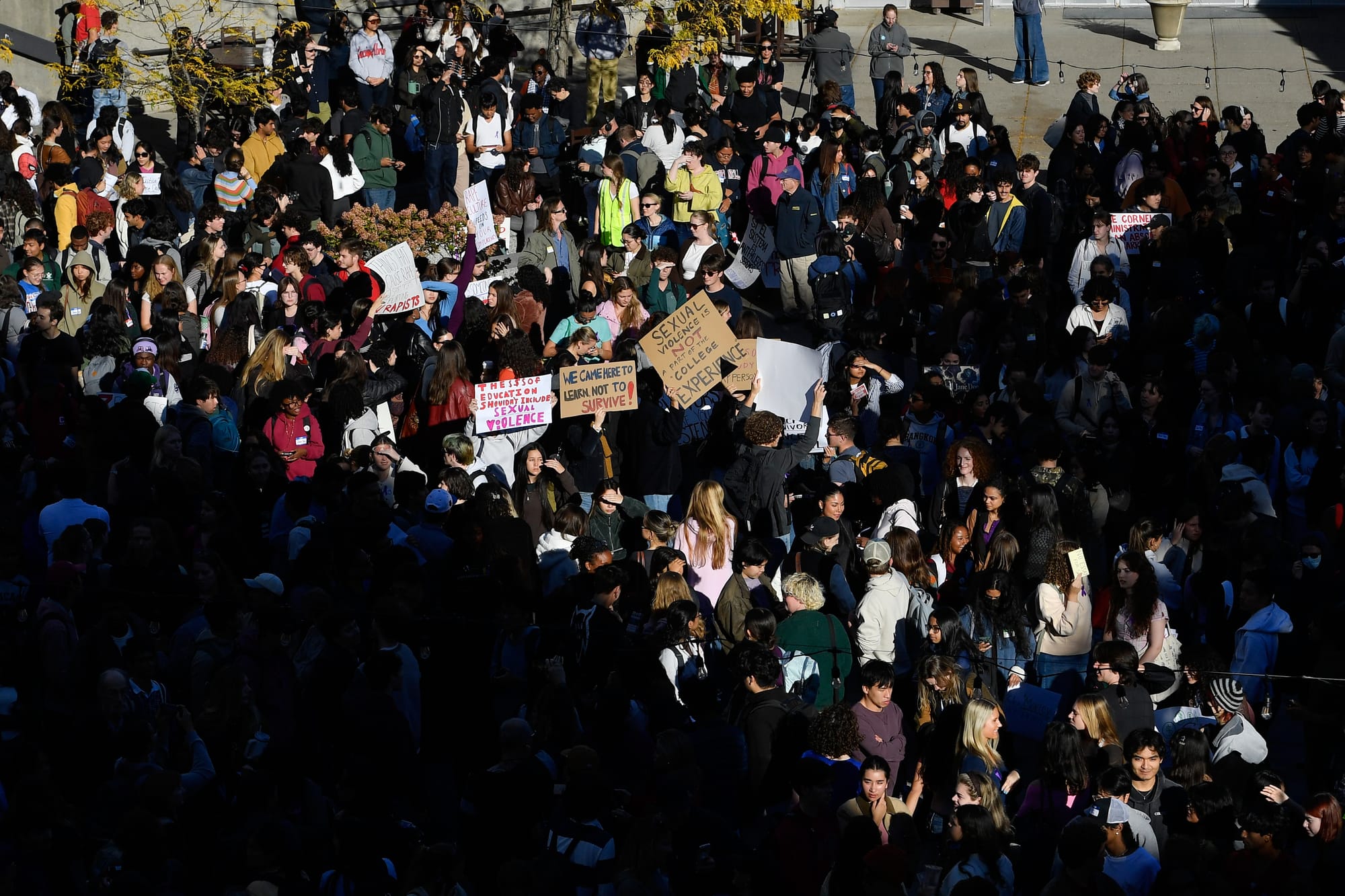
I’m not surprised that misogynist, right-wing Twitter CHUDs and bots have gone all-in on victim blaming in the Cornell case. Their ultimate goal is to run women and queer people out of public life — not believing in consent is as predictable as the sunrise for them. But an elected official who purports to represent and affirm the LGBTQ community in San Francisco — a highly visible and meaningful position by any account — cannot be running defense for a political ally by claiming different rules on assault for gay men. Statements like Mandelman’s ask us to accept the premise that sexual assault and unwanted touching are normal for a specific community, regardless of the fact that the accusers have repeatedly said that they did not consent.
Advancing this premise has real-world consequences: It supports the notion that gay men need less legal protection for assault, a sentiment which the Christian nationalist federal government would likely agree with, given that it formally stripped protections for LGBTQ students from Title IX.
In a follow-up call with the Standard, Mandelman denied his colleague Supervisor Myrnal Melgar’s testimony, claiming that he never said anything akin to what she quoted, which was, “For women, this is a big deal. Among the gays, it’s not a thing.” But he essentially repeated that justification to the publication, saying, “I think sexual assault occurs differently [in the gay community] and there’s a different threshold.”
I myself know many queer people who have been harassed or assaulted by other queer people — in homes and “party” spaces alike. Studies show that LGBTQ people, including gay men, experience higher rates of sexual violence than their straight counterparts. And variations of excuses like Mandelman’s have echoed throughout many of these cases over the years, making survivors feel at fault, or that they were “making a big deal out of nothing.” Given established histories of mistreatment of LGBTQ people by the state, survivors can also feel pressured to not report assault out of a desire to protect themselves or queer spaces in general.
Sexual liberation cannot mean there are no rules or that bodily autonomy doesn’t matter. In order for liberation to be as empowering as we make it out to be, “no” cannot be a negotiation. It’s why even the wildest, down-and-dirtiest kink parties have safewords, zero-tolerance policies for harassment, and zones with set rules of engagement.
In recent days, outcry over Cornell University’s handling of the gang rape case has prompted conversations over what accountability should look like for institutions that fail to uphold justice. At a Sept. 27 town hall in Ithaca, N.Y., Rep. Alexandria Ocasio-Cortez stated, “The culture of rape, sexual assault and pedophilia is protected in elite institutions across the United States, including Cornell University … This entire country is sick and tired of not just financially corrupt, but morally corrupt leadership.”
The case has been reopened, with New York’s attorney general, Letitia James, newly appointed by the governor as special prosecutor. Yesterday, the Cornell faculty senate signaled that it would put forward a vote of no confidence in the school’s administrators. And state legislators are working to fast-track a bill aimed at closing a legal loophole that classifies all sex as consensual if the victim voluntarily intoxicated themself prior to the incident.
It all begs the question of what San Francisco’s elected officials are doing to hold themselves accountable to sexual assault survivors — now and in the future. Will there be any reckoning for the mayor, who went on to endorse Yekutiel after the first accuser came forward in June? Or for Mandelman, who will be relying on support from the local gay community during his upcoming bid for a state assembly seat?
Yes, sexual mores can be complex, with levels of nuance that depend so much on shared context in different communities. But nuance is for navigating consent — not for excusing its absence.