Yap Zone: The September 11 Artifacts Playlist
What were you listening to after the September 11 attacks?


What were you listening to after the September 11 attacks?

For Soleil Ho, September 11 was their political origin story.
This week we've got pruning, taxidermy, corn, cardboard, making U2 mad, and more.

A Castro gallery show and a new Oakland bar ask what masculinity could look like if we stopped trying to nail it down.

The shop and art gallery Queer Arts Featured, posted up inside of Harvey Milk's old camera store, is in the perfect place to give the Castro community — and the tourists who make pilgrimages to the historic gayborhood — something fresh and challenging. The shop is filled with thrilling artifacts and handmade work by LGBTQ+ artists: a rhinestone-encrusted box cutter; stickers and pins about queer Latinidad, Palestine, and mutual aid; a zine about water sports (not yacht racing). In the back, you'll find a low-key gallery space, where owner Devlin Shand has spent nearly four years making room for queer art that reflects the diversity of the LGBTQ+ community. Now, it's dedicated to No One Way: Transmasc Art as Activism in the Bay Area, an exhibition about transmasculinity — a word that, if you ask enough people to define it, will eventually make you wonder if the search for definition, for certainty, is the wrong impulse entirely.
For a few weeks now, I've been asking people what a transmasculine aesthetic looks like to gain clarity for this piece, and nobody has given me the same answer twice. While the cis world demands a tidy summation to questions like “What is a man?” or “What is a woman?” the queer and trans people I spoke to find those questions limited and deeply uninteresting. Instead, the more exciting question might be, “What more can we imagine?”
There's a version of this story that tries to nail down what transmasculinity looks like — a defining of canonical historical moments, some kind of unified theory of T boyhood, a moodboard full of leather and lace. It would probably have a subhead like "Redefining Masculinity on Their Own Terms." I’m not going to write that story, partly because everyone would get mad at me, and partly because the whole premise of No One Way is that the attempt itself is the problem.
“No One Way brings together four artists across generations, shaped by different political moments yet united by a shared inheritance — the Bay Area as a foundational space for transmasculine resistance and possibility,” reads the didactic label about the show.
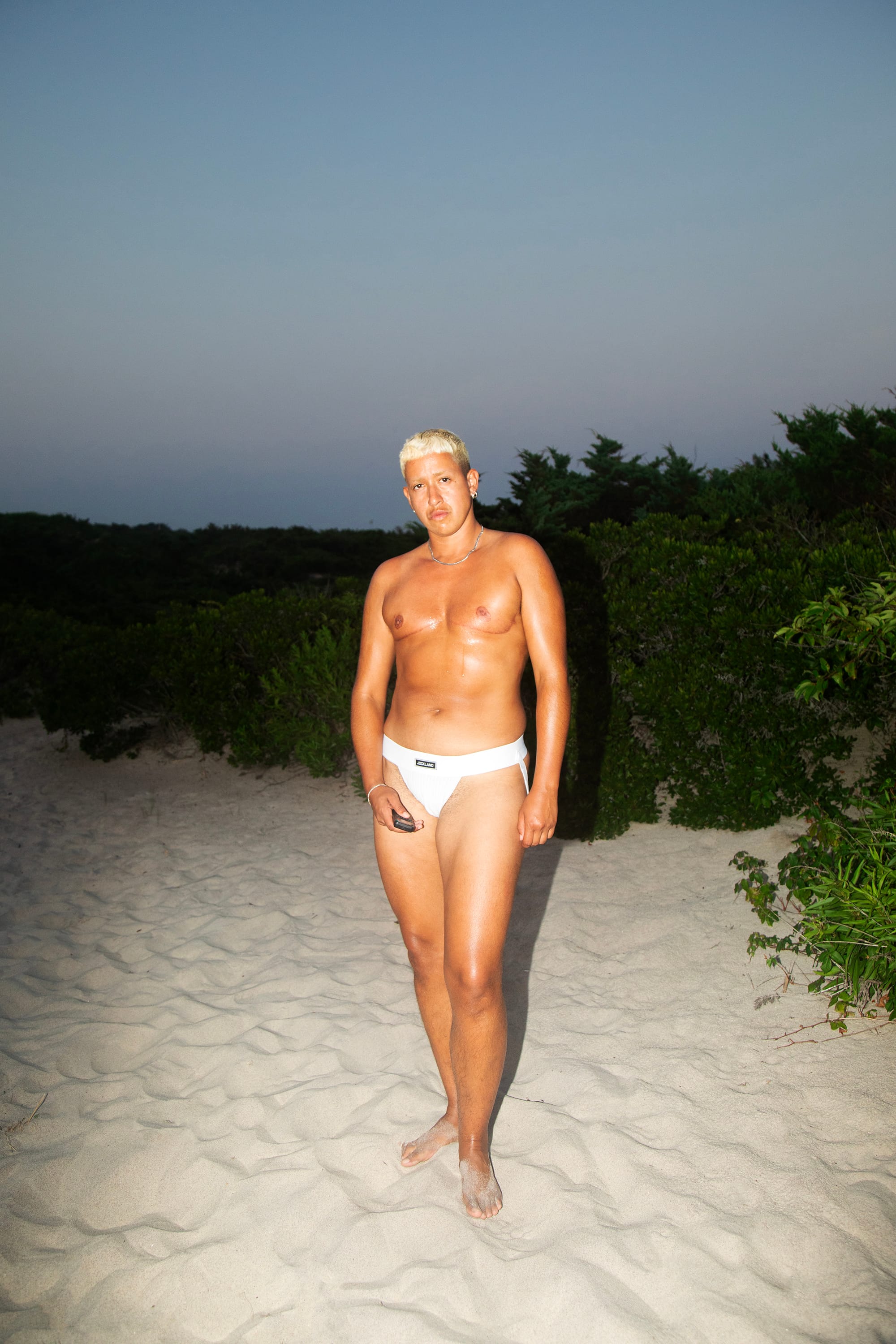
Marcel Pardo Ariza, an artist and activist whose self-portraits are part of No One Way, describes their work in terms of responsibility and repair. The San Francisco Art Institute graduate encountered few historical examples of transmasculine artists or subjects in school. So during a 2025 residency at Fire Island, they started photographing themself: often in classic art poses, fierce eyes fixed at the viewer, while wearing a jock strap in the sand dunes of the Meat Rack.
"What’s the ‘Meat Rack’?" I ask, because I am a baby.
"People say it's the first cruising site in the US. I don't know if that's true," Ariza says. Well, I don't know — I imagine that people have been cruising since we lived in caves. *Neanderthal wink*
"For a long time this space has been overwhelmingly cis and white, and I wanted my transmasculine migrant body to enter the visual space of this historically charged landscape. I wanted to insert myself into this archive of queer desire," reads Ariza's artist statement.
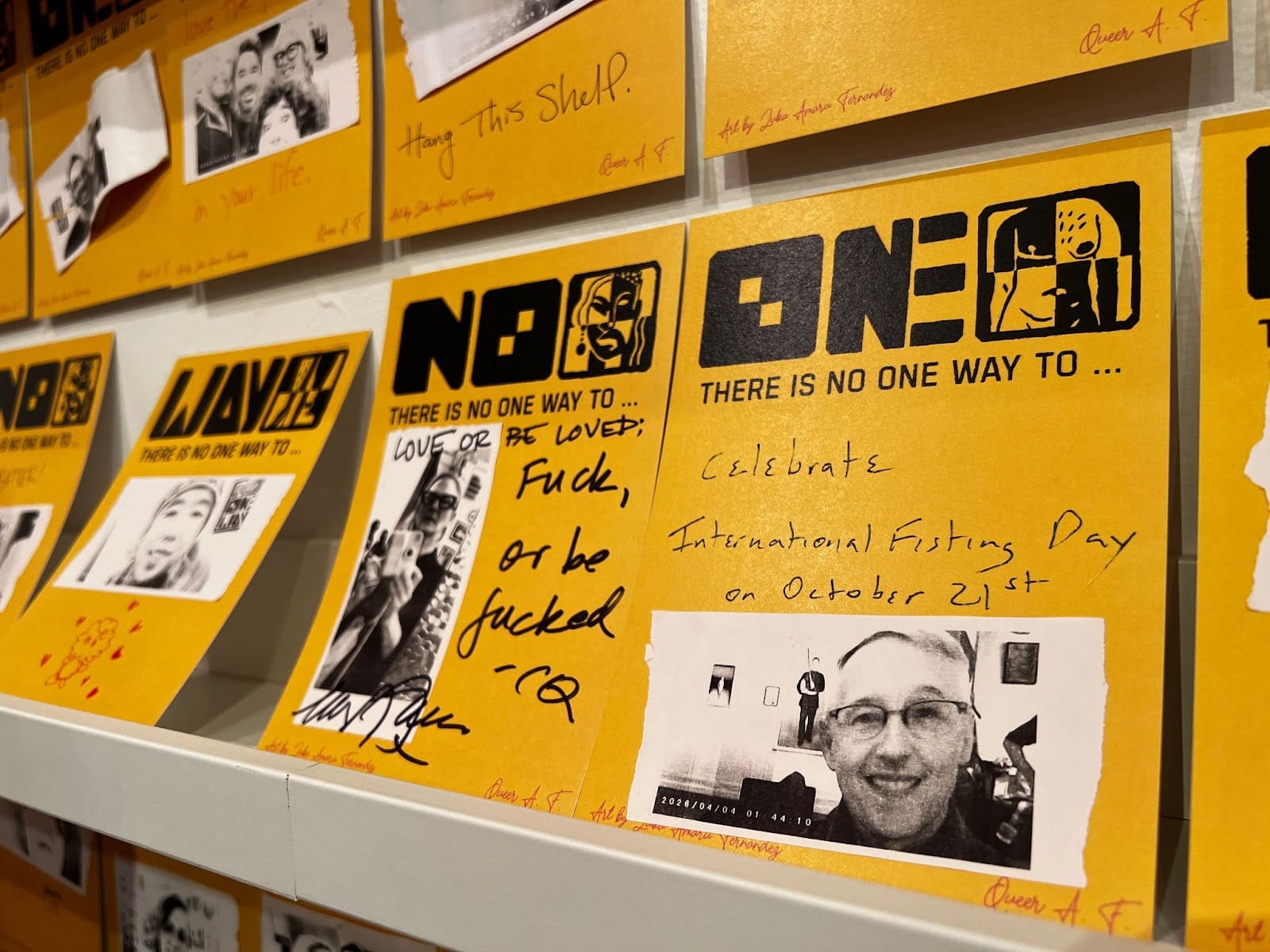
Visitors to No One Way are asked to respond to the installation by completing a prompt on a yellow card: There's no one way to ___. They can write it, draw it with colored markers, or photograph it with a provided disposable camera. The wall is full of proud ambiguity. There's no one way to love. There's no one way to be in your body. There's no one way to fuck, or be fucked. My favorite: There’s no one way to celebrate International Fisting Day on October 21st. Amen, sib.
"It's becoming this beautiful portrait of something that the queer community and the Bay Area knows," Shand says, "which is: fuck your rules."
When I visited, I could barely take my eyes off the monumental portrait of Christopher Lee — a trans icon of San Francisco, co-founder of the Transgender Film Festival (née Tranny Fest) — photographed by LGBTQ+ culture photographer Catherine Opie. You have Lee, in pristine military garb, holding a sword in his tattooed hand. It’s classic: Throw in a dog or bowl of fruit in the background, and you have a state portrait hanging in a presidential palace.
The show also features Éamon McGivern’s four oil portraits of local trans artists and heroes — Lou Sullivan, Sean Dorsey, Yoseñio Lewis, Prado Gomez — and a radiant painting by San Jose-born Luka Amaru Fernández of himself holding himself as a cat. “This piece is trans by virtue of my presence in it,” writes Fernández in the didactic label.
Ariza's self-portraits center transmasculinity for its own sake. "When I was transitioning, I didn't see a lot of transmasculine bodies depicted by transmasculine people. I didn't see a lot of trans brown bodies." Copies of the same images are currently also showing at a gallery in Medellín, Colombia, Ariza's home country, where the political terrain around trans rights looks very different than it does here. "The fact that I can push people's conceptions of transmasculinity with my body, without my body actually being there — without actually putting my skin for someone to react to — feels like a good strategy."
I apologized in advance for asking an artist to explain their art — and asked what the transmasculine gaze actually is, and how they signify it in their work. They are gracious about it. "It comes down to how things have been done in our history," they say, "which can be exploitative, or nonconsensual, or just for other people to consume somebody else's body. For me, especially when I'm talking about self-representation, it's really choosing how I want to be seen. And being okay with that." Part of what they're okay with is the range of reactions: some people are into it, some people are shocked. "There's a little bit of me feeling safe enough right now where I get to do those things."
Being a trans person, Ariza reflects, "requires so much daily discipline. People are constantly trying to say that we shouldn't exist, or kill us, and yet we are in this continuous process of transformation where every day we find the energy to be like — yes. I do want to go through this. Let me go find my hormones. Let me go find community…. We should really be patting ourselves on the back."
When I first spoke to Alli Li, who is opening a bar called There/There in Oakland this spring, they mentioned offhand that they wanted to make the bar a playful, “masc” space. Beyond expressing their own identity as a masculine queer person, Li sees There/There as a chance to extend the same feeling of play to a room: a physical location that could be a community space for queer and trans people. “I thought about what a space could be that serves as a mirror,” they told me. Li describes the aesthetic in terms of industrial materials that have been decommissioned and given new meaning; of color palettes that are technically wrong in ways that feel exactly right.
Li is thinking about all of this in three dimensions, with a pre-queered bar and dreams of creating an accessible, high-volume space for LGBTQ+ patrons of limited means.
There/There — the name a Gertrude Stein homage, a comforting phrase, and a non-transphobic pronoun joke — is being built in the former Friends and Family space, a bar that was beloved in Oakland's queer community before it closed at the end of 2025. Li, the bar’s former chef, was there for a lot of it. As a former patron, I can confirm that the loss of the space was significant. Thank goodness Li is building something in its place.
The official There/There playlist.
Li's design philosophy is what they call "high high, low low" — a campy clash of registers, expensive and grimy in the same breath. "I make a lot of wrong choices," Li says. "Classically wrong." Like a baby bib and designer jeans, or Oreos and carnitas. They're drawn to industrial materials — concrete, metal, the textural leftovers of things that have already served their purpose — because of what it means to reinterpret them. "When I think industrial, I think historically of what set the scene for there to even be industrialization at all," they say. "It's driven by world wars, driven by the greed of man and capital, by imperial expansion. Taking an aesthetic that is the product of that — this very male-dominant, hard, stoic absence of emotion — and making something warm out of it." Something amorphic, soft, a little bit sexy.
The color palette they're landing on is dark and warm, reds and oranges, the kind of tones that feel like something is happening rather than merely existing. Not the coldness of a lot of dude-coded bars — the Hockey Havens and Marina saloons of it all.
Li has a two-year-old nephew: a boy, “for now,” as they put it. Their brother is a frat guy, his wife was in a sorority; Li loves them both dearly. "He's two years old," they say of the nephew. "He can't even really speak a full sentence, and I already see him absorbing these ideas of masculinity and gender." They think about how many men never stood a chance — never met a version of masculinity that had any breathing room in it. "I really hope that giving him a representation of masculinity that allows for some questioning is good for him."
I am still coming around to what it means to be transmasculine, myself. Why would I want to be a man, or at least vaguely man-shaped, knowing what I know? Why should I feel so happy being called “sir”? The version of masculinity I grew up around was sitting around in the living room while the women cooked and washed the dishes, endless car talk, and a very difficult relationship with emotional communication. Despite this, I love the humans who were compelled to live it, even if I don’t want to reproduce it myself.
So when Ariza says that transmasculine people have a particular opportunity right now — to model a different kind of masculinity, intentional and generous, one that doesn't fall back on performance or violence — I think, YES! But also… what can that look like?
"I really love this idea of the unexpected space," they say — the alternative art space, an old iron factory filled with silk, a room that does something it wasn't built to do. Bringing warmth into an industrial space, making concrete feel soft, seeing new potential futures in places and bodies that once had seemingly fixed destinies. "Honestly," they say, "that sounds very trans."
No One Way: Transmasc Art as Activism in the Bay Area runs through May 31 at Queer Arts Featured, 575 Castro Street, San Francisco. A screening of Sean Dorsey's "Lou" and a panel discussion are forthcoming — follow Queer Arts Featured for details. There/There opens May 22 at 468 25th St, Oakland.