COYOTE Calendar: October 1-October 7
This week we've got live mural painting, mushroom architecture, slow walking, and more.


This week we've got live mural painting, mushroom architecture, slow walking, and more.

Bay Area community members remember “fierce and generous” Beatrice Dong, the co-founder of Berkeley’s Eastwind Books and lifelong activist for racial solidarity.

The new novel from San Francisco sci-fi writer Annalee Newitz is a thought-provoking meditation on human nature, told from the perspective of an adventurous alien amoeba.

Using found audio and interviews from the 2017 Tubbs Fire, the sound artist processes a tragedy through song.


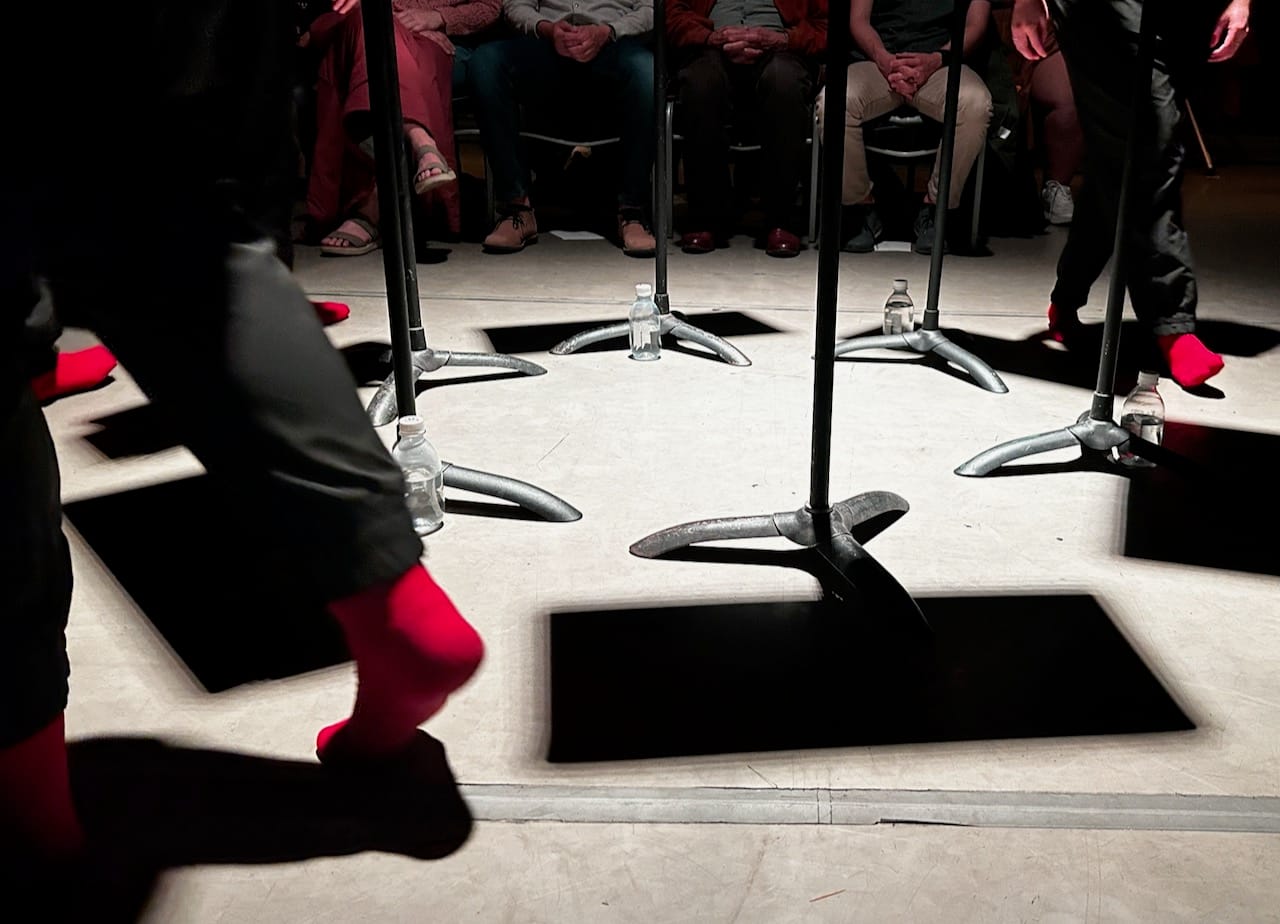
In West Oakland, inside a long industrial building, a room dims. A lone overhead light activates above center stage, where a ring of six black music stands, cold and rigid, await their sheet music. I open my notebook and immediately start writing — I know a pyre when I see one. My ears prickle, bracing for the striking of a match.
On May 2, 2026, I visited the Paul Dresher Ensemble Studio to see Merlin Coleman, a musician and sound artist whom I’ve admired for years.
Around 40 of us gathered that night to hear Coleman’s latest work, “DISPATCHES from the CHARCOAL FOREST,” a 40-minute quadraphonic “song cycle for 6 voices and soundscape.” Interweaving found sounds, interviews, live singing, 911 dispatches, and syntactic experimentation, DISPATCHES centers on the 2017 Tubbs Fire that tore through Napa and Sonoma, and which was, at the time, the most destructive fire in California history. Kelly Atkins, musical director of the Kitka Women’s Vocal Ensemble, helped guide the piece.
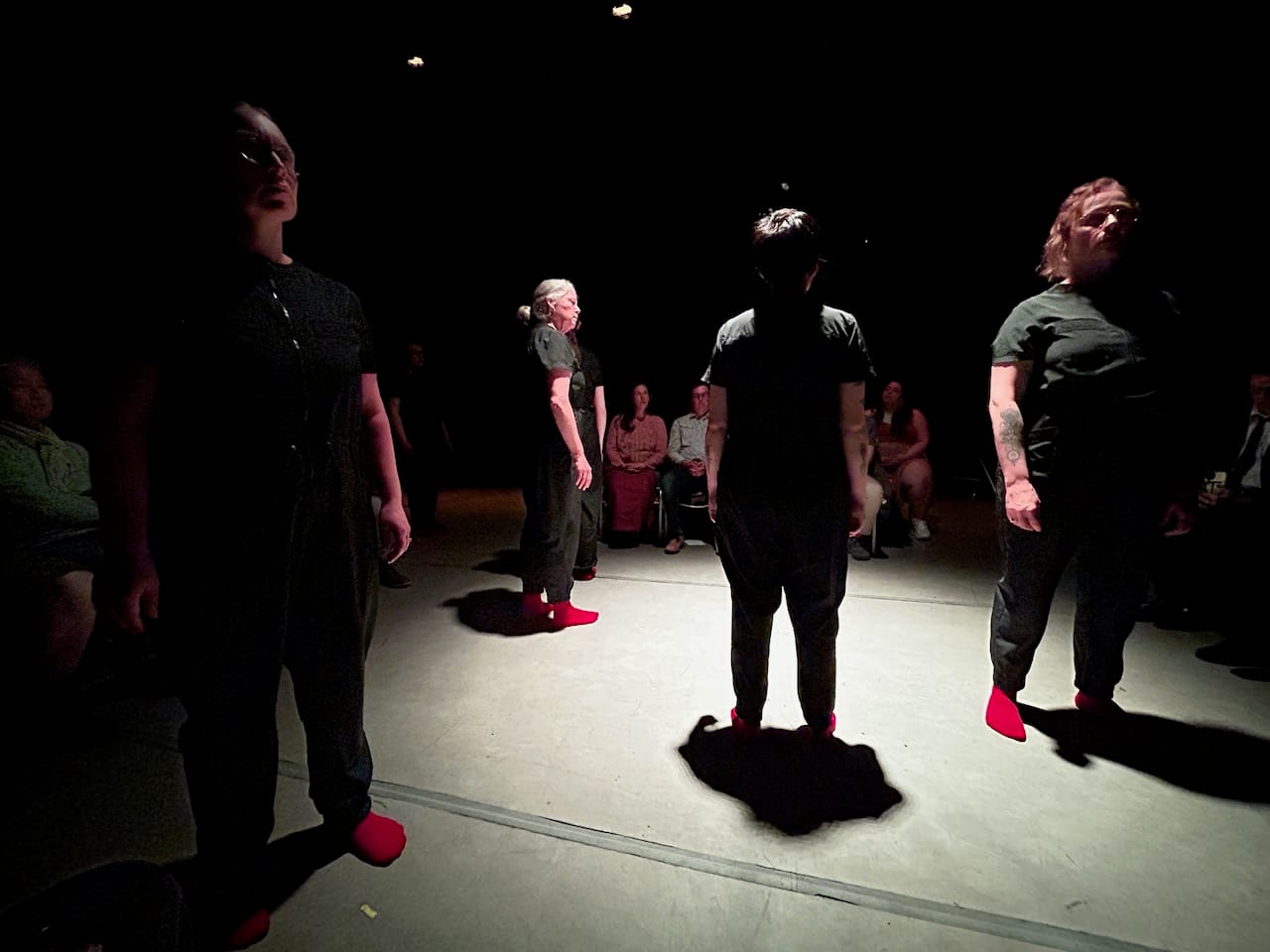
At the performance, we are seated eye-level in rows forming a square around the music stands. Gaps have been left in each corner, through which the six singers enter, dressed in black jumpsuits and bright red socks. Embers? I think, staring at their feet. Then the speakers start playing.
The first sound we hear is crackling, followed shortly by the singers voicing the word “fire.” A gentle if ominous lament. But then a carefully layered, intensifying cacophony of desperation unfolds.
The singers’ physical movements are precise and well-choreographed. They dart between and around the audience, at times echoing the recordings of the emergency dispatchers now filling the room. “Anybody? Anybody?” plead the singers. “All hands on deck! All hands on deck!” The phrases repeat toward a crescendo that stops abruptly. My vision blurs damply. Later, Coleman will tell us this piece was two years in the making, but it will only take a few minutes for me to begin swallowing repeatedly, silently, my breath struck in my throat.
It’s a funny thing to feel yourself starting to break down in public in response to art — to know there are 36 minutes ahead of you and none of them is safe from feeling. I say this as a compliment. It is a privilege, as a critic, to be in the presence of something so undeniably alive.
As an arts writer, I am at times too focused on how we got here and the threads of lineage at work. I could easily spend the remainder of this review writing about timbre and cadence, or about avant-garde composer Iannis Xenakis’ “Concret PH,” a wondrous musique concrète work from 1958, and how the sounds of its pitch-shifted charcoal have lived deep in me since my 20s. I could go on about consonance and the parts of this production that felt in conversation with Steve Reich’s “Come Out” in their glorious, ascendent repetition, or about the Charles Spearin track “Mrs. Morris,” wherein a tenor saxophone duets the melody of a Caribbean woman’s spoken words, and which I listened to through the early years of the Great Recession when I missed my home in Miami. I could write about how I spent so much of 2025 playing Will Stratton’s Points of Origin LP, and thinking about disasters, and wildfires, and the track “I Found You,” and its unflinching descriptions of possible ends.
But I think it’s more important to tell you I’ve spent a lot of the last six years living close to the surface of tears. This is distinct from the usual subject/object pairing of tears being close to one’s surface. I’ve lived close to the surface of tears in the way one might own a lake house after decades of hard work — in my case, a lifetime of ravenous listening and paying attention to the world — and all I need to do is open a door and walk 10 feet to reach the dock, assuming the water calls to me. And it did that night.
Coleman’s “DISPATCHES” is a work that rewards vulnerability, and is itself a collage of unsparing openness. There are stories of joy and heartache and numbness among the fragments we hear. A veteran asking a worker in a cleanup crew to look for his Purple Heart amid the rubble. A man who tried to reach his parents’ home in Santa Rosa only to find both they and it succumbed to the fire.
In the days since this performance, I find myself coming back to the craft of the vocalists. It is difficult for those who aren’t amateurs to sing off-key in a group on purpose — I’ve tried for fun and failed — yet here the swiftest dissonance confronts us and vanishes again and again. “People lost everything,” some sing, later drifting. In a work that’s surprisingly sparse in instrumentation, these singers serve as a conduit for all not being said by the recorded audio on the speakers. The heat of their bodies when they pass near me, of their hope or panic, impossible to replicate as a soundwave.
The composition asks us to sit with the enormous scale of grief. Of tragedy and its aftermath, of rebirth and new growth and the seed pods dependent on the flames to open.
“People lost everything,” the singers repeat toward the end. “People lost people. Everything lost. Everything.” I am momentarily overwhelmed by how trapped I feel, by how much the audience is being asked to carry, and how little it seems in comparison to those whose stories we’ve heard for the past 40 minutes.
Even the parts of DISPATCHES that didn’t quite land for me were worth hearing because, putting aside the subjectivity of art for a moment, intention matters more to me than a flawless execution. Every skilled artist should be brave enough to take risks. Otherwise, what’s the point?
On Sunday, I sat down to write and to tell you about a show and what I heard and if I liked it, and I think by now you’ve gotten the gist — that it’s an experimental sound sculpture of sorts about fire. Even Coleman’s website describes the project as a “contemplation of fire, emergency and aftermath.”
And sure, it’s certainly that, but I’d wager it’s more, or at least my experience of it was. To me, DISPATCHES didn’t just capture a specific time, place, and tragedy, but provided a glimpse of what likely awaits us in the West this summer. I’ve seen the current data: the snowpack levels in the Sierra, the states of Lake Powell and Lake Mead, the Colorado River a riparian war zone. “Drier weather, hotter winds,” chanted the singers, and all I could do was nod.
I’m curious to hear how “DISPATCHES” lands with people who have themselves been impacted by fire and how it might land with audiences next year, on the other side of whatever comes. If it catches listeners the way it caught me.
Merlin Coleman will perform “DISPATCHES from the CHARCOAL FOREST” on May 8 and May 9 at Milkbar, 241 South 1st Street, Unit A., Richmond, CA. Tickets: $28.