Field Report: Atomic Pasts and Present
Contemplating ‘Godzilla,’ bombs, and memory on the 10-year anniversary of a particular election.


Contemplating ‘Godzilla,’ bombs, and memory on the 10-year anniversary of a particular election.

With a new solo album and a mission to transform end-of-life care for Black families, the Seshen frontwoman contemplates impermanence as the ultimate call to live.

This week we've got horse appreciation, gems, queer soup, prison letter writing, mysterious limewood, and more.

Contemplating ‘Godzilla,’ bombs, and memory on the 10-year anniversary of a particular election.

On Nov. 9, I attended a talk by the Zimbabwean American scholar Zoé Samudzi at UC Berkeley’s Jarvis Auditorium. For years, I’d followed her writing on Black resistance, and I’d come that night to hear her speak on genocide, memory, and the nuclear age as a “porous epoch.”
It was 5pm on a Monday, which meant rush hour traffic around campus, and cyclists weaving between idling buses. But time had felt off all day. Undeniably, 10 years had passed since 2016, when the country arose to the news that Donald Trump had won the U.S. presidency. The arrangement of a voting populace, and a gerrymandered one, and a disenfranchised one of millions had formed (or, in the case of that final group, was forced to remain unformed) to such an extent that the world would suffer the consequences for years to come. And suffer it has.
I remember so clearly now that morning, the quiet on the streets through my window near Ralph Avenue, and the dead thunk of my thumb opening Twitter to see the New Yorker critic Doreen St. Félix post something along the lines of “I can’t believe I’m writing this…” followed by the number to a suicide prevention hotline.
At Berkeley, the disorientation of the day’s fact left me nauseous. I could not bear to be alone. It had also been three years, roughly, since the start of the genocide in Gaza and six years since the start of the genocide in Tigray. “Ceasefires” had since been called in both, and neither had really ended, but the power of a lone word to wave away reality had caused something in me to fester. I remain doubtful something like that ever really ends for people, not really. Second-hand, I feel certain that three years of watching a livestreamed genocide be normalized by those in power is something that won’t ever truly leave me or millions of others.
This week, the friend who came with me to the lecture led us through the school’s engineering building, where we took our seats beside a dozen or so young academics. There was among them a critical cartographer and a smattering of obligatory historians. Out of the corner of my eye, a yellow legal pad emerged for notetaking.
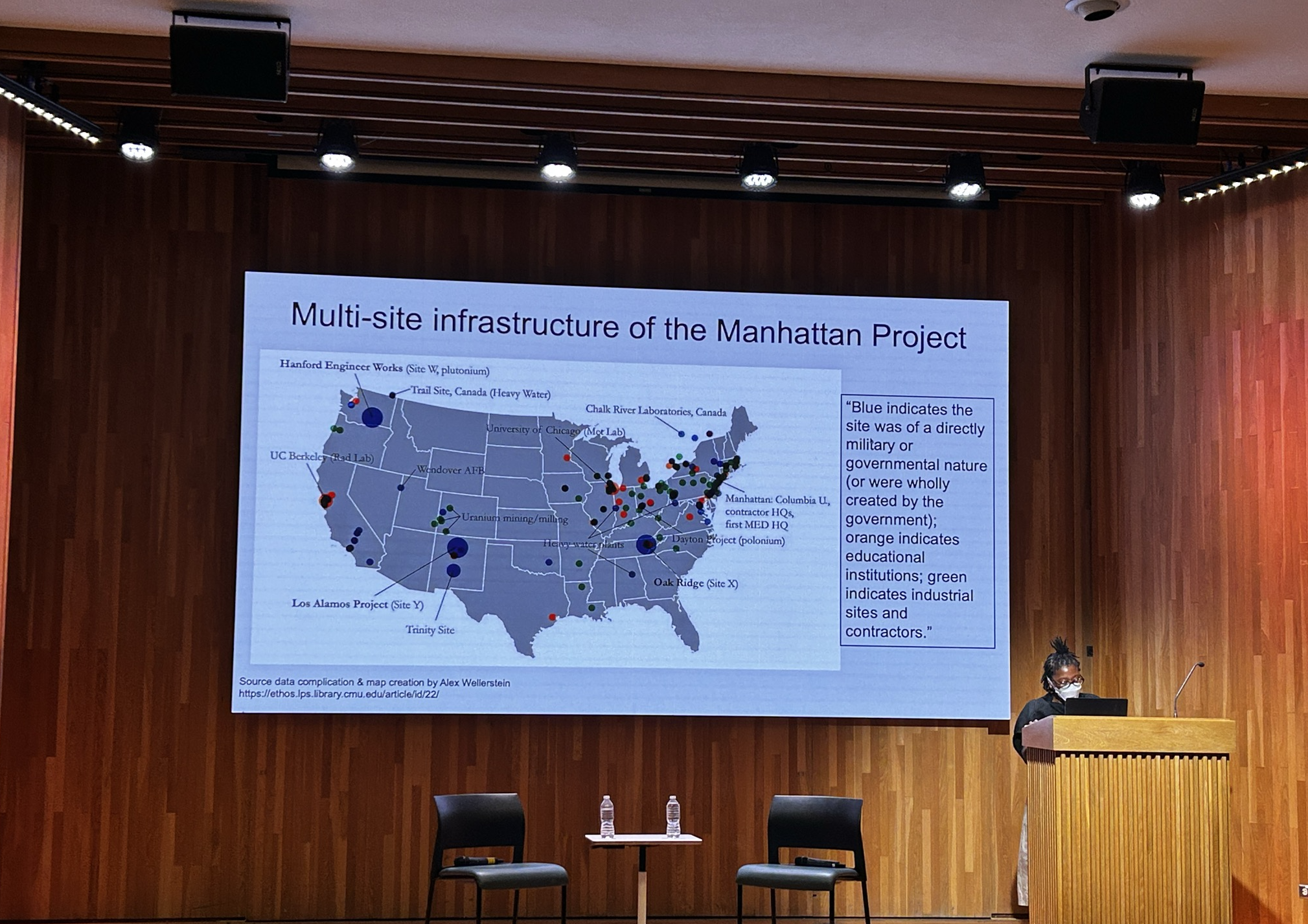
The focus of Samudzi’s talk was the atomic bomb, and the global arcs of its material realities, and the fallout from them — nuclear or otherwise. “[Samudzi’s] tracing of uranium extraction and/as warcraft conjoins King Leopold’s free state and the Katangese mines in the Belgian Congo, the Trinity test in Los Alamos and Operation Crossroads in the Marshall Islands, and the bombings of Hiroshima and Nagasaki and nuclear afterlives in Japan,” read the online event page.
It was a version of the type of sensemaking I pursued in my own work, this weaving of seams that defied neat starts and endings. When asked afterwards about her methodological approach, Samudzi said it was “like standing in the rain with a bucket and catching what made sense.” She also added, with a laugh, “historians kind of hate me.”
Surveys of colonization under racial capitalism often trace their way back to mining. The playbook is familiar: enslave, extract, deplete, repeat. In slide after slide, we saw flowcharts of how worlds were imagined in Europe, constructed with railways in Africa, and plundered beyond measure. On one slide, photographs that celebrated the colonial gaze (and the capitalist promise of export) were presented as both the mysteries their lack of provenance implied and the familiar biases their omissions affirmed. One could sense the ghosts in them.
Such hauntings, Samudzi said, were physical realities requiring indirect observation to deduce what the camera lens failed to capture. The atomic era could be seen, wholistically, as the globalization of the devastation wrought within the boundaries of the present-day Democratic Republic of the Congo.
We were asked to consider the unmapped African mine as a complement to the mushroom cloud, the former typically a footnote at most — even now, only this very sentence has reminded me that I’ve yet to name the Shinkolobwe mine, which provided the overwhelming majority of uranium used in the Manhattan Project. We were prompted to contemplate how radical geographies drove radical entanglements under “economies of nuclear proliferation.” And how place and public commemorations of tragedy, like those in Hiroshima and Nagasaki, could exist alongside the forgotten no-places and diffuse memories of a region, like the former Katanga province.
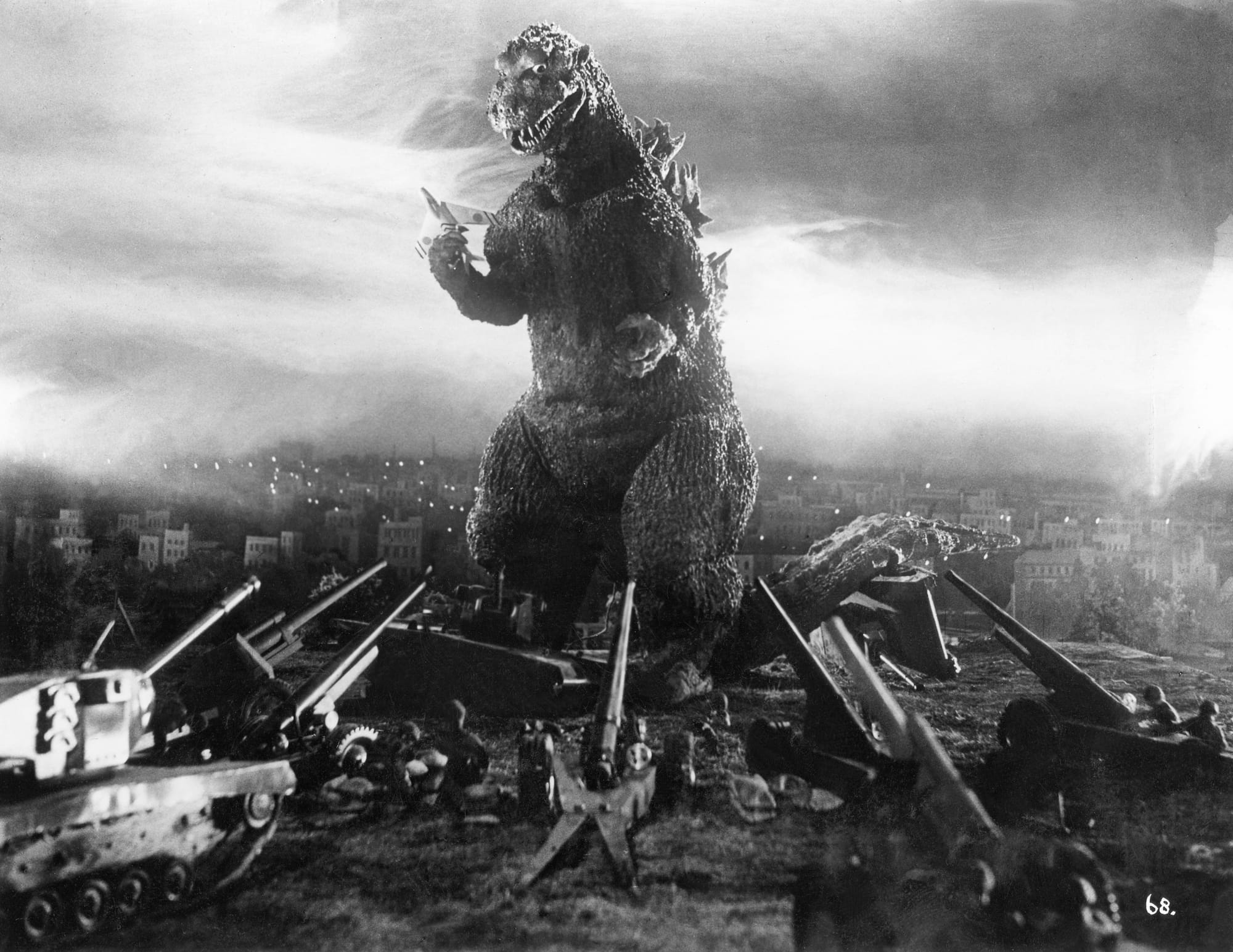
The following night, I watched Godzilla Minus Zero. The film is set in 1949, four years after the bombing of Hiroshima. In it, questions of the human body — its anxieties, mutations, and hauntings — live alongside lucrative IP monsters ripping limbs clean off of each other.
I watched the black-and-white version of the first film in the series, Godzilla Minus One, early in 2024, and thought it an incredible meditation on grief, trauma, and, crucially, consequence. And if I was underwhelmed by Minus Zero’s plotting, I believe that final component’s absence to be the cause. A poster on Bluesky had the hot take that “Godzilla Minus One is a great movie about life and grief that happens to have Godzilla” in it, while “Godzilla Minus Zero is a very good Godzilla movie that happens to have grief.” I do not disagree with this assessment.
If there’s one thing the film does right, bravely: It depicts loss as a thing that can be ever-present and ever-shifting, the gore of it laid bare in mind and matter.
I came home from the lecture and movie just as I entered them, exhausted. These 10 years felt like a ruin yet to be named. Among the final points Samudzi made during her talk was how the past mapped itself across a population, whether or not those in power recognized it at the time — how the futures that emerged from it could come to rest on cracked foundations. I am thinking more deeply these days about the source of my tomorrow and the need to choose carefully its aims. And I am starting with figuring out, for once, how to get a good night’s sleep.

