COYOTE Calendar: October 22-October 28
This week we've got a broth bar buffet, a backwards reading of the U.S. Constitution, rice porridge for dogs, and more.


This week we've got a broth bar buffet, a backwards reading of the U.S. Constitution, rice porridge for dogs, and more.

(It all depends on how you define the word "can.")

En Redwood City, un medio independiente en español informa al público con conversaciones cara a cara y un títere llamado Ramiro.

Zen Master Thích Nhất Hạnh had a “dramatic influence” on Benioff. On Tuesday, the monk's students delivered an open letter to Salesforce Plaza, petitioning the CEO to end contracts with ICE and voice support for democratic elections.


“A deep bow to you. We hope you are enjoying good health and peaceful breathing today. We wish we could speak the contents of this letter with you over tea or under a redwood tree.”
That is how a letter to Marc Benioff, CEO of Salesforce, opens. The letter, penned by followers of the prolific Buddhist monk Thích Nhất Hạnh and signed by over 630 individuals and Sanghas (Buddhist congregations), reads as both an appeal and an invitation. It is, in the style of Plum Village (the tradition of Nhất Hạnh), a “love letter.” Not a condemnation, but a call to action: that Salesforce end contracts with ICE and sign the Businesses for Democracy National Pledge in support of free and democratic elections.
Salesforce employees authored a letter earlier this year with similar demands, calling for Benioff to denounce ICE and prohibit the agency’s use of Salesforce software.
The Buddhist group’s letter was delivered digitally and handed out to Salesforce employees on Tuesday, Aug. 25, when activists and community members joined local Plum Village Sanghas in a ceremony and mindfulness walk around Salesforce Tower.
Benioff has said that Nhất Hạnh had a “dramatic influence” on him. In addition to integrating mindfulness teachings via meditation spaces in Salesforce buildings, he supported Nhất Hạnh after a 2014 stroke, hosting him and an entourage of monastics during his recovery.
When asked years ago by Nhất Hạnh whether success or happiness was more important, Benioff flippantly replied, “Both.”
Benioff’s central thesis, for many years, has been that corporate wealth and the principles of Buddhism are not mutually exclusive. His 2004 book (co-written with journalist Karen Southwick) is aptly titled Compassionate Capitalism: How Corporations Can Make Doing Good an Integral Part of Doing Well.
Yet Nhất Hạnh may have disagreed with his acquaintance’s thesis. “If you consider mindfulness as a means of having a lot of money, then you have not touched its true purpose,” he told the Guardian in a 2014 interview. It may appear to be the same practice from the outside, he continued, “but inside there's no peace, no joy, no happiness produced. It's just an imitation.”
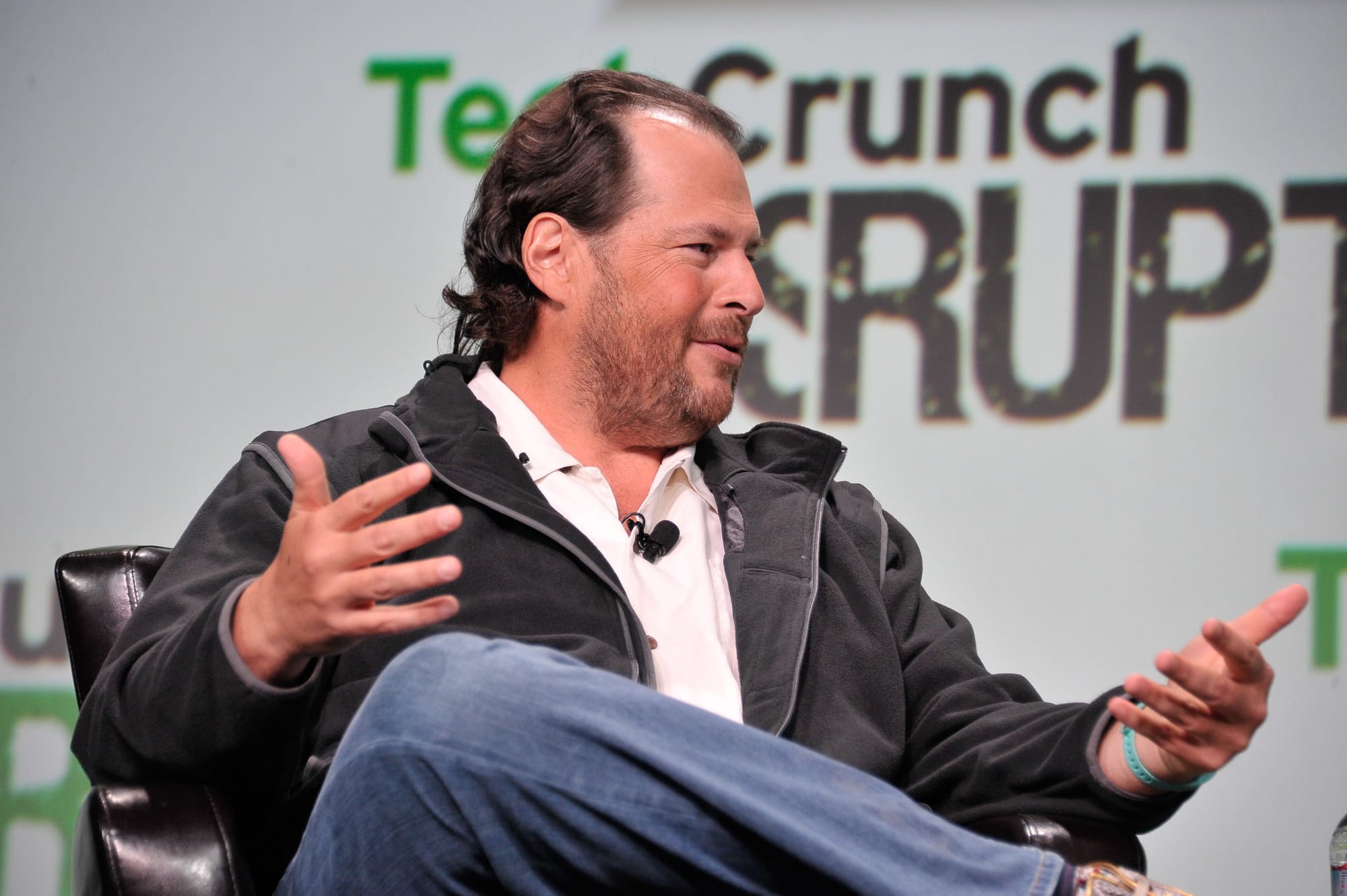
Furthering this divide is the fact that, according to Benioff, the U.S. government is Salesforce’s “largest and most important customer.”
The New York Times reported in October of 2025 that Salesforce pitched Immigration and Customs Enforcement (ICE) on using Salesforce AI to increase ICE staffing. The same month, Benioff voiced support for President Trump's calls to deploy the National Guard in San Francisco.
The Sangha's letter references The Fourteen Mindfulness Trainings of Thích Nhất Hạnh, which the authors write, “instruct us to ‘take a clear stand against oppression and injustice’ and to ‘speak out about situations of injustice, even when doing so may make difficulties for us or threaten our safety.’”
I met with activists and Sanghas on Tuesday at Snow Park in Oakland. Gathered under the shade of a tree, attendees were led in chanting “Namo’valokiteshvara” by organizers Sophie Sarkar and Guanpung Chu. The chant “invoke[s] the name of the Bodhisattva of Great Compassion,” a handout read.
“We chant Avalokiteshvara’s name three times: The first time, we return to ourselves and gently touch the suffering within. The second time, we become aware of the suffering of those around us. The third time, we open our hearts to the suffering of the world and send our loving compassion outward.”
Speaking with Chu on the demonstration’s connection to the wider Buddhist history of nonviolent resistance, they cited activism during the Diem regime in Vietnam. In the early 1960s, Buddhists faced religious persecution by the authoritarian Catholic government and were arrested and killed during peaceful demonstrations. Buddhist acts of resistance, such as the self-immolation of Thích Quảng Đức, dealt major blows to the regime until its eventual downfall at the end of 1963.
“I know that they were acting from that spirit of interbeing, knowing that whatever personal risk that they were taking on paled in comparison to the risks that their nation was experiencing through the rise of authoritarianism,” said Chu. “And so, in my greatest aspiration, we are embodying that spirit of fierce determination of saying that we won't sit idly by while the structures of democracy are eroded, while our neighbors are kidnapped and arrested.”
I boarded the bus with attendees soon after, watching as Oakland faded into the distance and the San Francisco skyline came into view.
“Well, there’s Salesforce,” said the person behind me with a sigh.

The largest looming building on the horizon, Salesforce Tower is an omnipresent force in a tech-dominated San Francisco – and there it was. Chu led participants once more in song, this time on the bus, singing Plum Village’s “I Have Arrived, I Am Home” as we passed under Salesforce Park and through the Salesforce Transit Center.
In front of Salesforce, an altar was assembled with various shades of purple fabric, paper flowers, and a framed image of Thích Nhất Hạnh. A sign reading “we inter-are” faced attendees.
Approximately 80 individuals gathered as incense was lit.
Chu, speaking to the crowd, discussed the traditions that led to their call to action and ceremony that day.
“The word interbeing is a core teaching in our tradition, reminding us that life does not exist alone…that our well-being is interconnected with the well-being of the trees here, is interconnected with the well-being of every worker inside this tower, is interconnected with the well-being of every child locked inside Dilley detention center right now, is connected to Marc Benioff. And so it's in that spirit of recognizing our togetherness that our love springs forth.”
I asked attendees their intentions for joining the demonstration. Liv, who traveled from Bay Point, shared: “I am here today to join in the collective experience of moving peacefully with an intention to open our hearts to something greater than we are…and when we are with community, using our voices, using our hearts, and coming together, to voice love, and to speak to love – I'm here for that love.”
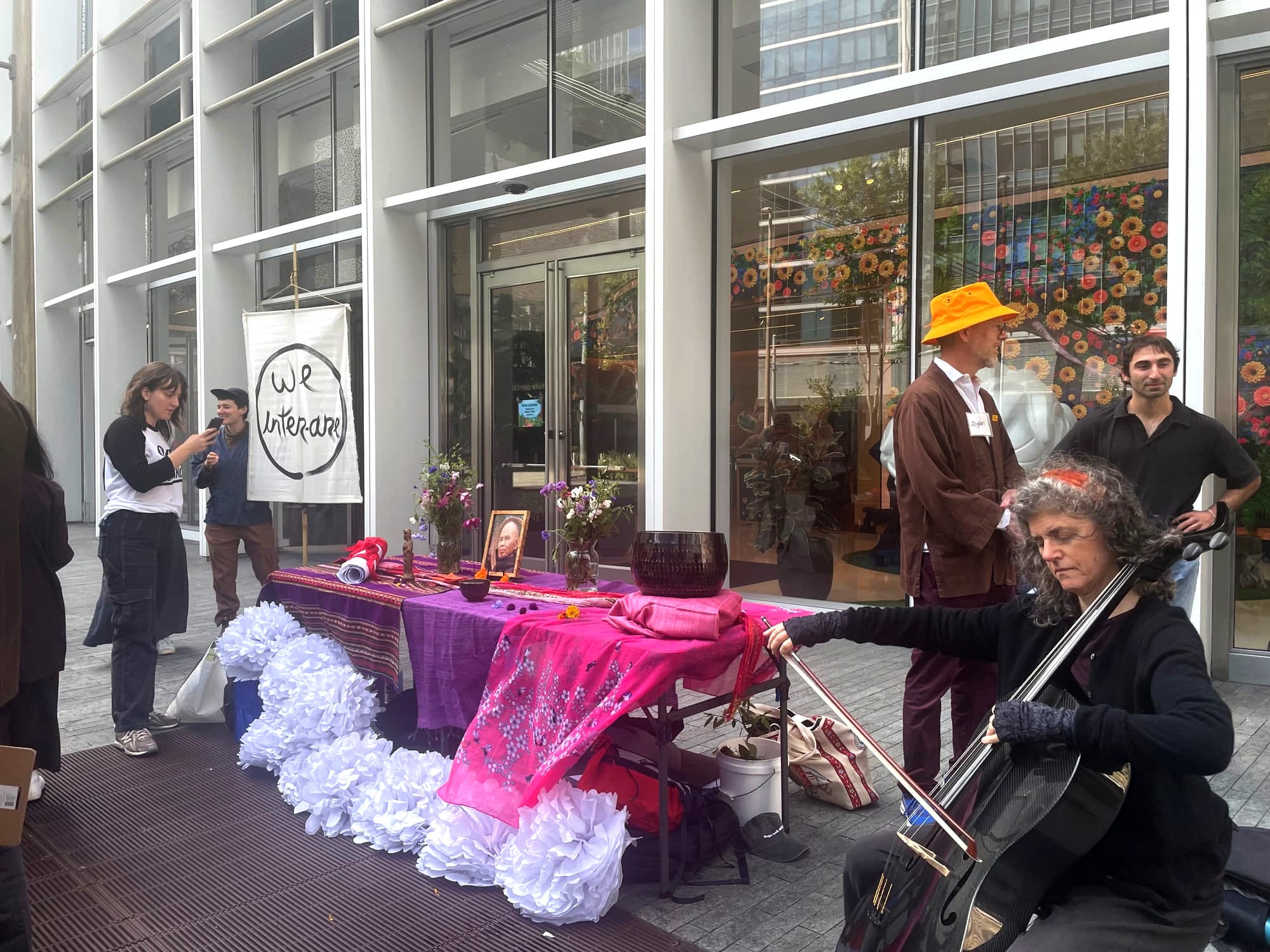
Sheena Dham, an attendee from Oakland, remarked that accountability “can take many forms, and one of those forms is a gentle reminder of why we're here.” Continuing, she stated, “It's just really great to see the many manifestations of how we can promote the liberation of all peoples to stop the oppression, you know, worldwide, and especially in this country right now.”
Once more, attendees were led in chants before the letter was recited by Plum Village students. A grounding ceremony followed, and we were then led in a walking meditation around Salesforce Tower. Salesforce employees who exited the building, wearing Patagonia vests and Goyard purses, wove through the crowd as we walked, avoiding eye contact. Finally, stopping in front of the glass front doors, the letter, wrapped in a red ribbon, was handed to an employee.
I emailed Salesforce to ask what happened to the letter after its delivery. I also asked for comment from Mr. Benioff or the company regarding the contents of the letter. They did not respond prior to publication.
“For those of us in the Plum Village tradition, [Benioff] is our brother in the practice. And we're calling on him, inviting him, to act in the service of our collective well-being,” Chu spoke earlier to the crowd.
The love letter is an invitation for collaboration. Or, if anything, opening the table for a conversation – including asking Benioff how he is navigating these decisions.
“We wanted to start that dialogue so we could understand him better, what he's holding…and have that be the basis of how we move forward together,” Chu told me after the event.
“I hope that we start with that spirit of connection and togetherness. And that from there, we collaborate on what it might be like to…invite Marc to use the influence and the power that he and Salesforce have, to defend the spirit of democracy and justice and safety for all people.”