An Oakland Photographer Surveils the Surveillance State
Cara Esten Hurtle’s drone-based art project shows the difference between being seen and being spotted.


Cara Esten Hurtle’s drone-based art project shows the difference between being seen and being spotted.

What were you listening to after the September 11 attacks?

For Soleil Ho, September 11 was their political origin story.
Cara Esten Hurtle’s drone-based art project shows the difference between being seen and being spotted.

On Sept. 12, the multi-hyphenate artist and engineer Cara Esten Hurtle shared her latest photography project to much digital fanfare. Entitled “Records of Enemy Surveillance,” the work uses drones to capture aerial views of the surveillance infrastructure that’s risen rapidly across U.S. cities over the last decade — namely, Flock cameras.
The images are arresting, at once depicting the geography of the Bay Area, the contours of the built environment, and the jarring ease with which tracking technologies have proliferated across these terrains.
The day after she shared the project, I spoke with Hurtle about her inspirations and creative process and the work’s intended impact.
(This interview has been lightly edited for length and clarity.)
Rahawa Haile: Where did “Records of Enemy Surveillance” start for you?
Cara Esten Hurtle: It kind of came out of a bunch of people I know who were part of the group arrested during the Stud Alley party. I know from reading what happened that they were trailed by drones, and that the SFPD deployed these drones using the new authority they received from a measure that passed a few years ago, allowing them to basically follow the party from one street corner to another before the organizers could even get there. They just sort of preemptively arrested all of them without even giving them a dispersal order.
I was furious about this. I was really, really angry.
RH: Understandably so.
CEH: My first thought — and this is a crime, so I didn’t do it — but my first thought was I’m just going to follow some cops around with a drone and do glitch art videos. And I quickly realized after doing the tiniest bit of Googling that I could not. So I was like, alright, well, I’m going to examine some other kind of surveillance, and the Flock thing had sort of been in the back of my mind.
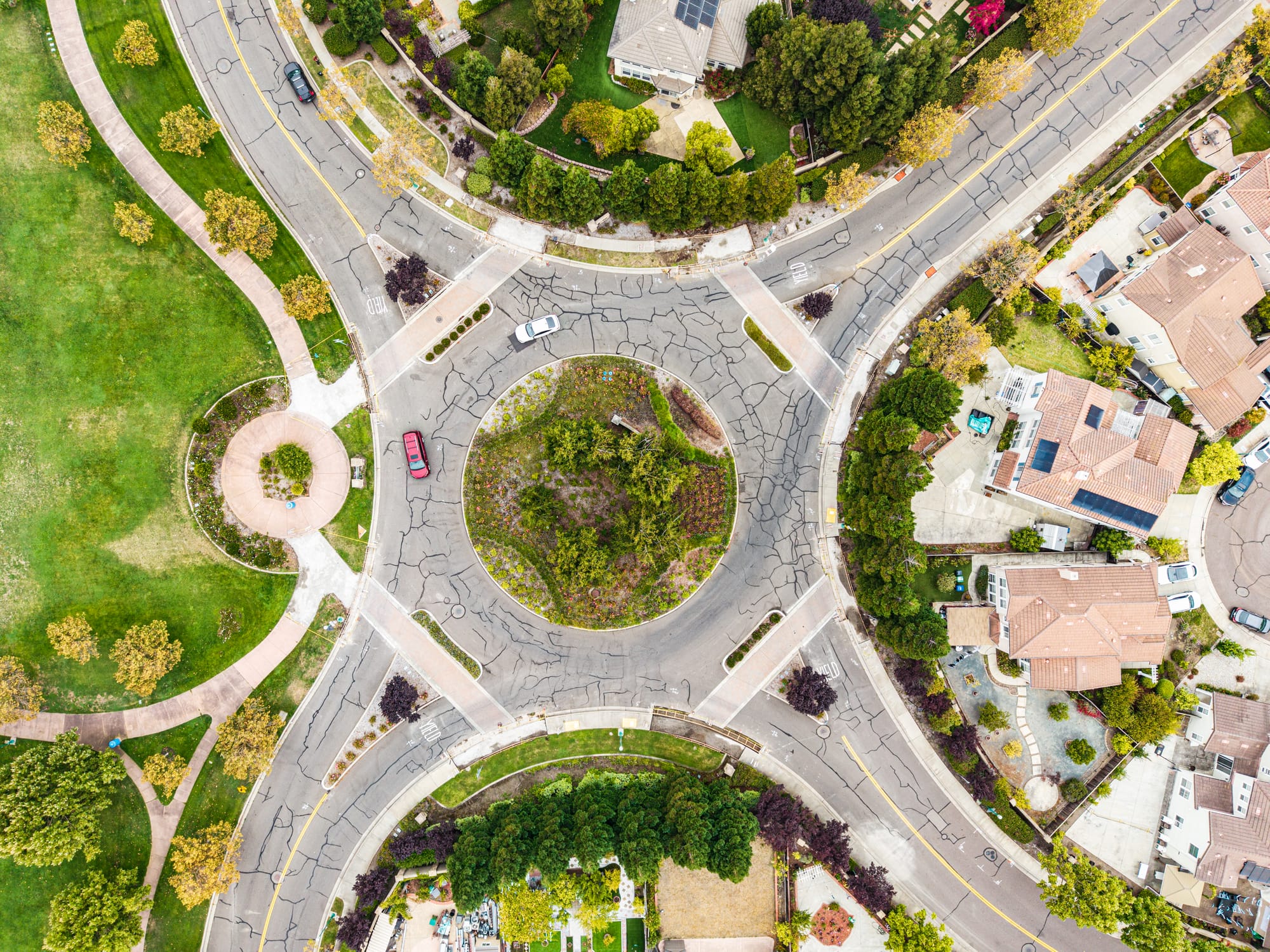
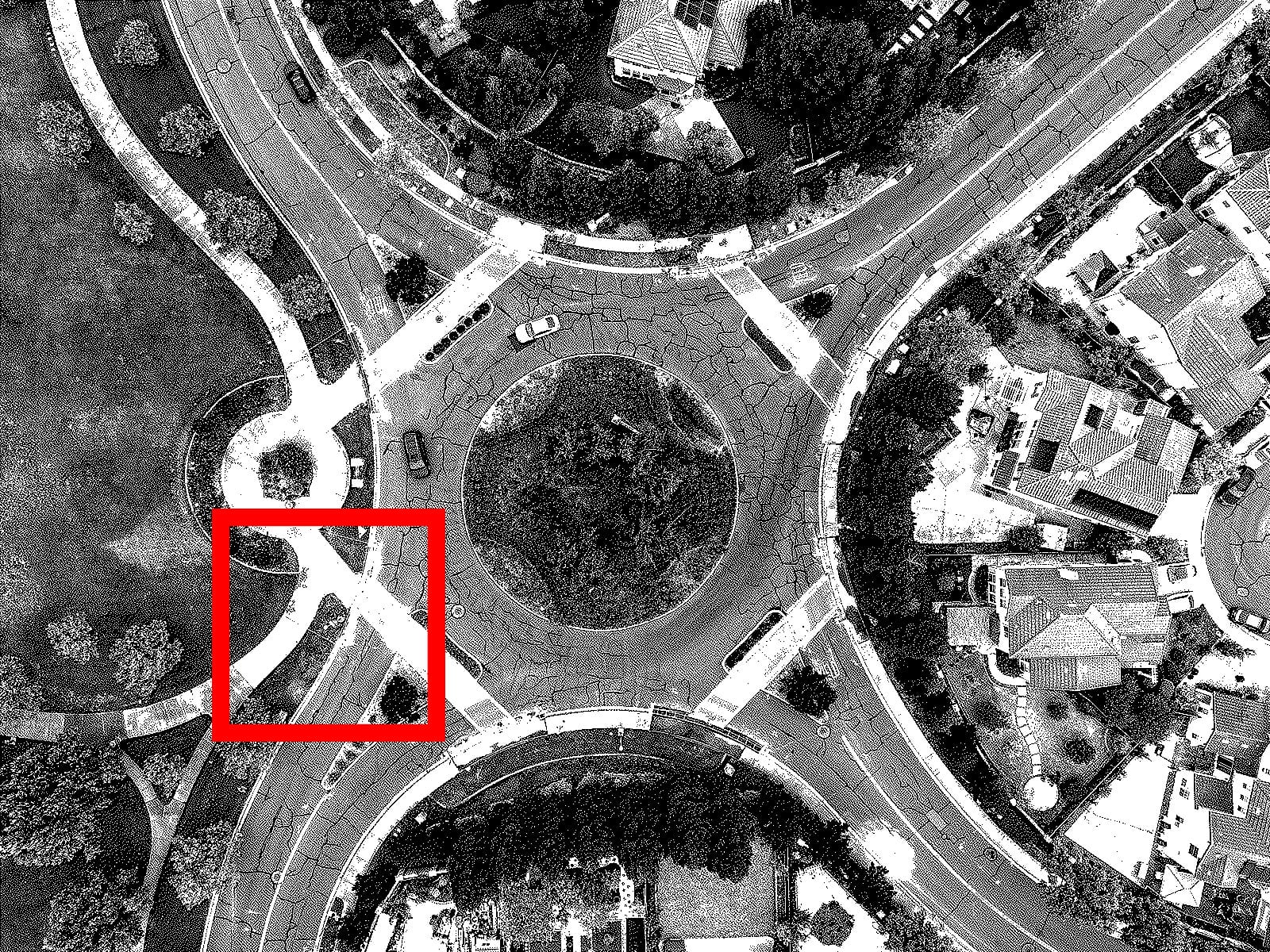
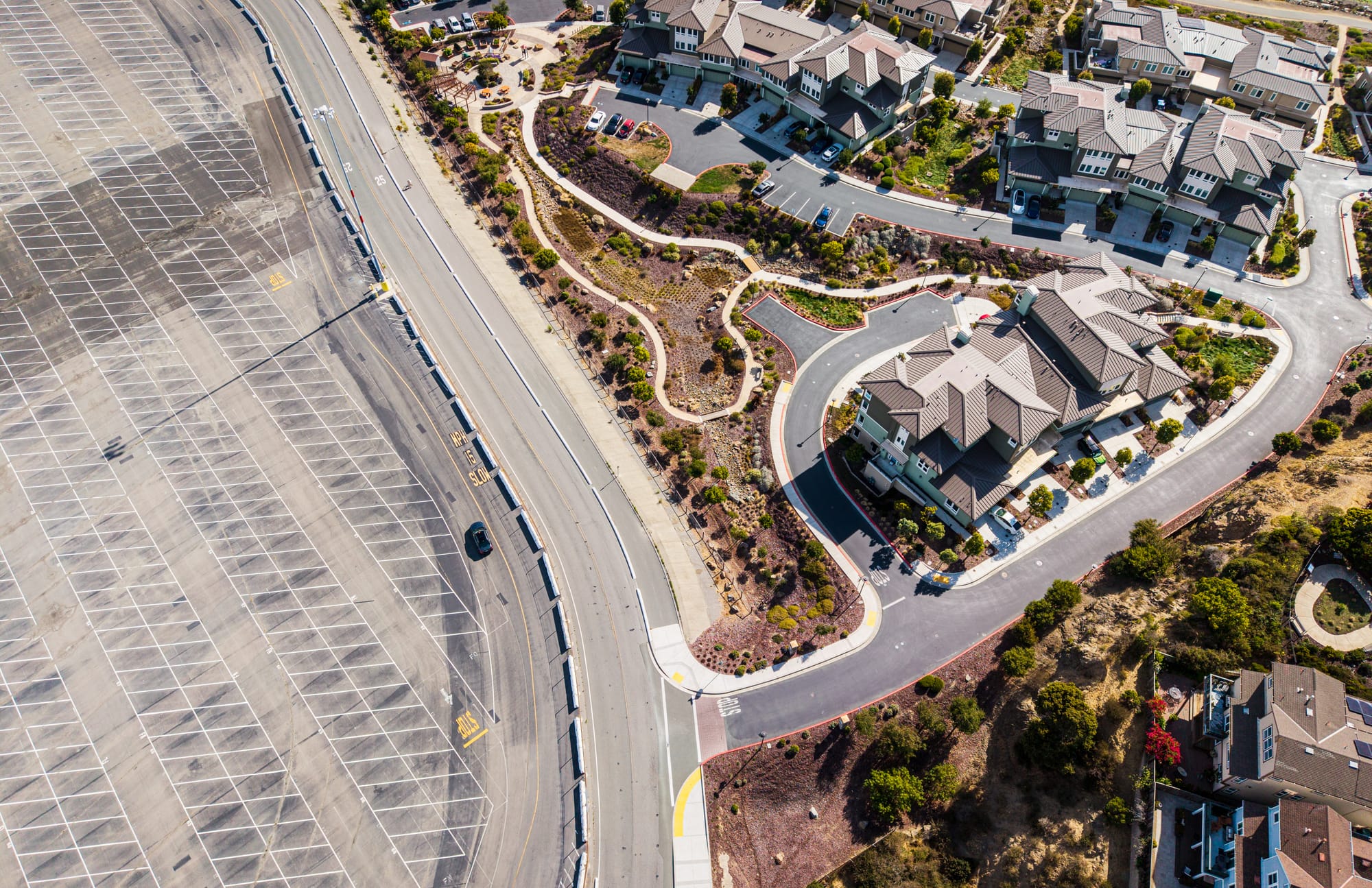
Aerial view of a roundabout with green space on one side and houses on the other in Hayward, CA. (Courtesy of Cara Esten Hurtle)
RH: What were some of the practical and legal considerations of learning to fly a drone?
CEH: I was really hyped about the project, and then I realized I would get in trouble with the FAA [Federal Aviation Administration] if I sold any images that were created with a drone without a Part 107 license. I ended up cramming like crazy. I basically set a one-week deadline to learn what I needed to pass the test, and all of my free time was spent studying. Eventually, I took the test and got a 97 and was like… OK, I may have overdone it a bit.
But I didn’t know about airspace rules! Like, I can only fly up to 200 feet over my house and only with actual authorization.You have to be very thorough about everything: For all of my flights, I had to write down flight logs and confirm that I checked the weather, that I checked my airspace clearances and did a once-over of my drone to make sure it wasn’t going to fall out of the sky suddenly. You have to take minute records of all of it!
I wanted to get some photos of the Flock cameras that were on the other side of Redwood Shores toward the business airport, but there was literally no way to do it legally because that’s part of the SFO approach.
RH: It’s fitting that a project about the borders created by these Flock cameras, in part, is itself contingent on existing within related borders.
CEH: The stuff that isn’t in the project is not in the project due to legal restrictions. There are definitely places, like in SF, where I wanted to take some photos but the city had quite restrictive rules. Most of the city is in SFO’s airspace, and if not in SFO’s airspace, then there are a million temporary flight restrictions on things downtown. Plus there’s the fog. You have to be 500 feet away from a cloud vertically, so if your ceiling is 800 feet, you can only fly 300 feet in the air, which makes things difficult.
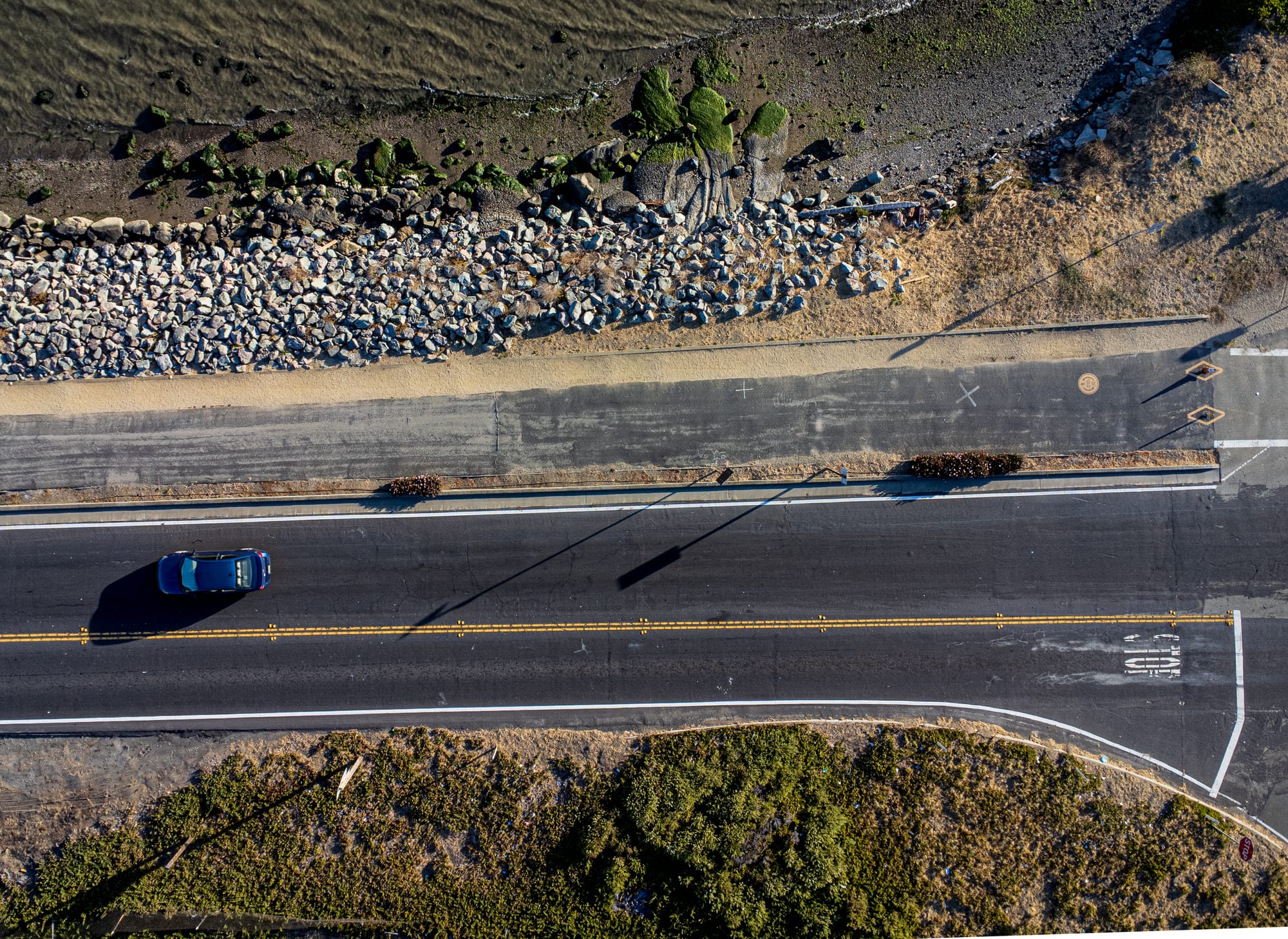
RH: To what extent did you consider photographic aesthetics such as lighting composition while selecting and developing these images?
CEH: One of the things that frustrates me about drone photography, in general, is a composition and photographic style that basically says, look, I have a drone. And that’s just so fundamentally uninteresting. I’ve been doing photography for a really long time, and I wanted to use strong compositional elements to pull people into the frame. You might notice that in a lot of the photos I’ve used some diagonal leading lines. It’s been fun working with the built environment of a city in a way I don’t usually get to as a photographer. And also trying to make aspects of the geography of a place fit into a frame.
RH: Did you always know there’d be a cyanotype component?
CEH: I’ve been dancing around doing cyanotypes for years. I’m a member of Real Time & Space, which is an art collective in Oakland, and one of my studio-mates was showing off a cyanotype that she’d made, so I started talking to her a little bit about it. Then later I went to a photo saloon, which is like a group of women and nonbinary photographers that do critique sessions monthly, and a lot of people brought cyanotypes, and I thought this is so cool.
The other creative aspect is that I wanted these cyanotypes to kind of look like blueprints. The thing that made me really excited when I saw it come out was one of the photos in North Oakland, where there’s that six-way intersection, and the contrast is really stark. I deliberately underexposed the cyanotype a little bit, because the whole thing, when you look at it, seems almost like an architectural planning diagram.
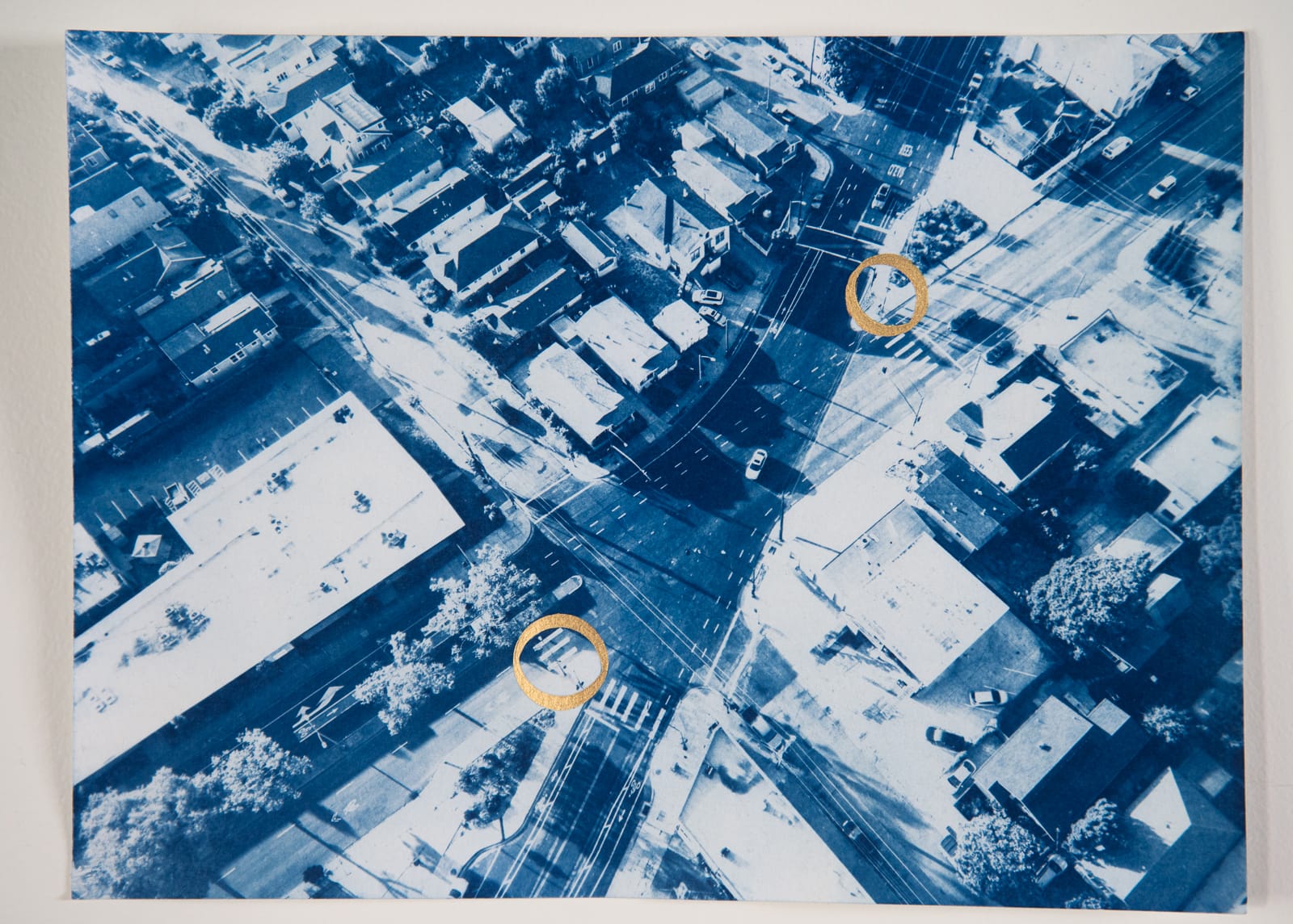
RH: It’s fascinating to hear you describe them as blueprints, because what stood out to me about the cyanotypes is that you’re translating these digital images back into real-world artifacts.
CEH: Yeah, I knew I wanted to do something that was very physical, because I get bored looking at images on a screen. I wanted to make it look very tactile and real. With the wooden ones, I couldn’t just do an emulsion transfer; it wouldn’t look right because it needed to be more precise. So I ended up thinking, well, I’ve got to cyanotype it, and I laser-cut those pieces of wood.
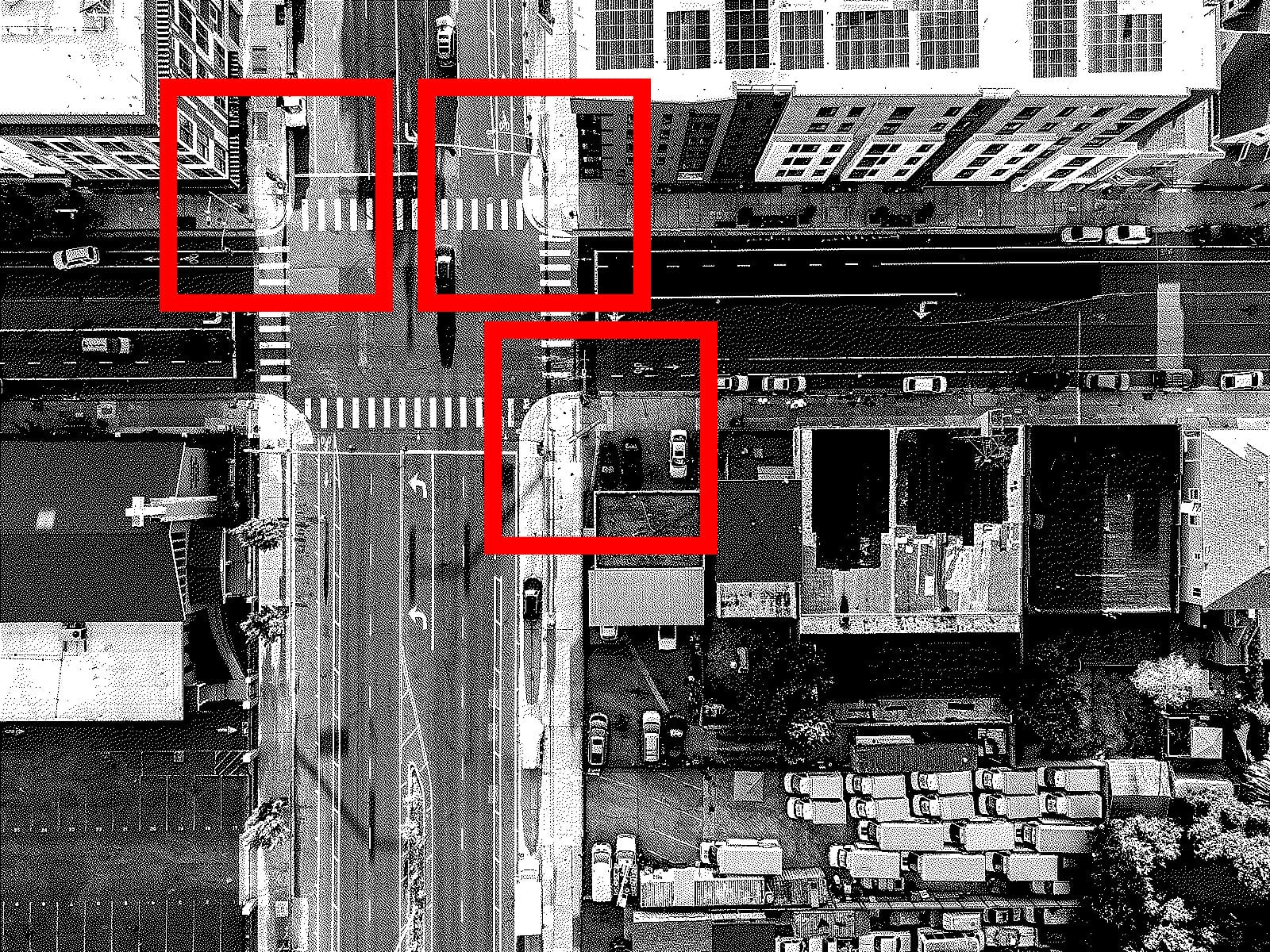
RH: When I hover over the images of your project, they go from full color to black and white, with the Flock cameras enclosed within red squares. What did you want people to feel with this contrast? Or were you treating the Flock cameras like they treat us?
CEH: It’s not actually just black and white — it’s 1-bit dithered; everything you’re seeing is sort of a binary pixel arrangement. You kind of hit the nail on the head in terms of “like they treat us.” That’s what I was going for. Like, it’s 1-bit, right? It’s stripped down to the binary of either there’s something there or there isn’t, which is kind of how detection works.
RH: Why do you think “Records of Enemy Surveillance” has struck a chord with so many people? It’s generating conversation in a way that simply pointing out that Flock exists largely hasn’t.
CEH: I’m a little bit surprised by the response, because I’ve done a lot of photo projects in the past, and most of the art that has resonated with people was a lot more conceptual. For example, New Session stuff like the Telnet magazine. This is the first time I’ve had a serious, long-term photo project resonate with people to this extent.
RH: Many seem genuinely moved not only by the purpose of your project, but the visual portrayals of our worlds and the possibility of new ones.
CEH: Organizations like DeFlock have done such a great job of [mapping] where these cameras are in people’s communities. You can walk around your neighborhood and see them, but I think there is a kind of weirdness to realizing “Oh, no. They are embedded into life, and life means something different as a result.” It’s a deeper look.
RH: I saw someone on Bluesky joke that the answer to “Who watches the Watchmen?” is you. I’m curious what it felt like to not just see what Flock sees, but to see Flock seeing, and in certain instances, to see yourself seeing Flock seeing you.
CEH: (Laughs.) My biggest worry was that I didn’t want anybody to view me the same way that they saw Flock. I didn’t want anybody to think this person is surveilling me … because Flock doesn’t feel shame about surveillance, but I do. Like, oh, I’m watching people, and it’s for a particular purpose, but I don’t feel great about it. As a human, I feel that doing this is only necessary to prove a particular artistic point, and I would not want to surveil people or locations unless that point was being made.
Like, these things should be shameful! If there were people just sitting there watching everyone coming in and out, they would hopefully feel shame for having done that. But because Flock cameras are this vast network of machines that get set up, there isn’t that sort of entry point of shame.
RH: I think a lot of our current era is about normalizing this kind of shamelessness, about acting with impunity.
CEH: I feel like that’s kind of the ethos of a lot of drone photographers too. You just see all of these people who are like, “I’m going to fly my drone around, and I know that it makes you uncomfortable, and I just don’t care.” And it’s like, oh, buddy, that’s not good.
RH: One reason I believe many people connected so deeply with the work is that it urges us to think through all our relations — to our oppressors, to our comrades, and to each other as individuals. It feels like a daring recalibration of potential. Where would you like to see us go from here?
CEH: I want people to think about the effects allowing this technology into the wider world with very few safety checks has had. There are thousands of these cameras everywhere, and they exist in a million different places outside of the Bay Area. It feels very frustrating to me that people will say whatever, we need to curtail the abuses but the thing itself is fine, while not actually understanding or taking a bigger look back at who’s being surveilled, what it looks like to be surveilled, what the goals of that surveillance might be.
Many people don’t want to interrogate their desire for surveillance. They just want to check a box: This makes me feel safe, or this doesn’t make me feel safe. Because you go to something in Piedmont and say, “Dude, you have a border set up around your little exclave city that is surveilling everyone who goes in and out. What in your heart of heart makes you think this is OK? What is your goal with that?” And if they interrogate it, it makes them feel horrible. But they don’t want to do that.
RH: Not to put a fine and very Black point on it, but this country has literally hundreds of years of monetizing perceived fugitivity under its belt.
CEH: Yes, exactly! When it comes to the drones in SF, they have set up a situation in which this tech can be used to attack marginalized people.
RH: It’s difficult not to conclude dehumanization is the goal. I don’t think we get here without that reduction of person to pixel.
CEH: I do think that’s the process taking place. When you make it explicit and see the coldness of it all, it’s scary. I hope if someone sees this project, and sees their house in the photo, they’re sort of like “I should write a pretty angry letter to whoever is in charge of the Flock contract.” Fingers crossed, anyway.