What's the Weirdest Thing You've Found at Oakland's White Elephant Sale?
Our intrepid correspondent found a haunted clown, a 125-year-old crib, and Boots Riley in the kitchenwares section.


Our intrepid correspondent found a haunted clown, a 125-year-old crib, and Boots Riley in the kitchenwares section.

The versatile battle rapper isn’t running for office, but with his new collaborative mixtape ‘Four Square,’ he’s earned my vote.

An acclaimed Jalisco-style restaurant opens a brick-and-mortar in Oakland.

“Everything that we think is disgusting about human life, pigeons wear without shame.”


Something about this long winter has brought Columbidae to the fore of public discourse, be it a recent Guardian article entitled, “The hill I will die on: Pigeons are working-class heroes and deserve some respect” or raving ex-NYC mayoral candidates who see nothing wrong, somehow, with the sentence, “All pigeons lives matter!”
I have loved pigeons all my life, and even more so after moving to New York City during the Great Recession, when Andrew D. Blechman’s Pigeons: The Fascinating Saga of the World's Most Revered and Reviled Bird and Stephen Green-Armytage’s Extraordinary Pigeons found me at just the right time (which is to say broke and in my 20s and staring up at the sky a great deal).
So when I came across Maggie Tokuda-Hall’s Bluesky posts about her pigeon painting practice last month, I knew I had to talk to her. Tokuda-Hall is an author, the president of Authors Against Book Bans, and most importantly, a recent pigeon convert.
This interview has been lightly edited and condensed.
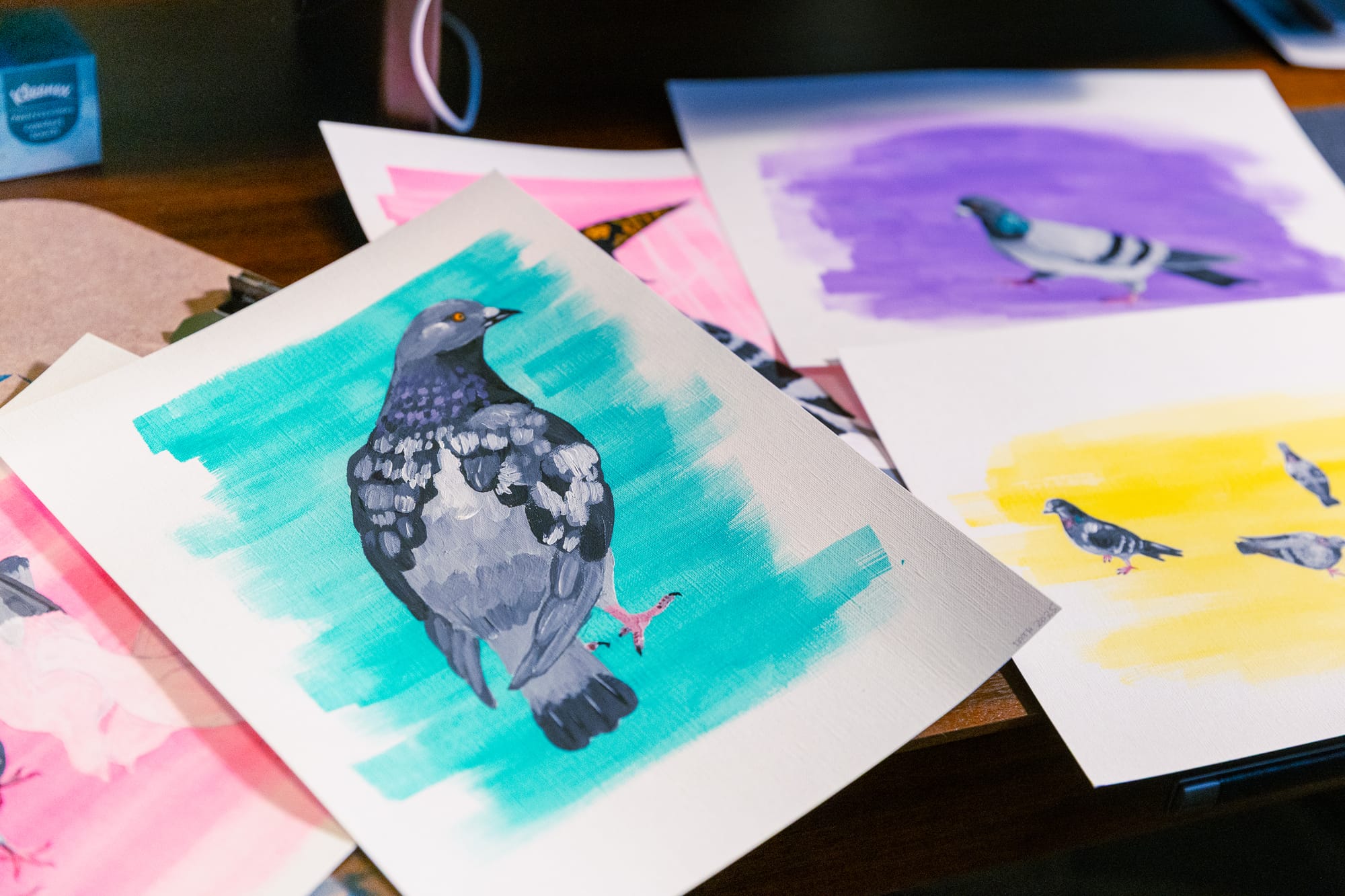
Rahawa Haile: Hi Maggie.
Maggie Tokuda-Hall: Thank you for coming over to my house and talking to me about my hyperfixation.
RH: Well, it's a shared hyperfixation. Have you always drawn?
MTH: In college I studied studio art, but even toward the end of undergrad, I was kind of moving away from visual arts and into writing.
RH: Where did your artistic interests lie back then?
MTH: God… I painted, and I painted with acrylic. Oh! I guess this is relevant: For a while, I was only painting elephants.
RH: Excuse me?
MTH: I hadn't thought about that until this exact moment, but my actual thesis was in the interplay between text and image, because by that point I was more interested in narrative. And it was deeply pretentious. And when I look at it, it makes me cringe.
RH: The elephants?
MTH: No, the elephants are cute. I gave almost all of them away. So every once in a while, a friend from college will send me a random picture of a canvas I completely forgot I did, and that's kind of neat.
The thing that I liked about visual art was the opportunity to engage with narrative. And then when I was actually writing, that was when I was most fulfilled and excited and doing what I did best.
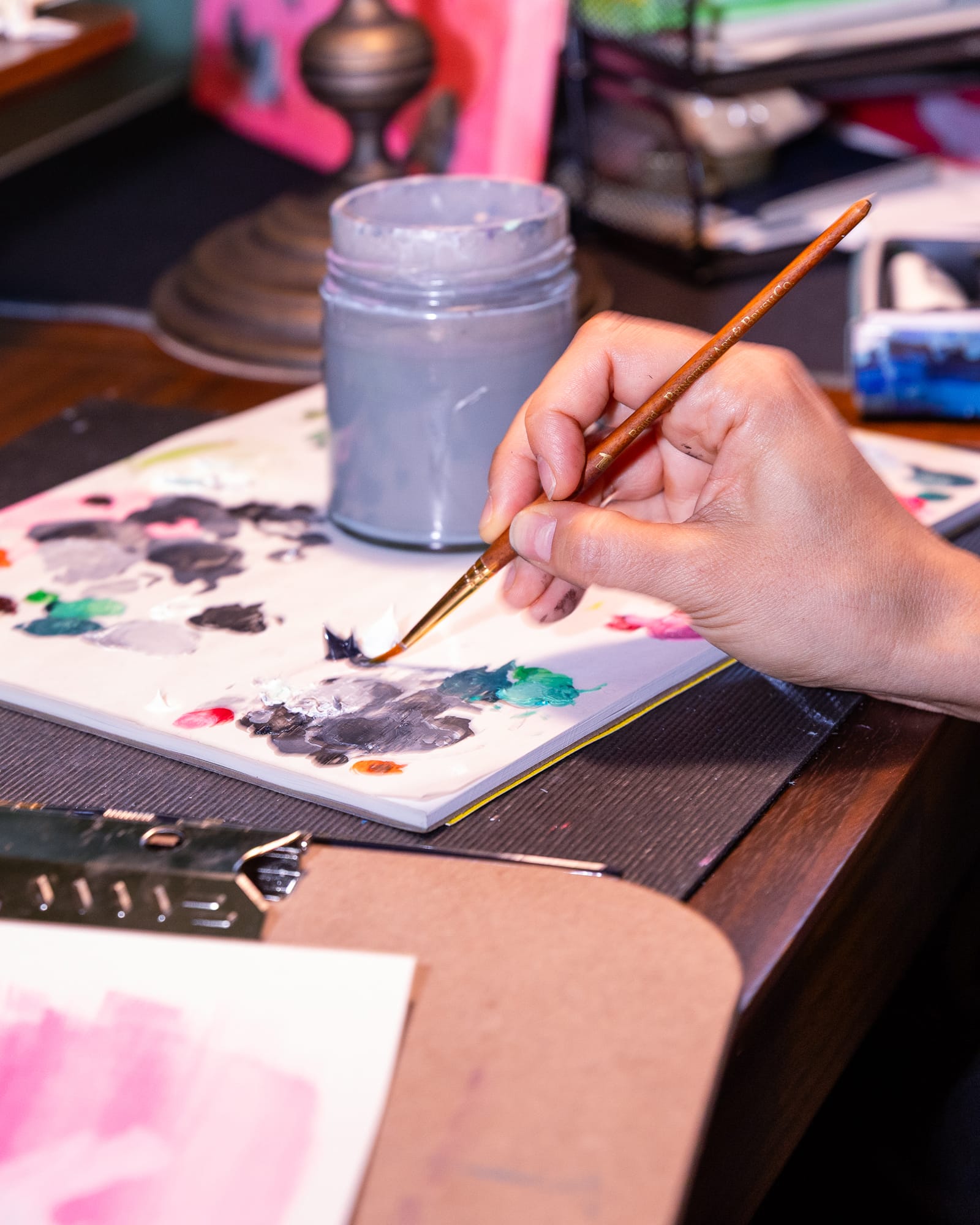
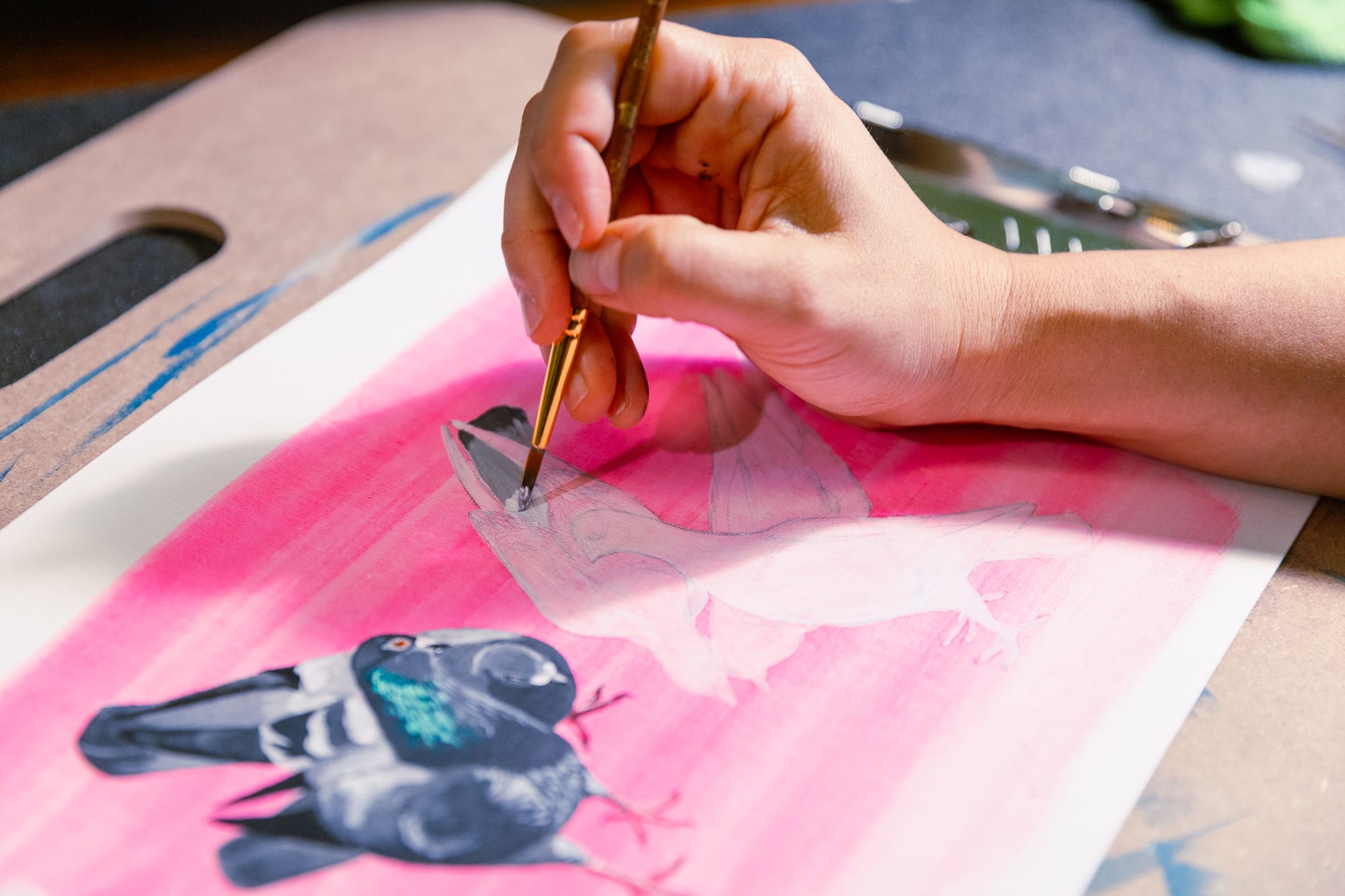
RH: You posted on Bluesky about picking up your brush again after so many years.
MTH: When I started painting again… I was just trying to manage my mental health and have hobbies.
RH: I get it. <lowers voice> I play guitar at home.
MTH: Exactly. It's just like you look at the horrors and you're like, “Well, I need something else to hyperfixate on, because if I do this only, it's going to be bad." And I have children, and I want to model art just being a part of life and not being your job, necessarily: just a thing you like to do. So, I don't know. I was happy to get back into it in that way.
RH: Had you drawn birds before starting this pigeon project?
MTH: No, and I stridently really disliked birds for the most part.
RH: Until?
MTH: I think like most middle-aged people, there's like a light switch that turns and you go from being indifferent to birds and then you're like, oh, now I notice every bird that's around and I have bird questions.
RH: Have you gotten into birding in general?
MTH: Not in a significant way. Not in, like, an Ed Yong way, but like, when I walk around, I'm always looking for different birds and telling my kids about the birds that I've seen. And so it's like, I appreciate the discipline of birding, but I don't have the interest in waking up early in the morning about it.
RH: How did you choose pigeons?
MTH: I love pigeons.
RH: <optimistically> And always have?
MTH: No. I came about it philosophically.
I don't want pigeons to touch me or be near me. I think they deserve their personal space and so do I. I don't like it when they flap close to me because I'm afraid of birds. But I think that they are the birds that we deserve. I think they reflect back at humans — sorry, I'm going to sound a little crazy.
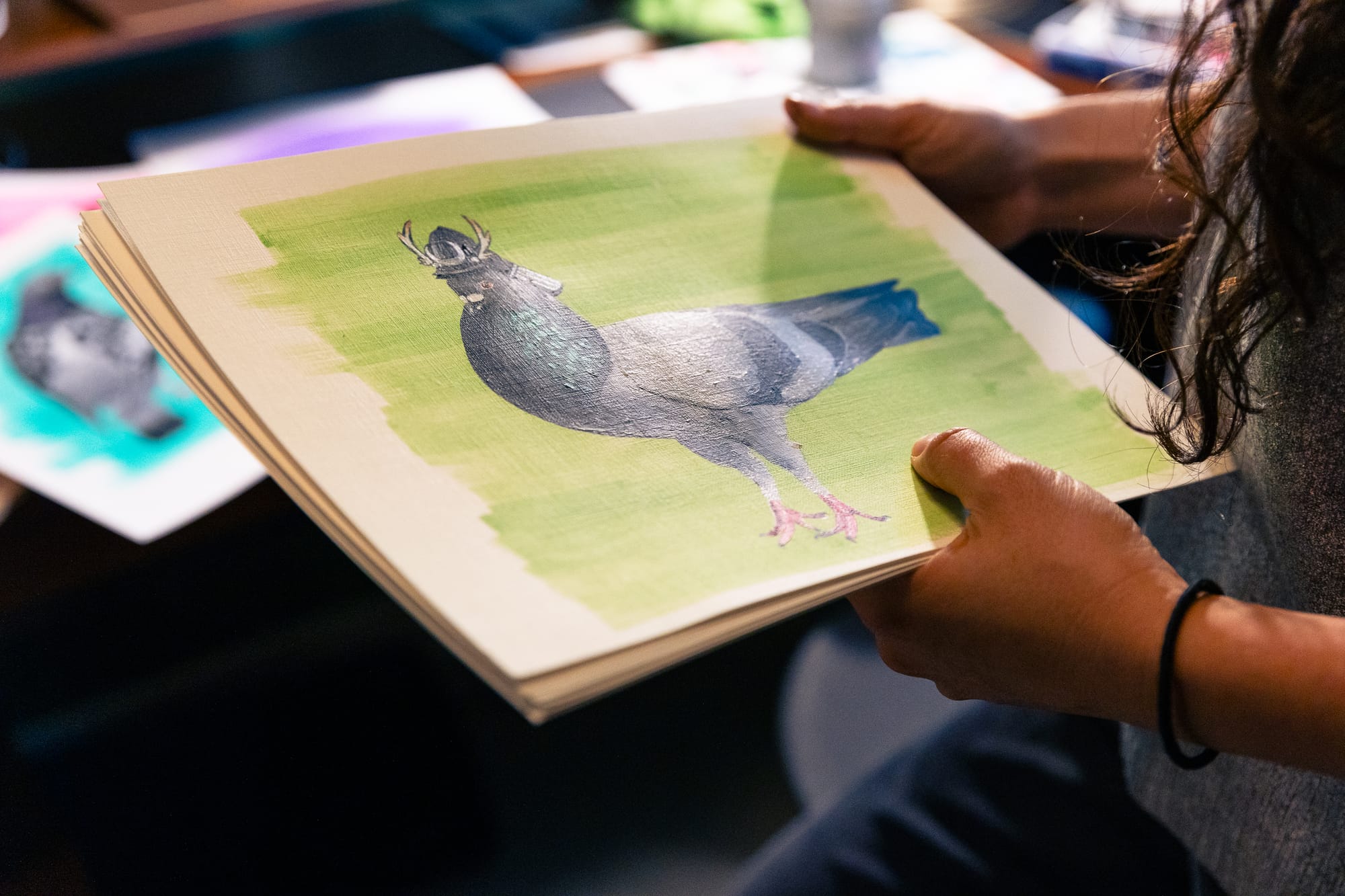
RH: Please keep going.
MTH: I've written about it before, but like, they’re populous everywhere we’re populous. They were our pets. And then we just let them go, and they have thrived without our care next to us in our filth. And I think what we don't like about them is everything we don't like about ourselves: Everything that we think is disgusting about human life, they wear without shame. And we're like, ugh, rats with wings. But they're actually sweet animals that tend to their babies until they're nearly full grown. And they make really lazy nests, and I think that they have the right idea with parenting, which is just like, you take care of them until they're really ready and you don't worry about how it looks while it's happening.
Although, one time I tried to scare a pigeon on Haight Street in like a moment of frivolity, and it flapped back at me in a way that I realized I was going to lose that fight and I've never been more humbled than that.
RH: No, I do love this. And I agree that they are a reflection of us, and it's why I've always been so enchanted by them.
MTH: Also, they're doves. And the fact that we're like, oh, these ones are disgusting and these ones are beautiful is hilarious and stupid to me. They're the same bird.
RH: And so, like, you went through this period of time where you weren't painting? Is that right?
MTH: Yeah, like 20 years? Yes.
RH: May I ask why?
MTH: I mean, when you're mid at something it's hard to find the motivation, I think? Especially because I'd studied it and realized I wasn't that good at it.
My stepsister is a wildly talented painter, and I would look at what she did, and I would be like, well, that is art. And I would look at what I did, and I would think, that… is your best effort.
RH: Right, and so to pick this back up again later… like, you hear this from former athletes about how hard it is to, if you used to run in high school or college or whatever, to then in your mid-30s try to run again. And trying to find any joy whatsoever when you know—
MTH: You used to be good.
RH: You used to be! And it's not even that you were great in the past, necessarily, but you were pretty good in the past.
MTH: It's exactly like that. I also played softball into college and like, that was like my whole… well, I played year-round.
RH: What position?
MTH: Pitcher, center field, and second base.
RH: Okay then!
MTH: No, I was serious. I did the whole thing. Then I got the yips in college and I quit.
Before I knew what the yips were, I was just like, oh my God, I can't throw anymore. This is so weird. I'm surely the only person this has ever happened to before in the history of time.
RH: And so why now? Why start painting again?
MTH: It's kind of a grim answer, but honestly, the state of the world is so bad that I needed a hobby to put my energy into, because looking in the face of what is going on is so crushing.
I'm the president of Authors Against Book Bans. We basically train authors to become activists in the freedom to read space all over the country. And it means that I'm really intimately aware of things that are going on in other states, like Florida and Texas and Idaho and North Carolina and Utah and South Carolina and Iowa that are just horrifying. And when Trump won the election last time, I was like, OK, I have my single-issue focus and I'll just really throw down on that, because during his first administration I just tried to throw myself at every moving car, you know? Of the nightmare fuel he was giving us. And I was like, why am I exhausted and depressed and feel like I'm accomplishing nothing? And I thought, oh yeah, because you can't fix everything and that's insane.
RH: And you get a pandemic as a reward.
MTH: Yeah, and here's the pandemic! So this time I knew I needed a game plan. So [Authors Against Book Bans] was my game plan, but it does mean that I'm constantly talking to people who are losing fights all the time. It's deeply depressing work. Because everywhere that's happening, you know there are queer kids, and kids of color, who feel so alone and so scared and so sad because they know their communities hate them. I needed something to do [while fighting] that could make me go full smooth brain.
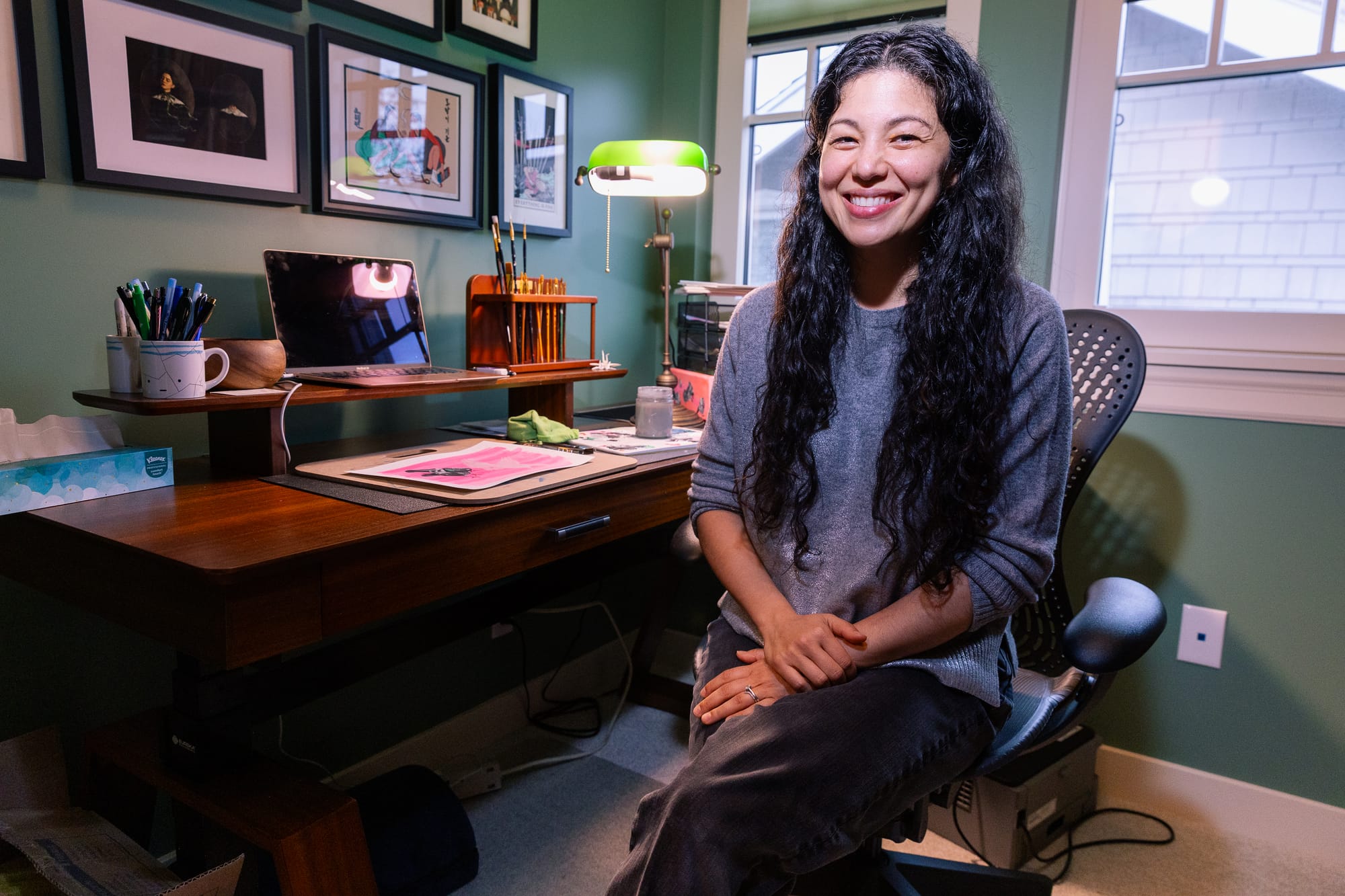
And I thought, well, I used to paint, so why not? I have an office now. I have my own room where I can close the door. That seems nice to me.
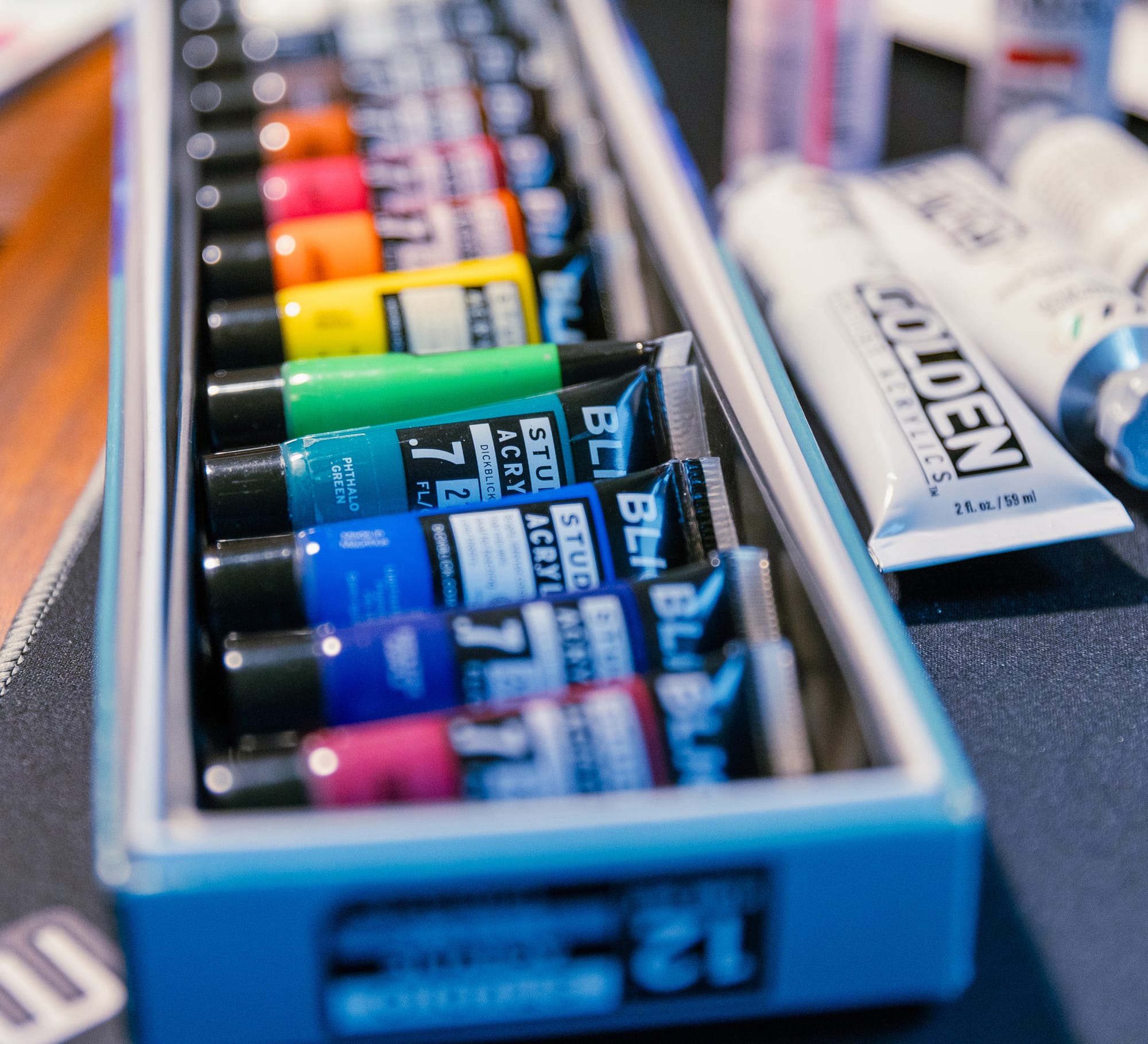
I bought the cheapest set of paints and brushes that I could buy, because I didn’t know if this was going to work out. But it's been really fun.
RH: The paintings have really connected with people. I would like to hear more about what happened when you started sharing these paintings online?
MTH: It's all one thread on Bluesky [of pigeons]. I post them on Instagram too, because I like attention.
I didn't paint them because I was like, oh, people will buy them and give my organization money. I was just like, maybe I can pawn these off on friends like I did when I was in college, because I don't like really keeping my own stuff around.
And somebody DM'd me about buying one, because I painted a pigeon he sent me a picture of. And I said, oh, if you make a donation to Authors Against Book Bans, I'll send it to you. And I was thinking he'd, you know, donate like $25 or something, but he gave $150, so that became the base price.
RH: Wow.
MTH: And I don't intend on scaling it out in any meaningful way. Like, I kind of love that you have to be interested enough to talk to me like a human being.
I'm not setting up a shop. We can talk about a price that you feel comfortable with, but now it's more like $225 or $300 for the bigger ones, because I'm spending more time on them than I was at the beginning.
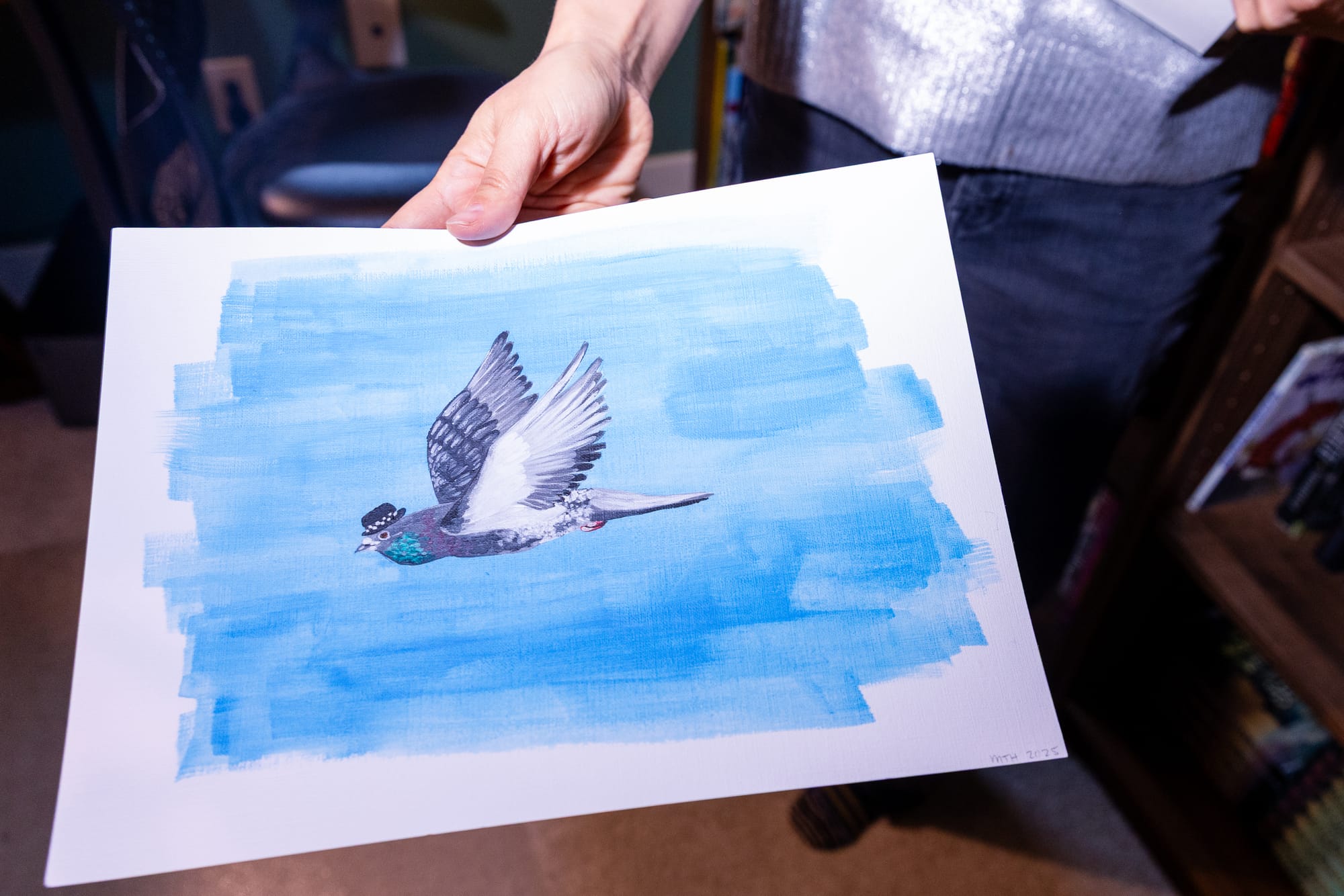
RH: The hats are new.
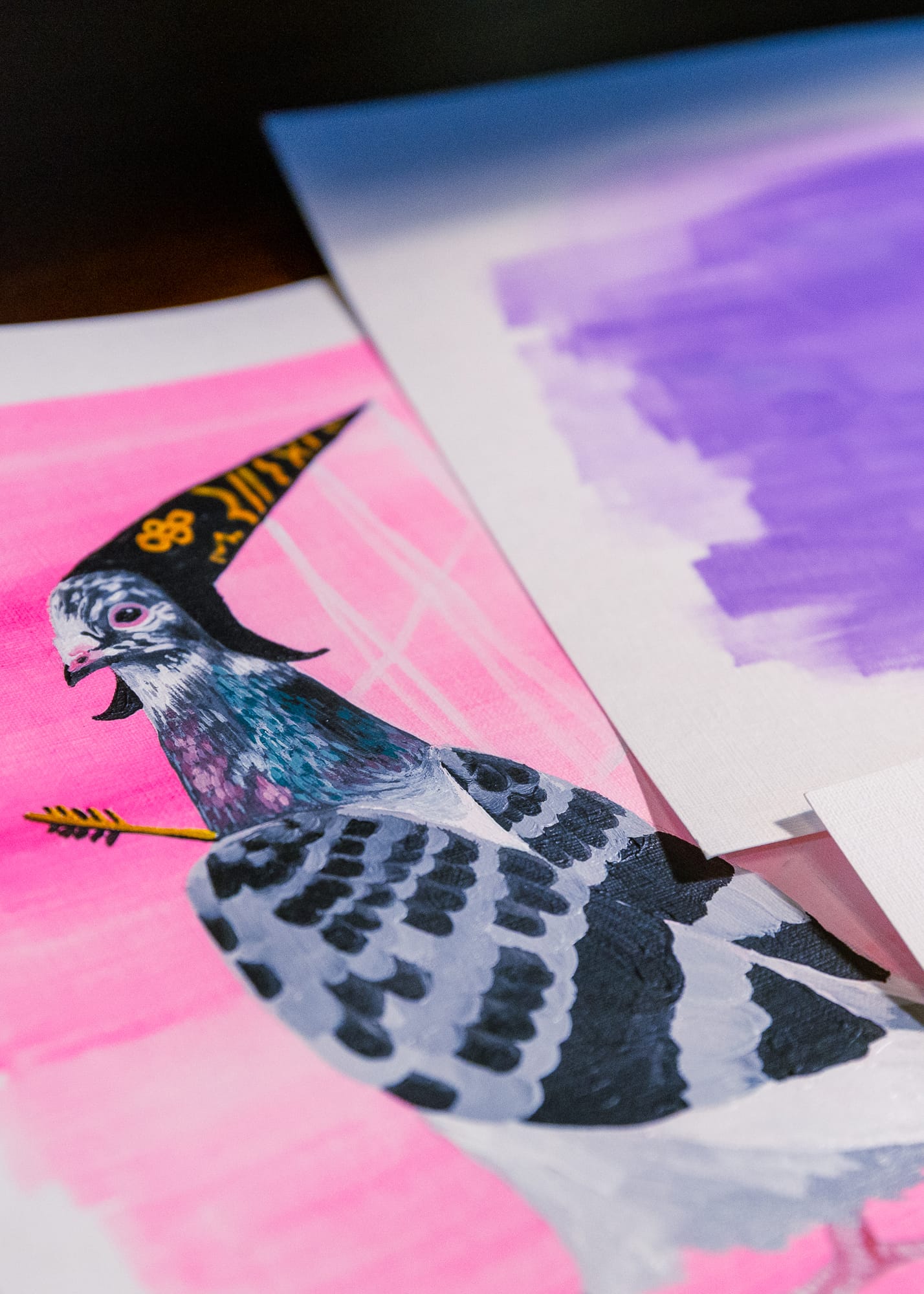
MTH: Thank you for bringing up the hats. It's my favorite part. It's just fun. What's wrong with an animal with a hat? Nothing. Absolutely nothing. Everything is right in a world where an animal's wearing a hat.
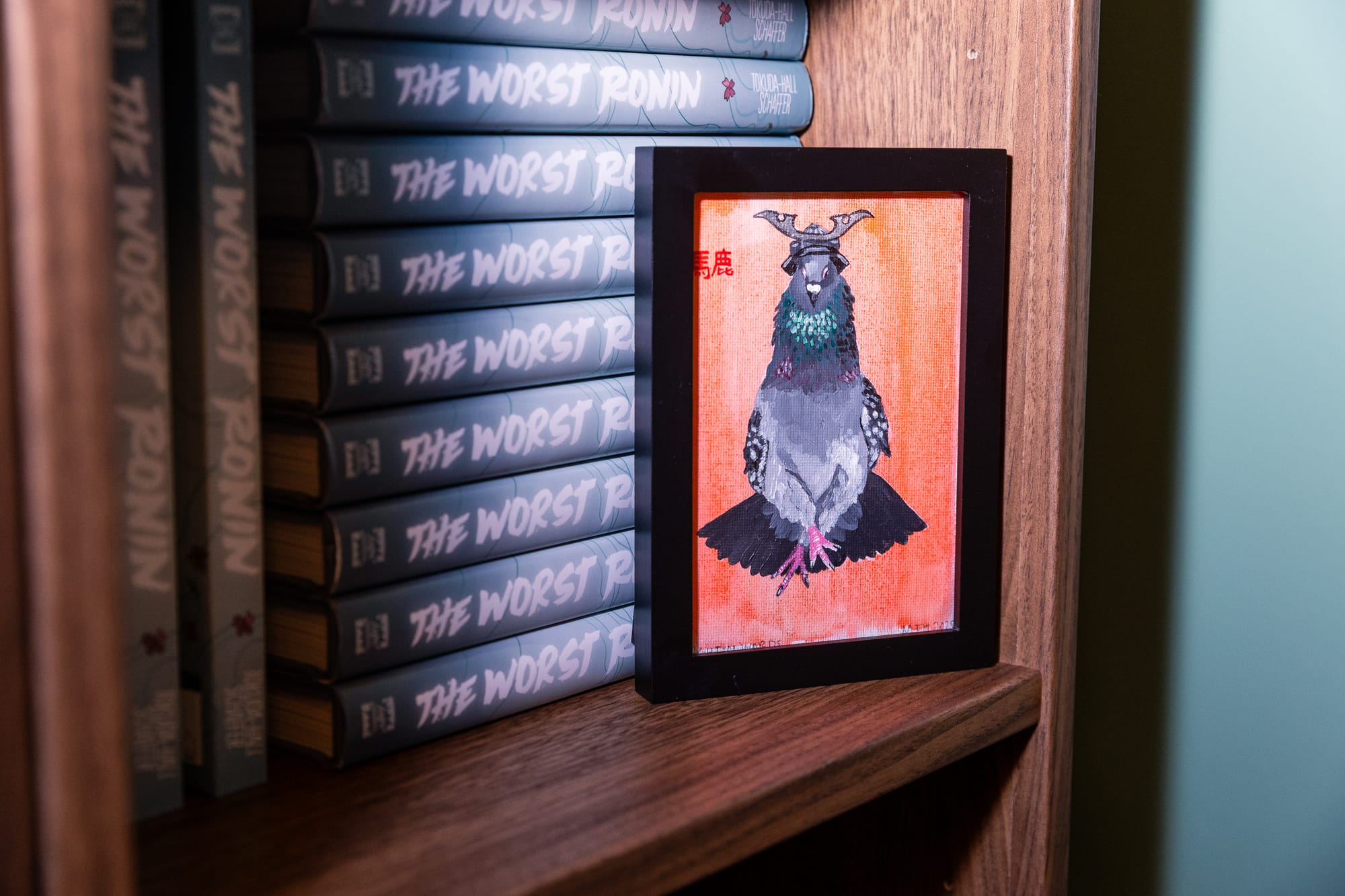
RH: And also, there are so many kinds of hats.
MTH: There are so many kinds of hats, and it has sent me down so many weird research holes. The other day, I ate my little, five-milligram weed gummy that I have every night after my kids go to bed, and I was deep diving on medievalist Instagram accounts, because they're great.
RH: Sure.
MTH: And they got a lot of hats! I actually just finished one this morning that was from a portrait of a lady whose name I forget, but she has an arrow coming out of her chest and she's wearing this like, huge, black pointy hat with a veil coming off of it. And I was like, say less. This is the best day of my life.
RH: I just love that you weren't painting, started painting, and then now you have this hyperfixation.
MTH: Highly recommend it, honestly. It's been really good for my mental health.
RH: I’m very inspired by what you’re doing. I'm very inspired to see someone who's choosing a steady way to survive these times. So, thank you.
MTH: That’s very kind of you. I'll have a big cry about it once you leave. Like, yes, that is exactly how it feels, but it's very different hearing it from somebody else.
RH: I think many people understand that art matters and that artists matter. It's hard to see it on the day-to-day scale. It's hard to see what it looks like on a personal level.
MTH: I love watching other people do things just because they like it… and that they aren't trying to sell. They aren't making their brand or whatever. Just the natural, organic offshoots of your personality that are so hard to fucking come by on the internet especially.
Everybody is forming whole personalities around what it is they're trying to sell you, and I think I'm really allergic to that, and I dislike it, and I dislike being pushed to do that by publishers, or the forces of capitalism, especially as an author. None of my books have anything the fuck in common because part of being an artist is getting to do whatever the fuck you want, right? Like, that's the great joy of doing it is that you're supposed to be expressing these things that are natural. And the internet is so inhospitable to that. And so I like it when I see other people just being a regular fucking weirdo on the internet, because it's like, right. Human beings are still out here.
Like, I don't know, not to make it about pigeons, but it's kind of about pigeons. You see them and you're like, they all look the same and they're all disgusting, and that's true on the one hand. But also if you look at all of them, they're all completely different and they all have some weird, beautiful detail on them that makes them special and worth looking at.
RH: Like us.
MTH: Exactly. We’re just as disgusting and meaningless as they are, and we're just as beautiful and meaningful as they are. And so I like painting pigeons because it puts me, I think, in like the proper headspace of thinking about myself and the world. It's all of a piece to me of how trying to look at the world with any kind of hope and compassion in my heart involves needing to be really frank about how disgusting and disgusted I am by so much of it. And so I need to find a reason to enjoy it and to, like, find anything worth looking at in it.
And pigeons help me do that.