Exclusive: Bottom of the Hill Sold, Will Continue as Live Music Venue
The storied San Francisco club will reopen in 2027 under new ownership.


The storied San Francisco club will reopen in 2027 under new ownership.

This week we've got a broth bar buffet, a backwards reading of the U.S. Constitution, rice porridge for dogs, and more.

(It all depends on how you define the word "can.")
The Trini doubles humbles you, then leaves you wishing for more.

In the same way one should avoid wondering too much about the current whereabouts of a lost love, I try not to think about doubles very often. But once I start, the floodgates break open, streaming with sensorial reminders of what I can’t have — at least not with the same ease as when I lived in New York City, where the Trini restaurants of Queens were just a quick train ride away.
Invented in Trinidad and Tobago in 1936, doubles began as a survival food — a side hustle — for a family of Indian plantation workers. Like bunny chow in South Africa and jambalaya in Louisiana, doubles are part of a robust genre of diasporic food created by laborers or enslaved workers who made local ingredients more recognizable with the techniques they knew. If you squint, doubles could be the cousin of the Punjabi chole bhatura.
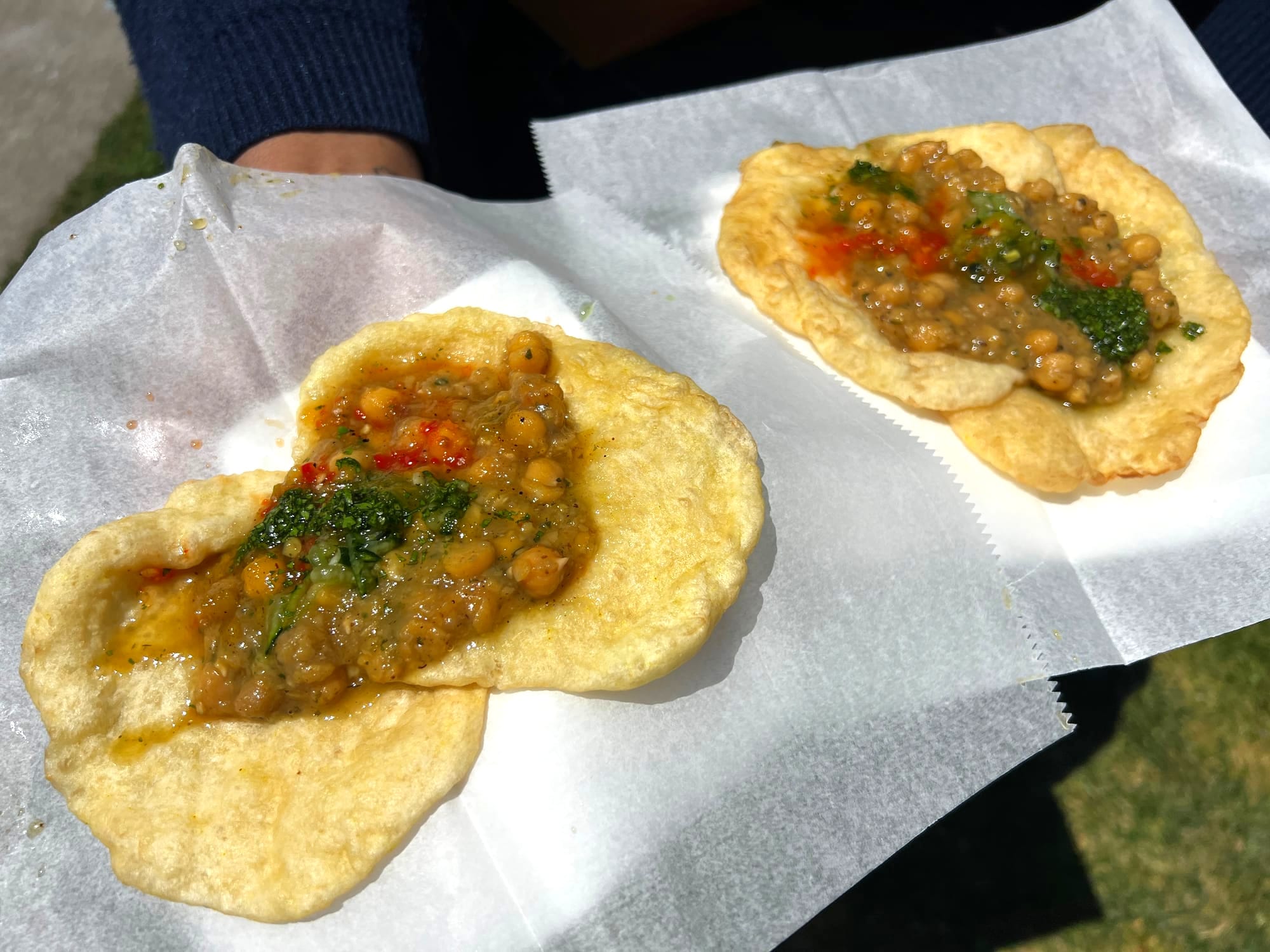
Whenever I visit a city with a large Caribbean population, like Toronto, Boston, or London, doubles are the first thing I look for. I miss the tender bara, earthy and yellow from turmeric powder, the zip-zap of Scotch bonnet sauce as it lingers on the lips, the trickle of channa juices migrating down my wrist. At first, the dish looks like a tiny, yellow catcher’s mitt that some misguided soul is using to juggle a stew, and you do have to accept some level of mess and potential humiliation as you eat it. The Trini doubles humbles you, then leaves you wishing for more.
Here in the luscious and abundant Bay Area, the doubles lover finds themself in a desert. Cocobreeze in East Oakland is the one restaurant that offers them, but even then, you don’t quite get the spirit of the doubles as standing-around-and-shootin’-the-shit food.
Khadine Singh, a Trinidad native who lives in San Francisco, calls them the “holy grail” of street food. “I went home to visit and it was so nice to wake up and get doubles and coconut water for breakfast,” she says. “I came back and was like — why am I living without doubles? I love California, but life is not life without doubles.”
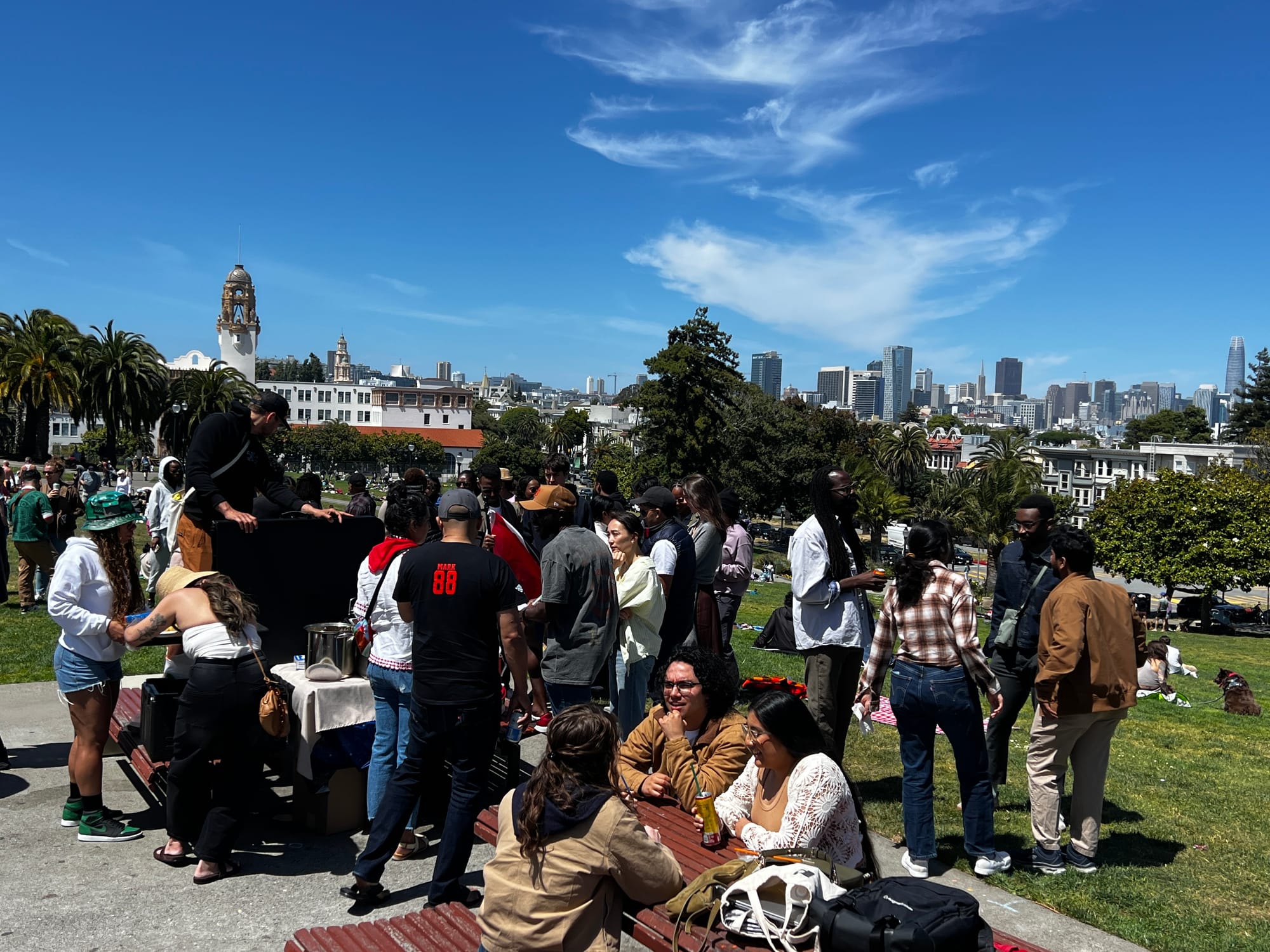
This weekend, however, the Bay received a much-needed reprieve. Singh and her collaborator, fellow Trini Nicholas Tsoi-A-Sue, met at their day job, when Singh spotted a giant Trinidadian flag on his desk. Inspired by their shared nostalgia, Tsoi-A-Sue has been making doubles at home for months, cooking for Trini friends, who convinced him to share them more widely. Their first pop-up, in May, was mostly for Trini friends; someone said it was the best doubles they’d eaten outside of Trinidad. Dolores Park was next.
Marked by the fluttering red-and-black flag of the island republic, the pop-up’s team frantically set up music, pots of channa, and the all-important garnish station at about 1:30pm on Sunday as a crowd of a few dozen began to form. At just $5 a piece, the 250 doubles available for pre-order sold out quickly, but a total of 300 doubles ended up going out the door.
People came from the Peninsula, Oakland, and even Pittsburg. A few aunties from Trinidad waited a full hour until the end of the pop-up to see if there were extras and left with ten more to take home and share with friends. “That’s the magic of doubles,” Singh says. “It’s food for all of us. It’s food for the poor person and the rich person. And everyone enjoys it, no matter what their skin color is.... That’s why Trinis are proud to make it and proud to share it.”
Singh assembled each order by hand: first the two pieces of soft bara, overlapping like a Venn diagram of fried dough circles. Then, a nice dollop of channa, followed by rainbow splashes of roast pepper chutney, a sharp-tasting culantro (bandania) sauce, cucumber, and a sticky-sweet sauce of cooked-down green mango. All this Singh put together on a parchment-lined plate — then, you’d put out your hands with a napkin and she’d slide the parchment onto your palms, with the practiced ease and reverence of a Catholic priest handing you a communion wafer. Body of Christ, amen.
To get your hands on these doubles, keep an eye on the SF Doubles Shop on Hotplate or Instagram.