Taifa Nia Finds His Second Wind
With new EP ‘Invidia’ and two more on the way, the San Francisco musician and prolific collaborator comes into his own as a solo artist.


With new EP ‘Invidia’ and two more on the way, the San Francisco musician and prolific collaborator comes into his own as a solo artist.

On making friends with maps and Marxists.

I’ve spent over 10 years obsessed with so-called “gender verification” tests. Proponents claim they have history and science on their side. They don’t.

With new EP ‘Invidia’ and two more on the way, the San Francisco musician and prolific collaborator comes into his own as a solo artist.

Taifa Nia is tough to pin down. After our interview downtown on a warm Friday afternoon, the musician will dip into Yerba Buena Center for the Arts (where he serves as a house manager of sorts, one of his two day jobs) to say hi to coworkers at the opening party for the exhibition Conjuring Power: Roots & Futures of Queer & Trans Movements.
Then he’ll head to Chase Center to meet Text Me Records founder Patrick Brown for the Warriors game. After that, he might stay out dancing until 2am to some weird underground electronic music — like he did last night. Or he’ll go home and noodle on his guitar, sample some hallucinogens, and listen to Sun Ra, or metal, or Soundcloud rap. Come Sunday morning, you might find him at Saints Peter and Paul Church near his place in North Beach; he’s considering getting confirmed so he can officially be a godfather to his bandmate’s baby boy.
“I’m a chameleon,” says Nia, with a wry smile, of his tendency to bounce between different scenes. “I get to just pull up places and vibe, and no one questions it. That's like my superpower.”
The omnivorous nature of Nia’s tastes is immediately apparent on his new five-song record Invidia, out March 30 on Text Me. The first of at least three EPs Nia plans to release this year, Invidia is a catchy little cluster bomb that veers from heavy, wall-of-distorted-fuzz guitar rock to Vocodery indie-electro pop, interspersed with sampled voice messages from Nia’s friends and family.
The constants are an impeccable sense of melody and lyrical vulnerability: “And I hate that I’m in love with a memory/and I hate that line, and I hate that lie,” he wails on lead single “FML2020.” Built around an earworm guitar riff, the song sounds a little like Guided By Voices got hit on the head and decided to cover Panic! at the Disco. It works.
While Nia is proud of his eclectic influences now, it wasn’t always that way. He grew up in Oakland with a Black father and a Puerto Rican mother, both East Coasters who came west and found work in radio and at record labels. Sadiki Nia and Tamu du Ewa were hosts of the hip-hop-focused “The Sunday Morning Show” on KALX in the ‘90s, then a reggae and dancehall show on KMEL. A favorite story about his dad involves the elder Nia driving around Wu-Tang Clan, who apparently had only smoked East Coast weed up until that point, and introducing them to the potency of California cannabis.
For their son, who wore skinny jeans and loved emo and anime, cultural identity felt like a minefield. “I struggled with that shit,” says Nia. “It was some quintessential bullshit where you’re too Black for white kids, too white for Black kids . . . my identity was all types of fucked up until I started playing music.”
By the time Nia graduated high school — a year early, at 16, from Piedmont’s alternative public high school, Millennium — the teenager had found his friends. They were in basements and garages, doing bong rips and freestyling, and they didn’t care how he identified.
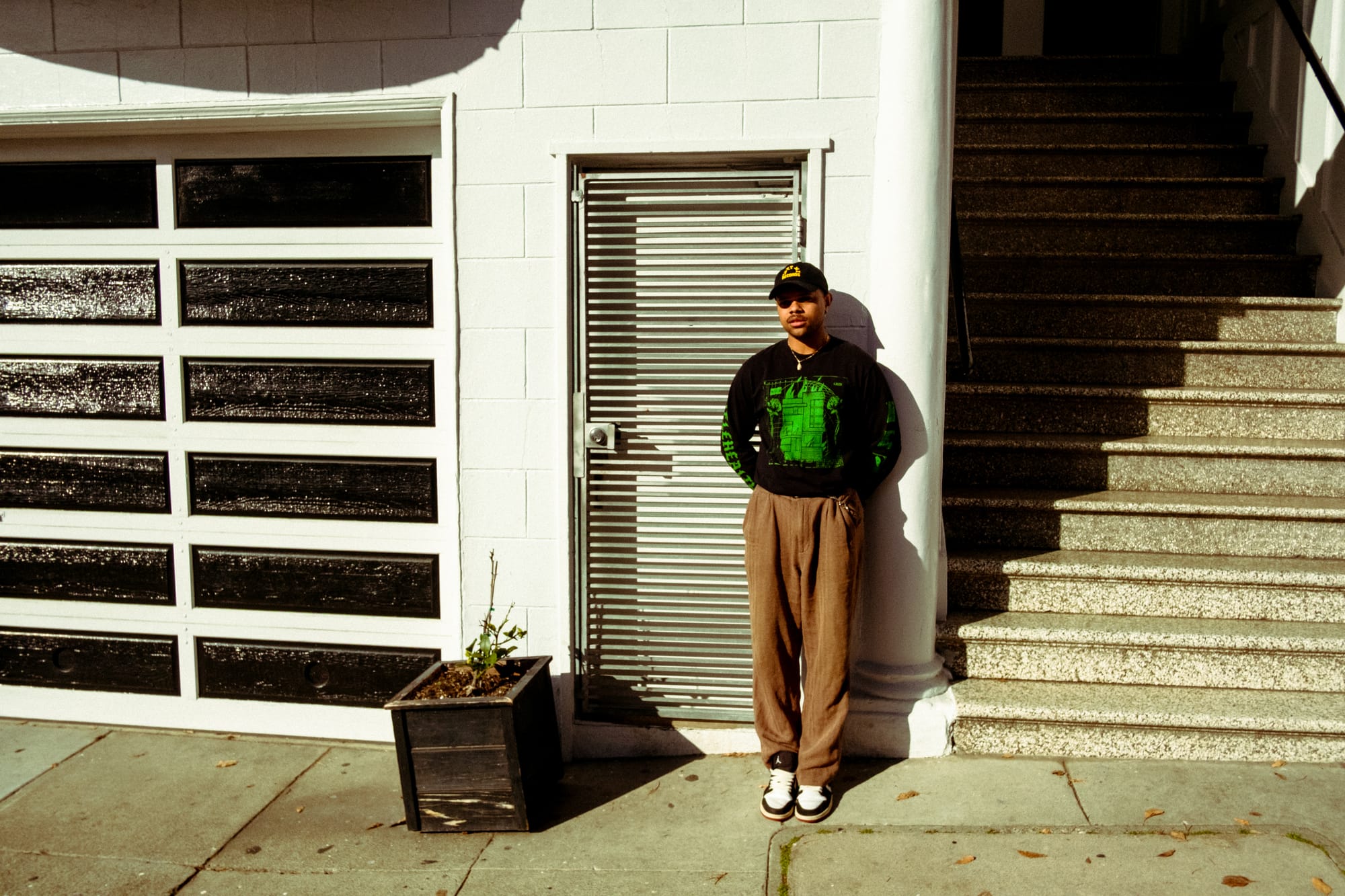
A decade and a half later, Nia’s resume still reflects that sense of music as a haven, a lifeline, and a team sport. There was the Oakland indie rock band O.C.D., in which he played bass. He found his voice as a frontman in the band Same Girls, made up of best friends from high school (so named because they always had crushes on the same girls). He went on tour selling merch for his friends in the once-ascendant SWMRS (which fell apart in a fucked up way, about which Nia has no comment; however, they are not friends anymore). Somewhere along the way Nia started playing bass in Bay Area punk legend Brontez Purnell’s projects, and the two have become kin.
“I would die for him,” says Nia. “We always wind up playing phone tag and catching up at 3 in the morning when I’m leaving something I’m probably not supposed to be at, and he’s on his way to something he probably shouldn’t be doing. It’s a funny friendship.”
Home base for Nia over the past decade has been Mission District studio Different Fur, out of which the indie label and publishing group Text Me Records started in 2017. Nia has become one of the label’s cast of regular players, bringing an impish kid-brother energy to collaborations with indie pop-punk artist Nocean Beach and rapper-actress Tia Nomore, among others. He also finds time to play guitar with experimental trap and rock purveyor Ricky Lake. Nia points to Text Me’s Brown as a crucial mentor, and to the label, which hosts collaborative songwriting and production boot camps, as a formative hub.
“Every time he gave me an opportunity, I just didn't fumble it,” he says of Brown. “He kept giving me the opportunity to perform, and record, to just show up and hone the craft, develop the skills. Different Fur is a second home for me.”
But if the last decade has been characterized by Nia’s love of a group project, Invidia has a different aura to it. “Something about this music just feels real to me,” he says of the solo effort. “It’s for real this time.”
The musician, who just turned 30, has a funny way of sounding older when he reflects on his life and output thus far. That’s also probably because this EP has him purposefully looking backward: Invidia (Latin for “envy”) is a project he made for “little teenage me” — it’s a record he would have loved at 14, when he was wearing out Weezer’s Pinkerton.
The second EP, Avaratia (“greed”), is more in line with his early 20s, when he was living in West Oakland. “I had such an abundance of creativity around me. Everybody I knew was creative and so fucking cool. And I could not get my head out of my ass… wanting more and more and more shit,” he says. “I damn near hustled my way out of a beautiful situation.”
Of course, he notes, that house also had rats. All things considered, he’s glad he’s moved on.
He prefers for the third EP (maybe a fourth?) to remain a mystery for now. But taken together, these records clearly reflect a period in which Nia did what most Bay Area kids decide to do at some point: leave. Toward the end of 2020, he felt like he had to get out of West Oakland. So he picked up and moved to Seattle, which he describes as “San Francisco’s younger, goth sister who doesn’t like to be in the sun.”
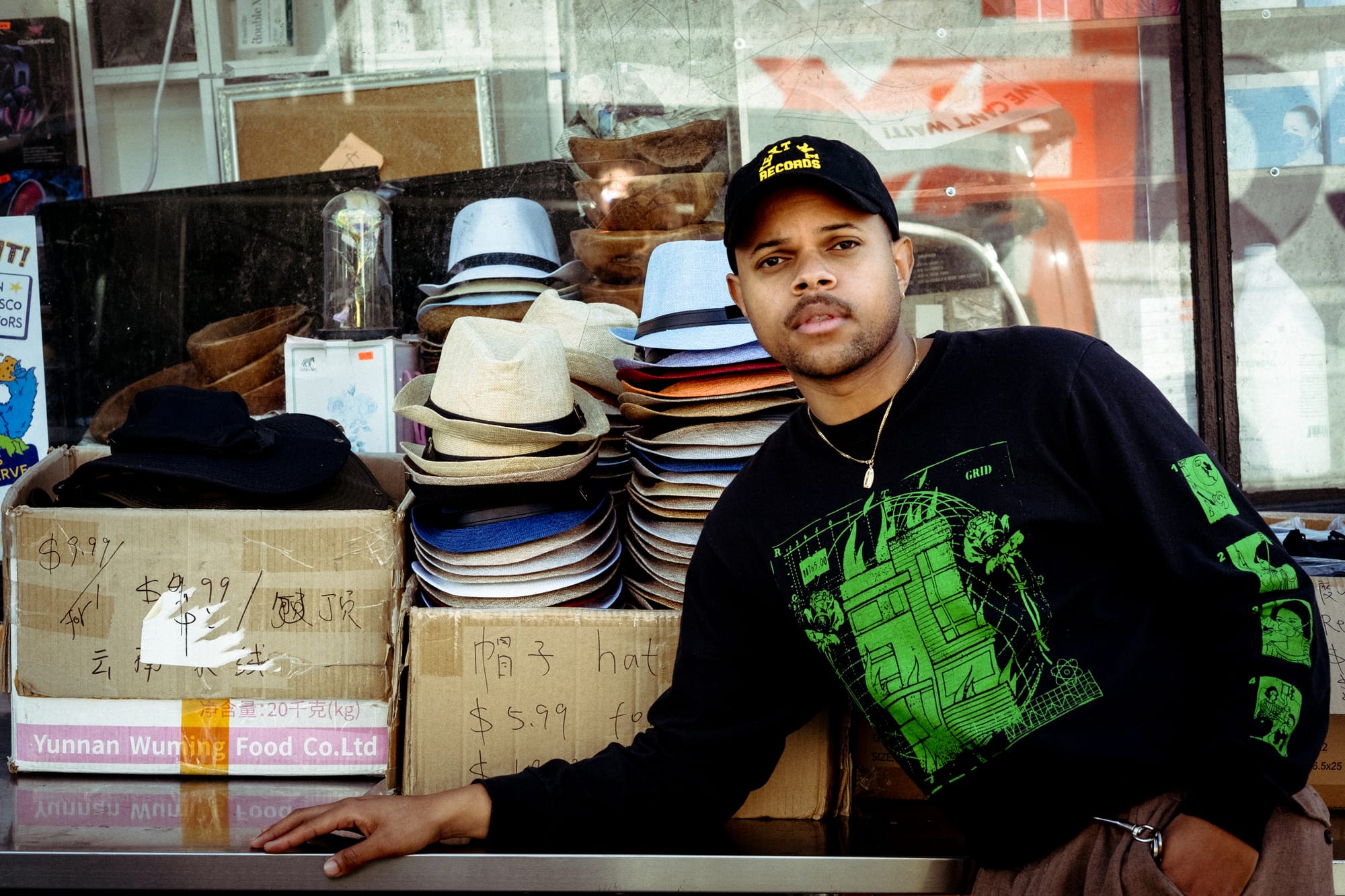
He returned to the Bay, to North Beach, within two years (this is something Bay Area kids do, too). But that distance gave him some perspective on the scene here. He thinks a lot about how the Bay has such a widespread influence on music and art and culture; yet at the same time, it can be so insular and so hard for artists to break out from.
“The Bay Area is a bubble and a vacuum,” he says. “We have our own artist culture that is just so unique, but it does sometimes feel like a gift and a curse.”
After a couple years of frustration and resentment about the industry, this record also reflects Nia finding his way back to making music for the love of it. He’s the first to admit that he can get scattered, unfocused, and despairing about the state of the world. But music always feeds him, he says. Performing always brings him back around.
“Making music is making magic,” he says, recommending that everyone spend some time with Sun Ra’s creations. “Sun Ra said music is like taking the vibrations you create and giving them to the highest consciousness. You’re knocking on the door of God being like, ‘This is what my soul sounds like.’”
That’s probably one reason he became unexpectedly emotional a couple weeks ago while playing a happy hour set at San Francisco bar Bender’s during Noise Pop. He’s performed there at least a dozen times, he notes; Bender’s was actually one of the first real shows he ever played as a teen.
“When I was in O.C.D. and playing there, I was underage, so I had to stand outside [when I wasn’t on stage] and watch everyone else have a good time,” says Nia. This time, he almost started crying. “I was like, yo, I’ve come a long way. I’ve risen, crashed out, rebuilt myself. I just turned 30, and I feel like I’m just getting a second wind."
“Like, look at me. Look at life.”