Entanglements Lost: My Day at a Geography Conference in San Francisco
On making friends with maps and Marxists.


On making friends with maps and Marxists.

I’ve spent over 10 years obsessed with so-called “gender verification” tests. Proponents claim they have history and science on their side. They don’t.

On making friends with maps and Marxists.

I am beginning to worry that geographers might be some of the nicest people in the world. This is inconvenient, as a journalist, given how committed my profession is to giving the worst people in the world the biggest platforms to describe how they’d “improve” it (e.g., more white people, fewer trans kids, enslavement where possible). Nice people rarely make the news.
Last week, the American Association of Geographers’ (AAG) annual conference took place in San Francisco over the course of six days. It was a chance for academics and students from around the world to network and share research on topics as diverse as “New Fluvial Geographies: critical currents in riverine thought, practice and activism” and geospatial data analysis pertaining to infectious diseases. I was present for only one of those days, but my immediate takeaway from what I saw was how we’d all be better off if our largest news outlets bothered to listen to these people instead of profiling eugenicists and fascists.
But beyond the incisive critiques of environmental deregulation I heard, and in between talks methodically tearing apart neoliberalism’s tenets, the people I encountered were just so… kind? So open? It unnerved me to realize the last time I’d felt this welcomed by strangers was on a long trail in deep Tennessee; that a decade had managed to pass between those two points in time was frankly beyond me.
I returned to Oakland on BART’s yellow line, abuzz and sick with temporal reckoning.
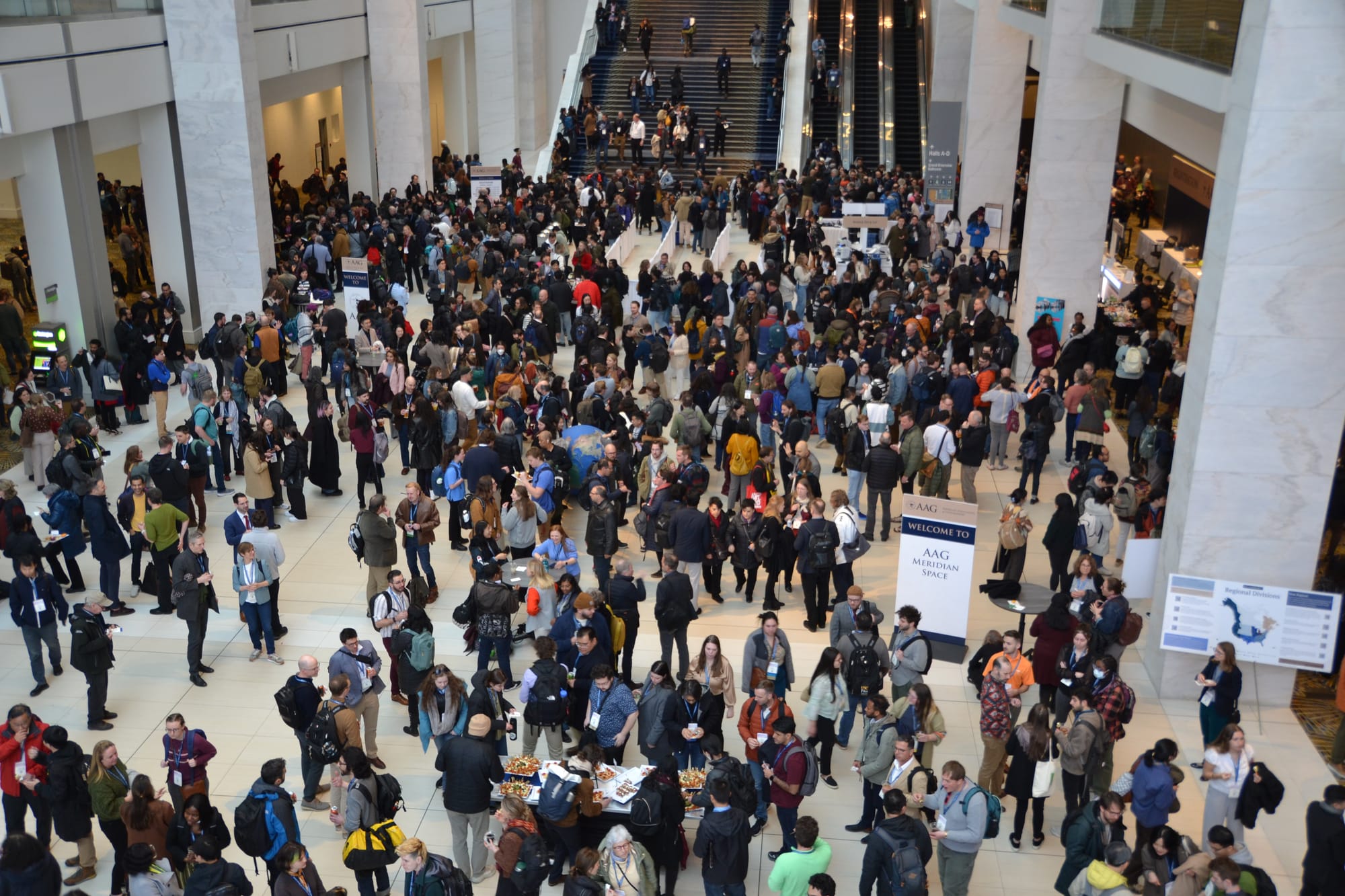
At dinner with Ingrid Burrington, a geographer friend who’d flown in from NYC for the conference, she half-jokingly told me the warm vibes I’d picked up on were because, to quote, “the field of geography is split between tech nerds and communists.” I nodded into my ravioli with the unearned conviction of someone who bore the barest hint of a data set. An exaggeration, sure, but if it were even somewhat true, then from the thousands who’d gathered at the Union Square Hilton in SF on March 17, I’d go with the folks who couldn’t wait to quote Ruth Wilson Gilmore (and twice, actually did).
I admit to having arrived in SF that morning a little nervous, even if I was there as someone with nothing to prove, nor gain, nor fight for professionally. Instead, I had only my own opinions on our hell and its causes. I was an observer at a gathering of academics. The badge on my lanyard identified me simply as “Press,” and I wandered the halls between talks with the freedom and uselessness of a blissfully unaffiliated dust mote (at least university-wise).
While waiting for an elevator before my first set of talks, a middle-aged white woman asked me out of the blue whether I was also heading toward the transportation justice meeting. Before I could respond, a stranger behind her said he was, at which point the two started chatting excitedly before turning to ask me my destination.
I desperately wanted to see three different panels at 10:10 am. The first, “The City as Archive; Archive as Method,” sponsored by the Black Geographies Specialty Group explored “Oakland, California, as archive through multiple entry points: policy, photography, and urban logistics” and had papers by UC Berkeley geographers titled “Progress and Perish: The Paradox of the Black Worker-Renter.” The second panel was “Predatory Tenures” and dealt with “contemporary developments in the relationship between housing and inequality, particularly those implicated in modes of tenancy and debt.”
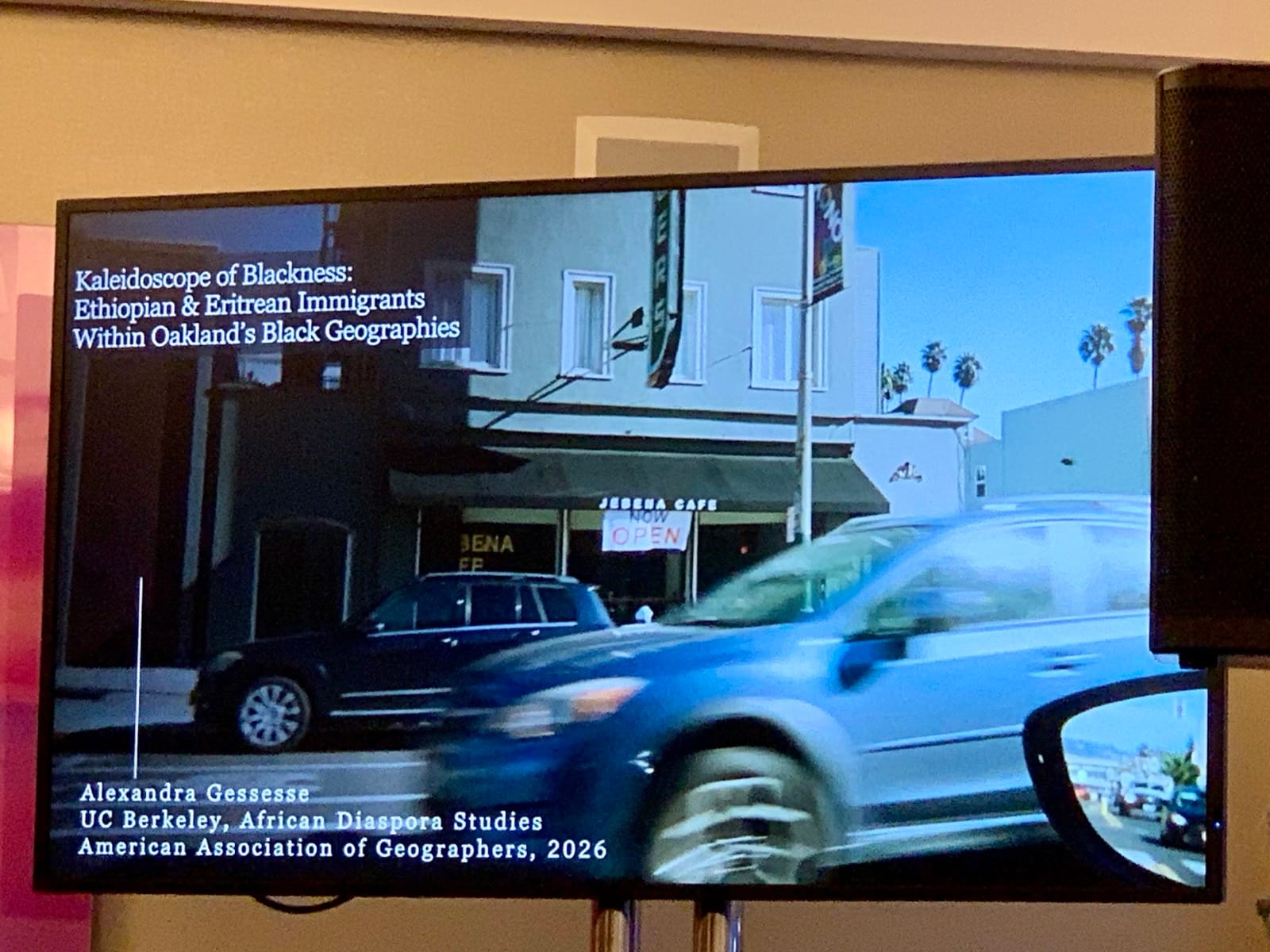
I ended up choosing the third panel, “Geographies of migration, identity, and belief,” which featured the presentation “Kaleidoscope of Blackness: Ethiopian and Eritrean Immigrants within Oakland's Black Geographies,” so that my ancestors would not haunt me for the rest of my days. A woman sat beside me holding an annotated copy of Sara Ahmed’s Queer Phenomenology and asked, unprompted, about my work; by the end of the session we’ll have swapped contact info in WhatsApp.
How immigrants orient themselves — or to quote presenter Alexandra Gessesse “Whom are they orienting themselves in relation to?” — has been, if not an enduring question at my core as an Eritrean American born in Miami, then at least one in close orbit. Gessesse’s framing of Black Oakland as “a diasporal kaleidoscope,” producing encounters between those who arrived during the Great Migration and refugees who fled Eritrea and Ethiopia, spoke to a convergence I’d felt but never explicitly named ambling up and down Telegraph Avenue. “Place is not where things end,” Gessesse concluded, “It’s where things meet.” In other words, latitude and longitude are surface-level identifiers: Cities were relentlessly alive with us, and both the positive and negative frictions we produced.
I sat in the hotel lobby afterwards, during the hour-plus lunch break between sessions, watching hundreds of geographers meet and disperse and erupt in laughter, the energy in the air palpable and veering on the intimacies of airport reunions. Earlier, I’d thanked Gessesse for her talk, which led to us swapping numbers in the hope, at least for me, of meeting up soon (this would happen again with another presenter within hours). Near the corner where I sat charging my phone and writing notes, a group of excited 20-somethings said the word “spatialized” no fewer than 50 times in 10 minutes, with all the reverence of priests. The woman seated beside me, working busily on her laptop, stood and stretched and asked if I’d like a coffee since she was heading in that direction, but I needed to run.
By 12:50, it was time for a screening and discussion of a documentary-in-progress called BlackItalian, which I attended so that, again, my ancestors would not haunt me for the rest of my days (Eritrea was colonized by Italy). The film focused on three cities as sites of historic Black and Italian entanglements: New York, New Orleans, and Milan. The team responsible for creating it consisted of ethnomusicologist Christina Zanfagna and sociologist Camilla Hawthorne, whose writing on the Black Mediterranean and its attendant refugee crises this last decade informs parts of my own work.
I realized at the end that I'd spent the day drawn to talks on the liminal spaces where cultures meet. Sicilians and Afro-Creoles in New Orleans. Eritreans and Black Americans in Oakland. The uneven distribution of mobilities across them arising again and again. These presentations had ultimately been about power and how it develops, or erodes, or absconds within the confines of white supremacy. Look, they said. And I looked. When one of the presenters asked the audience if we knew of people who might be able to help fund their project, my looking led straight to where examinations of power almost always did: money.
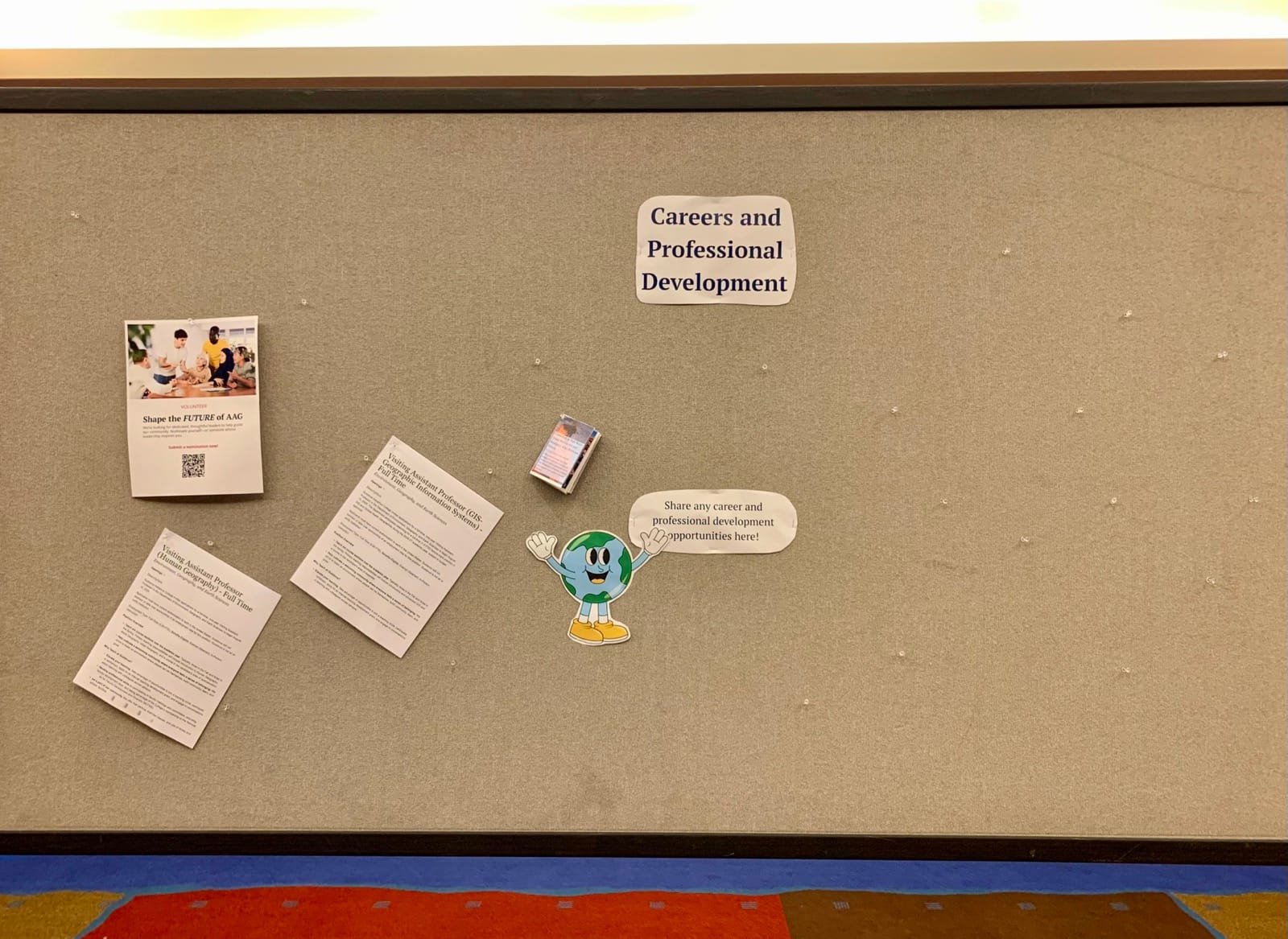
Such calls for funding support would emerge in nearly every remaining AAG panel I saw. At the packed to-the-rafters “Archive as territory: Historical methods in Black geographies,” a presentation specifically about the “significance of ‘the archive’ to the practice and study of Black place-making and knowledge production,” a presenter joked they might not have a job by the end of the year. On March 21, when I streamed several panels online from the comfort of my living room, a presenter whose research focused on housing spoke candidly of his own recent eviction. At my final viewing on Black Ecologies, amid all the talk of soil syllabi, was the half-joke that if anyone knew of people interested in funding the group to let them know.
And honestly? This isn’t even what I planned to write about when I sat down to draft this essay. I wanted to spend its majority going long on housing policy, because AAG in 2026, in San Francisco, was filled with geographers emphatically debunking YIMBY claims left and right — here in the movement’s birthplace. I wanted to talk about the recent wins made by Geographers for Justice in Palestine to get AAG to “[divest] funds from key firms profiting from Israel’s genocidal war and military occupation.”
But I can’t get past the reality that so many brilliant people and their work are on the edges of precipices. Not just geographers, but across academia and our federal workforce. As someone prone to anxiety, I am at this moment filled with dread for all the lost futures already in motion — perhaps even my own. However heavy with promise my phone felt after one day at AAG, Hallie Bateman’s illustration “It’s A Miracle We Ever Met” kept coming nervously to mind.
I want the world for this conference of weirdo academics who’ve thought so hard about place and personhood that at times they moved me to tears. If place is not an end but where things meet, then what is one to make of entanglements lost? In truth, I felt sad for us all, for the hindered potential and connections unknown. I could not stop thinking about how much poorer we’d grown in these dark days of wondering. When? hung over the Bay and beyond like a departures board waiting to load.
