‘Old Man in Flip Flops’: Notes from a Surprisingly Exciting Water Tasting Class
Camper English’s popular water tasting course is an exercise in attention — even for us tap-lovin’ plebes.


Camper English’s popular water tasting course is an exercise in attention — even for us tap-lovin’ plebes.

Blue Note's Black Radio Experience drew sold-out crowds to Napa Valley. Months later, some contractors were still chasing their money.
Oakland historically lacks soccer fields. But a group of local players and community advocates hopes to kick off a brand-new space — featuring soccer, coffee, retail, and more.

Camper English’s popular water tasting course is an exercise in attention — even for us tap-lovin’ plebes.

Pour yourself a glass of water. Take little sips, letting the liquid warm up on your palate. What’s the texture? Are there notes of magnesium? Drywall? Swimming pool? Perhaps… Tums?
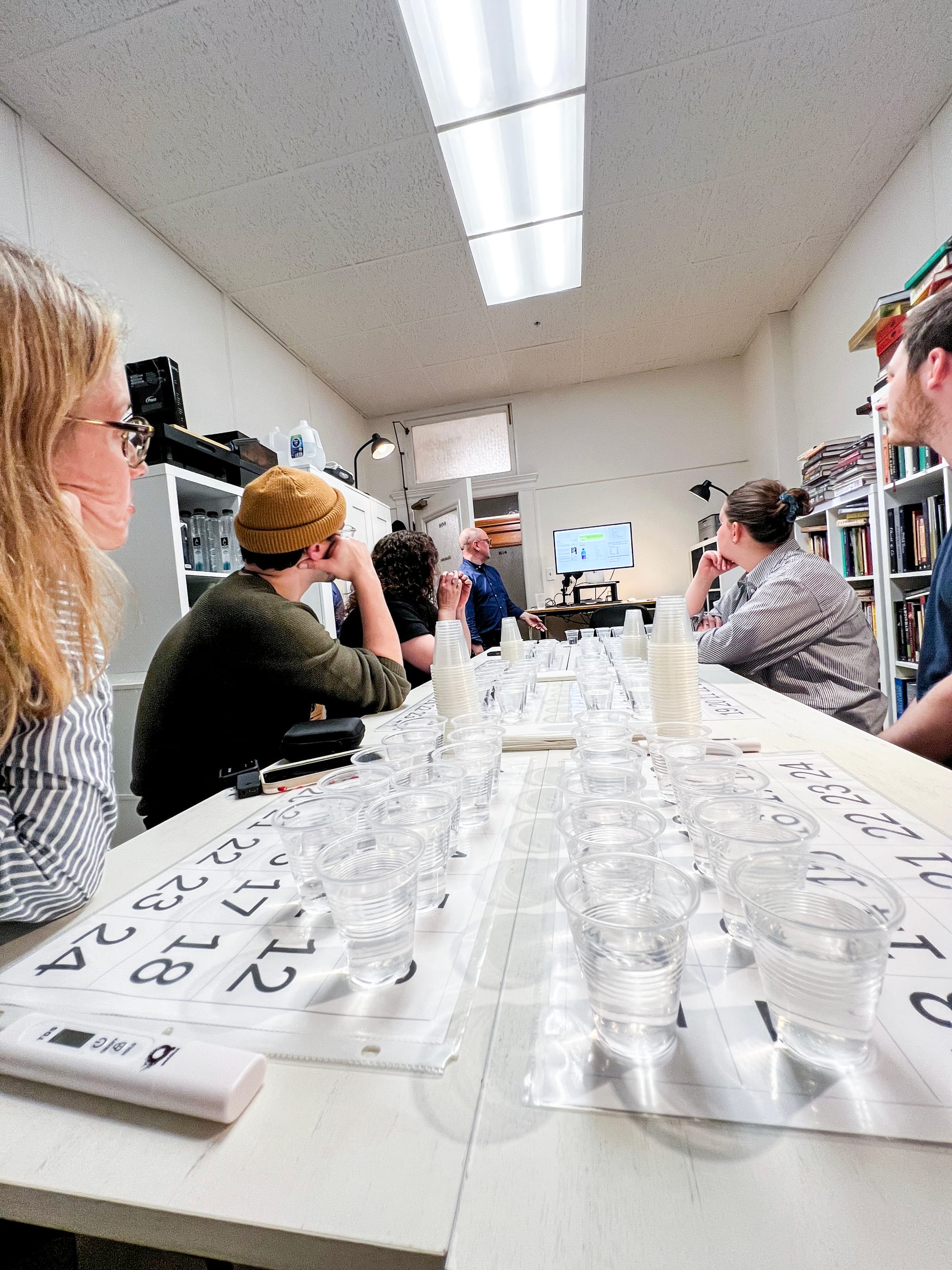
On a recent Tuesday evening, at the Mechanics’ Institute building in downtown San Francisco, a handful of strangers and I holed up in a tiny office to consider these questions at a water tasting class.
Each of us had 11 small plastic cups of water arranged before us. Every cup looked clear, clean, and still. But they were not the same. Under the tutelage of Camper English — a prolific San Francisco spirits writer who began getting geeky about water as a way to understand its role in brewing and distilling — we were to go through each one and think very, very hard about the taste.
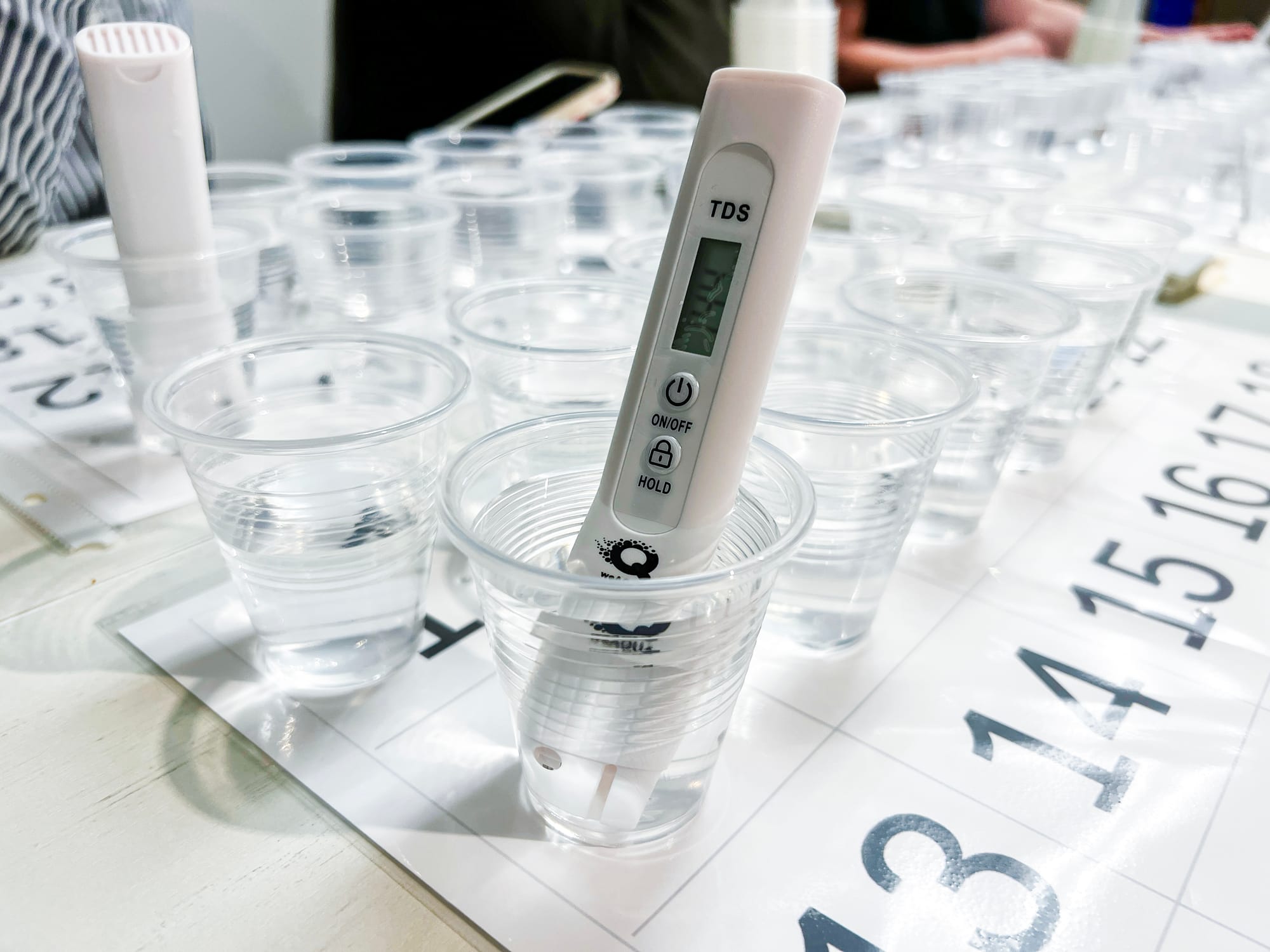
I don’t usually consider water in my daily life. I drink good ol’ tap water to wash down medication, hydrate during a hike; if I’m feeling wild, I’ll toss in an electrolyte tablet. Any emotional attachment I might feel to water has to do with context: the bracing quality of a cold, 20-peso Mineragua on a humid tropical afternoon, or the glass of room-temperature tap that I grab when I randomly wake up at 3am. I’m probably not the only person who looks at the ever-expanding array of branded bottles of water on grocery store shelves and thinks it’s all a scam.
But that Tuesday night, I set aside my cynicism and tasted 19 different types of drinking water: still and sparkling, artesian well and tap, local and imported from far, far away. English comes by the impressive variety honestly: He seeks out new waters all the time, tracking them down at Bevmo or other specialty shops. Each class involves about $70 worth of bottles. He’s always chugging new varieties of water: “I’m like if AI was a person,” he quipped.
And you know what? He convinced me, once and for all, that being a water nerd is a completely rational behavior.
English, whose office contains hundreds of books about cocktails, brewing, and the senses, began the class with a simple but disarming prompt: What’s your favorite water? A bartender said it was whatever came out of the soda gun behind the bar. Another attendee settled on San Francisco tap water. I offered Saratoga, frankly because it was a name I remembered. (Also because I like the blue bottle.)
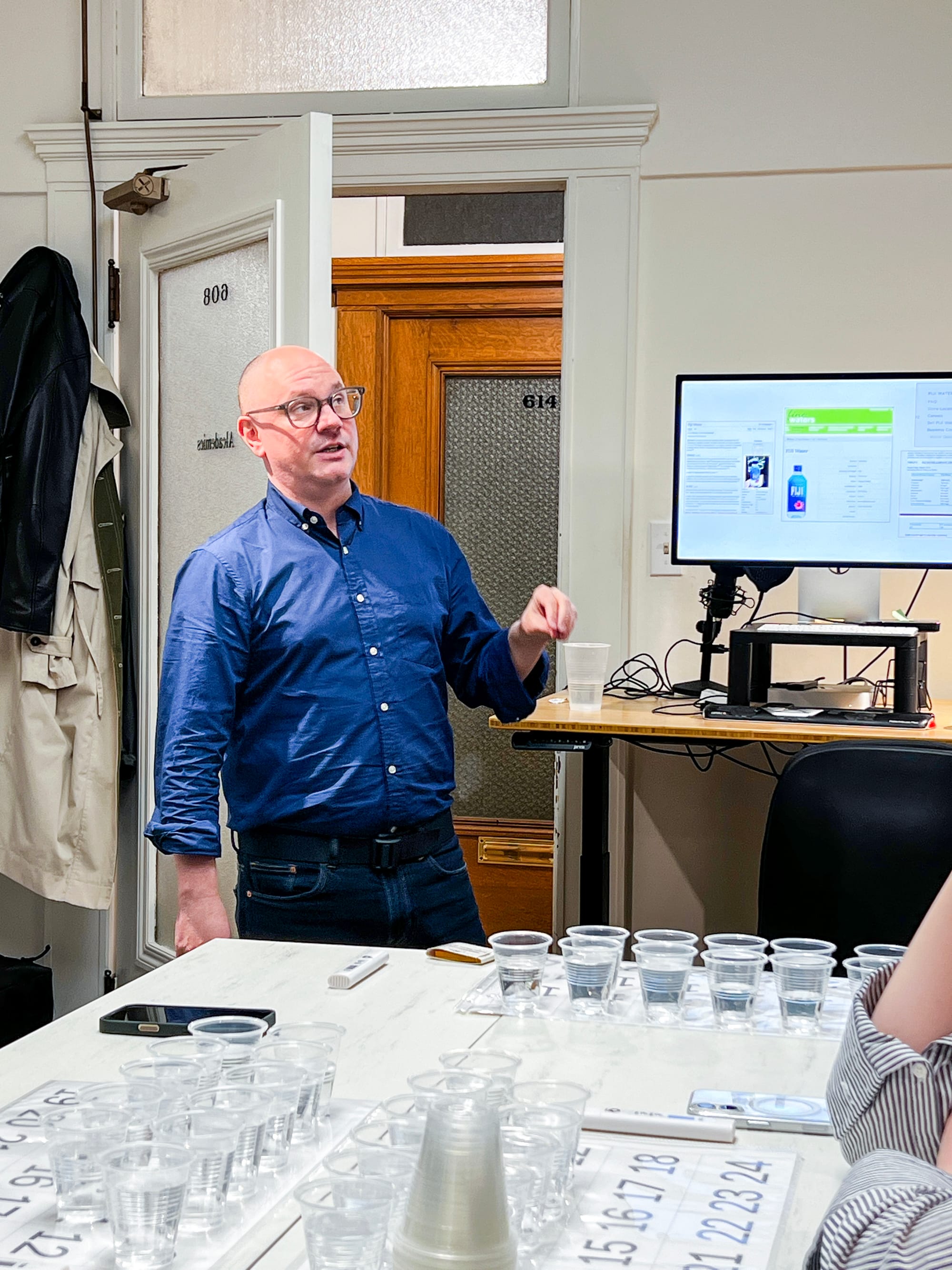
English teaches this class twice a week, always with an intimate group of up to eight people (the maximum his office will fit). Usually, he says, there’s one person in a couple or a group of friends who’s a water nerd, and has dragged the rest of the party to class to prove a point. Most people who walk in are somewhere between the fairly common “Dasani haters club” membership and “will buy a $20 bottle off Amazon”-level — they know different waters taste different, though they might not know exactly why.
As for English himself, he claims agnosticism on the Dasani question: “I honestly don’t know what Dasani tastes like,” he told me. What he does know is that it’s not a “natural” water, and water sommeliers take that seriously — Dasani and Aquafina are both municipal tap water stripped down and remineralized to a proprietary formula. English, for his part, finds something to like in that. “I like science,” he said. “I think making your own water is cool as heck.”
He’s less interested in the people who walk in convinced that any water with dissolved minerals in it must be contaminated — the ones who buy cases of Kirkland water at Costco and treat their TDS (total dissolved solids) meter like a pollution detector. “I’m not trying to convince anyone at that level,” English said. The people who come to his classes, he figures, have at least moved past that. They’re ready to be surprised by how much range there is in something they've been drinking thoughtlessly their entire lives.
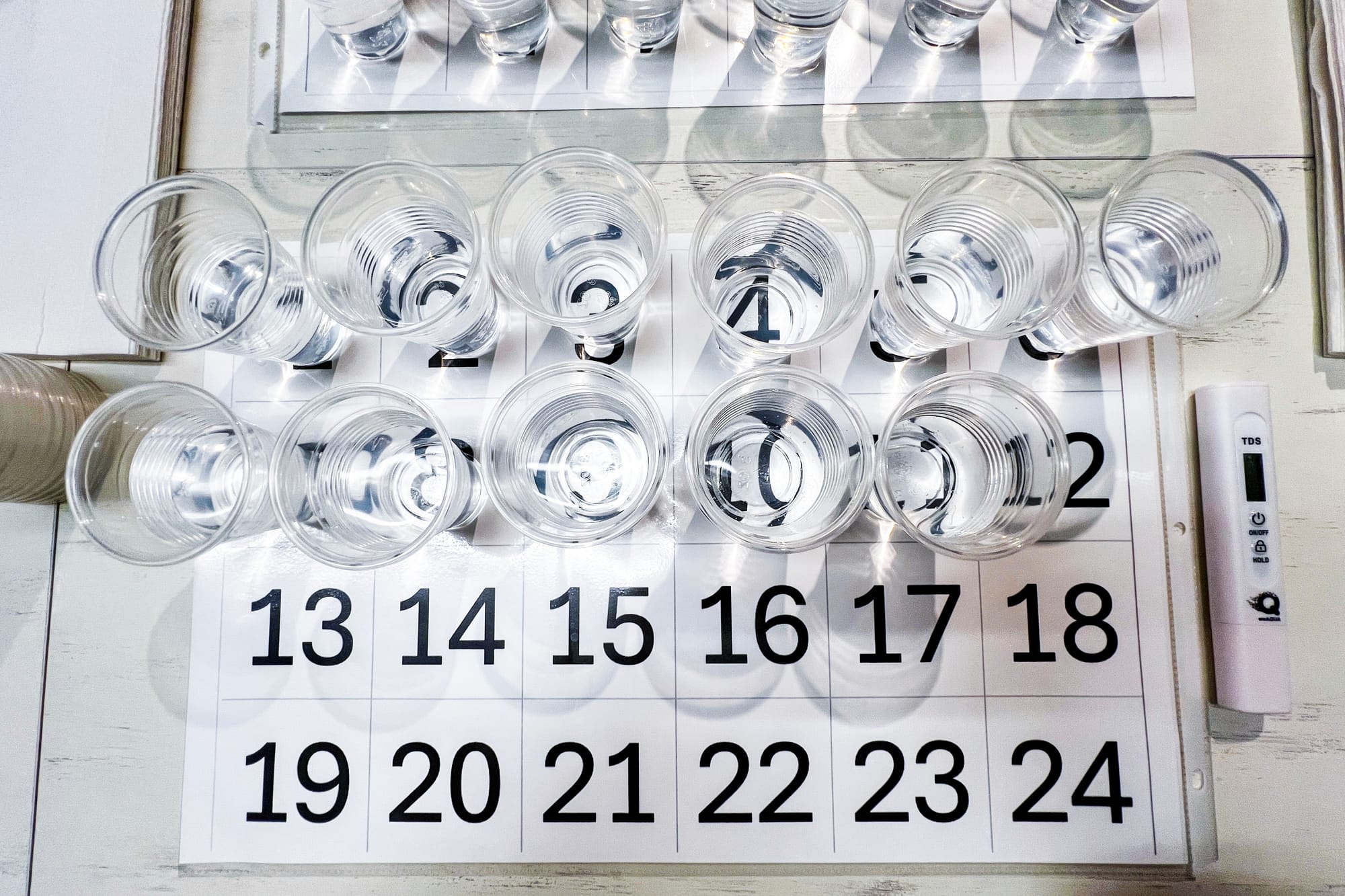
Our tasting gauntlet began with a review of words we might use to describe the waters we were about to sip. I was skeptical — could water really be “citrusy,” “savory,” or “silky”? English, a self-described Tums connoisseur, copped to using that, or “chalky,” as a positive descriptor for water. I could believe bottled water could be salty or sweet. But creamy?
It’s incredible what emerges when you isolate a sensation. The first water, a plain BodyArmor sports drink, was clearly just a whole lot of nothing: worse than even the most casual Sam’s Club water in those plastic bottles that crinkle like dead leaves when you finish them. Despite the brand’s claims to replenish electrolytes, there was no salt in the water. You might think that just plain water would be fine, but it, and the distilled, just-plain-H2O water that we tasted next, seemed less than functional, with the collective appeal of a paper towel. “With distilled water in particular,” English said, “you can almost feel it pulling the minerals off your tongue.” It’s the kind of water that makes you feel like you’re drinking the concept of thirst rather than the cure for it.
The tasting progressed from these extremely plain waters to those with more minerality in them. Minerals equal flavor, English told us, and one of the bigger misconceptions out there is that water with lots of minerals is more polluted.
On the other end of the spectrum are waters like Australia’s Three Bays and the French Evian that actually make you feel “full.” These are waters with texture; with body. One taster said Three Bays was like a main course, like if a steak was a bottle of water. Procured from an underground source located on the coast of southeastern Australia, a 12-pack of these bottles runs at $150 online. (By comparison, a 12-pack of Evian is around $20.)
You’d think something like Three Bays would be a prime candidate for the many Michelin-starred restaurants in the Bay Area. English said that’s not the case: “Restaurants don't give a fuck about water.”
I think he’s onto something here. While there are a handful of certified water sommeliers out there English couldn’t name anyone doing that work in Northern California. The closest one is Los Angeles’ Martin Riese, who holds the distinction of being the first water sommelier in America. In 2013, Riese’s 44-page water menu at Los Angeles’ now-closed Ray’s & Stark Bar generated a torrent of incredulous headlines. More than a decade later, few have followed his path.
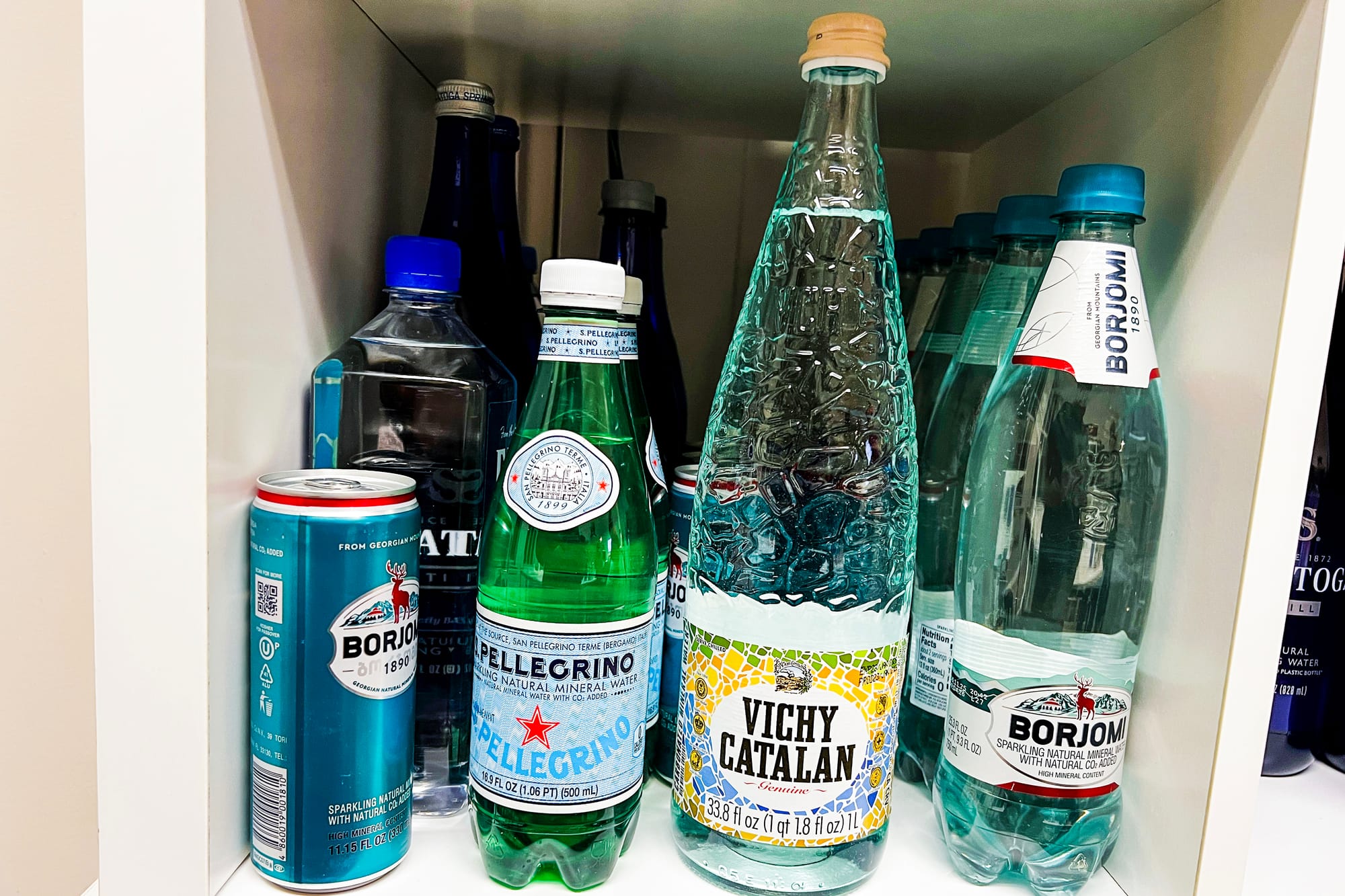
Consider San Pellegrino, the Italian sparkling water you’ll find on nearly every restaurant table in America. Most places use it as a default soda water mixer behind the bar, if they’re trying to do something beyond the soda gun. English is unsparing about what that does to a drink. “It flattens the flavor of whiskey so much,” he says. “It sucks the brightness right out of a highball.” A water like Topo Chico or Saratoga, by contrast, has relatively few dissolved solids. It doesn’t add much flavor of its own, which means it doesn't take anything away either.
That lesson applies beyond cocktails. In distilling, he explains, brewers actually want high-mineral water during fermentation because it helps the yeast do its job. But when it comes time to dilute a spirit down to bottle strength, they almost always use distilled water — because at that point, the last thing you want is anything changing the flavor. A good mixer works the same way: invisible, neutral, purely a vehicle.
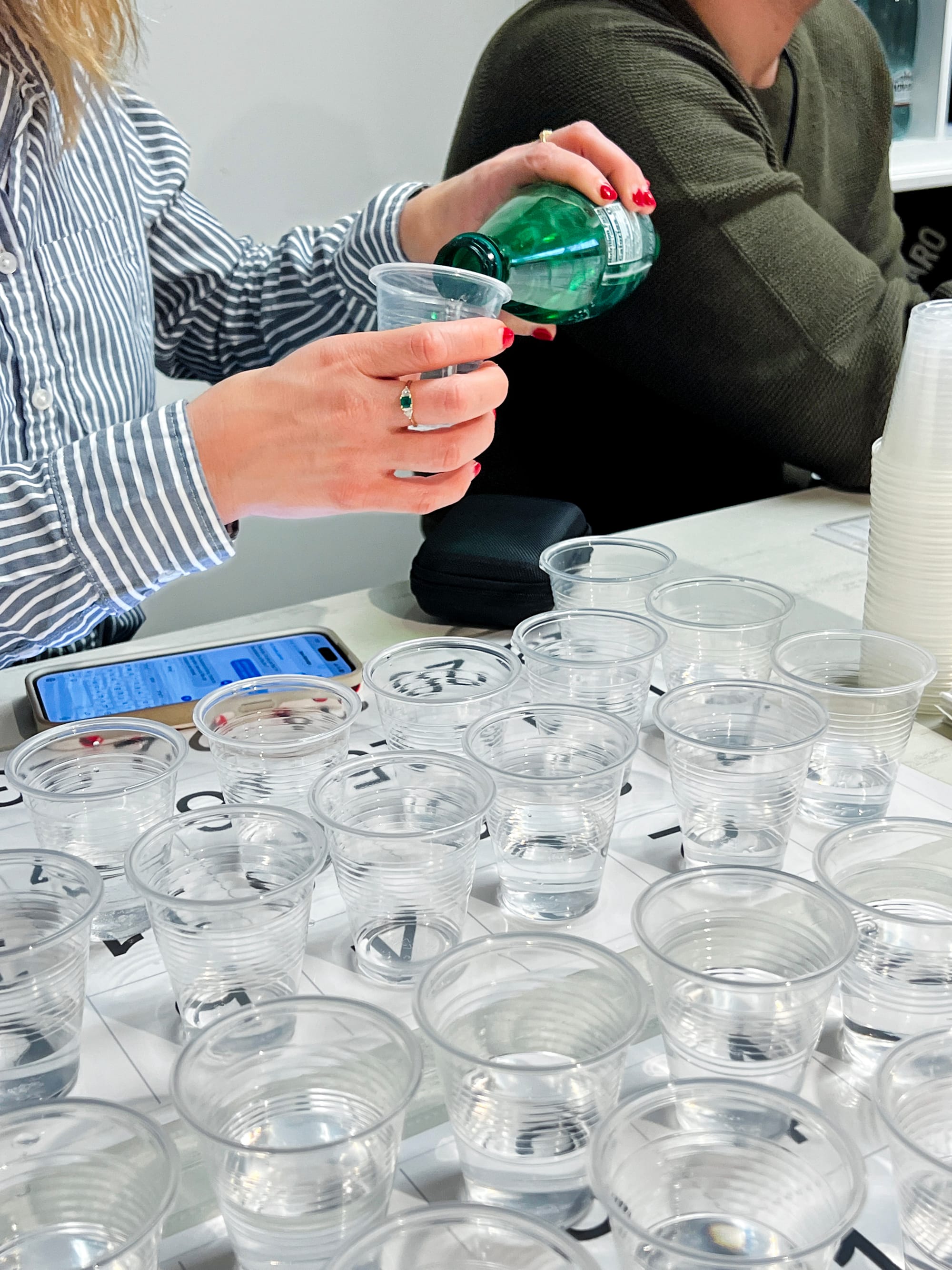
It was Vichy Catalan that convinced me water could actually pair well with food. Some premium waters, like Saratoga, advertise pairings, but they don’t really taste like much. It’d be like pairing air with sushi.
But Vichy Catalan, a salt-forward water that you’ll find all over Spain’s Basque Country, demands a complement of that specific sensation of umami that concentrates when a lobster shell begins to char over a charcoal grill. It’s water destined for washing down a mouthful of gelatinous fish cheeks, almost like a potion necessary for fishermen and mermaids to transition from sea to land and back again.
I do think the most fun you’ll have in this class is coming up with ways to describe what you’re tasting. Newbies to that kind of thing will probably feel less intimidated than they would be at a wine tasting; it’s just water!
But gosh, I cannot imagine a more polarizing, or challenging, water than Georgia’s Borjomi. It’s actually one of my weird personal favorites, if only because it’s water that forces you to notice it. I’ve tasted it a few times before, but never in a restaurant in the United States. Which is probably because it tastes like old man water.
Whenever I taste wine — or, now, water — I like to try to imagine a guy. Borjomi is someone’s grandpa: wiry hair covering his chest, wearing a gold chain, freshly emerged from a sauna with whiffs of cheap cologne still drifting off his skin.
Even if it’s not necessarily casual sippin’ water, it was Borjomi that really reminded me of how cool and interesting drinking water could be. There’s excitement in the specificity of mineral water pulled from a real place you could find on a map! And it’s this kind of luxury that reminds you that something so commonplace actually has the potential to be incredibly special.
That, perhaps, is the real point of spending an evening sipping waters with the homies. Not that water is secretly complicated, or that you’ve been drinking it wrong. Just that paying attention — to the texture, the weight, the faint mineral hum of something you’ve been gulping down thoughtlessly your whole life — is its own small reward. Even if what you find tastes a little bit like Tums.
The Water Tasting, Education, and Appreciation Workshop takes place Tuesdays (6pm) and Saturdays (11:30am) every week in San Francisco. Tickets are $50.93 per person.