‘Old Man in Flip Flops’: Notes from a Surprisingly Exciting Water Tasting Class
Camper English’s popular water tasting course is an exercise in attention — even for us tap-lovin’ plebes.


Camper English’s popular water tasting course is an exercise in attention — even for us tap-lovin’ plebes.

Blue Note's Black Radio Experience drew sold-out crowds to Napa Valley. Months later, some contractors were still chasing their money.
Oakland historically lacks soccer fields. But a group of local players and community advocates hopes to kick off a brand-new space — featuring soccer, coffee, retail, and more.

As we kick off a new year, what else is there to do but reflect on the sage teachings of the BasedGod?


There comes a time in one’s spiritual life cycle when a holy force insists, through a series of intercosmic nudges, on the need for change. Without change, there is no growth. Without growth, there is no self. Yadda yadda.
I’ll be real: I welcome transformations, and the ways they challenge, stretch, and strengthen our needs and limits. And I admire those who usher in change, and embody it, too.
For me, no Bay Area figure of this millennium has fit that bill more than The BasedGod himself: Berkeley rapper, self-styled philosopher-prophet, and inscrutable meme lord Lil B.
In ruminating on the passage of time — something I think we all do around the close of one year and the start of the next, and an act in which I must constantly partake as a tormented Aquarian — I’ve been thinking a lot about Lil B in his Super Saiyan prime.
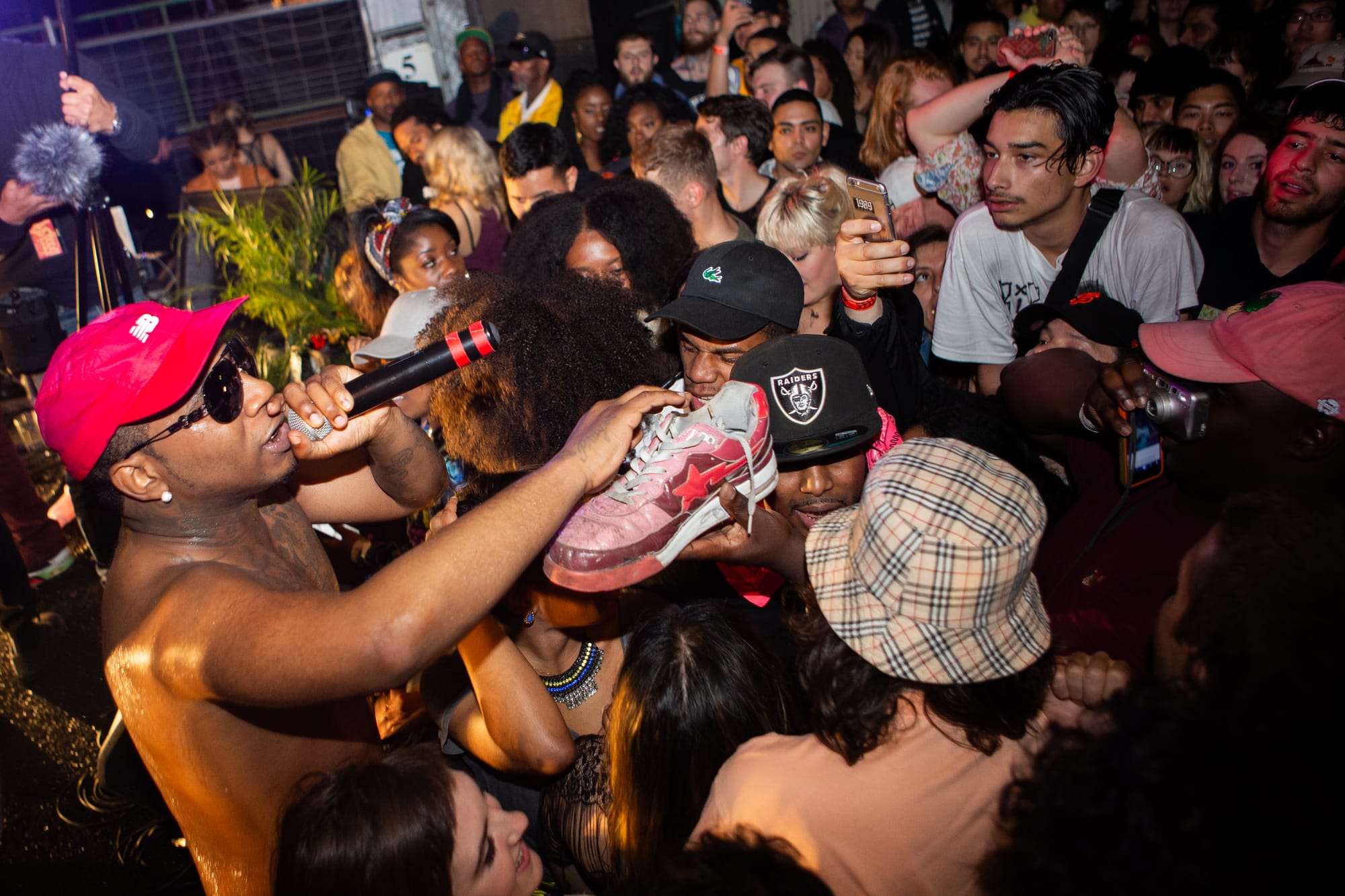
Looking back, I’m going to tell my son that Lil B was the Bay Area’s mixtape Jesus. During his stretch of underground fame, he gave us hope, and embodied the joyful changes he felt he needed to make to endure society’s woes, whether that meant using fake dreads, rapping about Barbie dolls, adopting pacifism, or cursing NBA superstars he deemed unworthy. At the same time, his music foretold some surprising truths about political firestorms, AI slop, and the modern world.
When it comes to grasping the stature of Lil B at his peak, you just had to be there. His influence — though certainly much fainter in 2026 than it was in, say, 2016 — deserves to be acknowledged. We maybe need him now more than ever.
A cloud-rap internet deity whose career took off in the late aughts when he was a member of The Pack — the East Bay rap group of “Vans”-wearing fame — Lil B’s obtuse yet positive personality launched the artist into global cult popularity. One of his first breakout tracks was the Clams Casino-produced, Imogen Heap-vocalized “I’m God” from 2010’s legendary album 6 Kiss (in which the lyricist says things like “bruh think I’m gay cus’ I’m grinding in my tiny pants” and “got my own website with the dot-com” while wearing a highlighter-yellow NHL cap).
Then there was “I’m Miley Cyrus,” the bouncy lead single off the era-defining, DJ Trapaholics-hosted Red Flame mixtape, which presents the avant-gardist proclaiming to be the Hannah Montana star reincarnated. Lil B understood the early interwebs in ways other mortals could not: He became the first rapper to amass over a million followers on Twitter, which earned him the oft-contended “Father of Internet Rap” moniker. (Some dissenters believe Chicago rapper Soulja Boy fathered internet rap, but I wholeheartedly disagree.)
At his zenith, Lil B garnered an army-sized legion of fans who worshipped him as their oracle. A 2013 Pitchfork article with the headline “FanBased: Inside Lil B's Ecstatic Cult” dove deep into the ranks of his followers, proclaiming “hip hop oddball Lil B's sprawling BasedWorld community [was] home to some of contemporary music’s most fiercely loyal, spirited, interconnected fans.” Lil B was stanned before that word became part of our wider cultural lexicon. Back then, Lil B was the lexicon.
The Pitchfork story introduces a cast of real-world characters within Lil B’s “Task Force” — a group of his most extreme loyalists with the self-appointed duty of countering any Lil B slander by responding to his haters with overwhelming positivity and love. One such Task Forcer was a 60-year-old white man named Chip, who recreated a Lil B song with a bootleg music video of his own, filmed inside his home and pottery studio. Chip even got his wife to join the Task Force. (Is Lil B the only rapper in history who has compelled white grandparents to make their own rap videos in homage to the artist and genre?)
Lil B became a de facto pseudo-philosopher of the nascent social media era, with his prophecies woven throughout his music. In tracks like 2011’s “The Age of Information,” he foreshadows humanity’s downfall: “Everything is now on the internet” he spits, before theorizing on how, and why, the internet and technology have “ruined the human race.” This is pre-AI, pre-Waymo. The bootleg quality of the music video is endearing as he riffs on deforestation, the increased cost of living, and seeking internal peace while listening to his iPod amid a deluge of information (an existential crisis which he equates to “hell,” with computers increasingly “sedat[ing]” its users). He ends with a rant about racism existing on the moon. It’s not a perfect song by any measure — in fact, Lil B’s style is often off-rhythm and nonsensical, if not sonically ugly — but the message felt timely then, and still does today.
Not everyone gave Lil B his props. He had some music fans criticizing him for “ruining the future of hip-hop.” The New York Times once published a review of his music as “a thematically thin cesspool.” The issue of whether he was actually capable of making decent rap music is still debatable. But his truest believers never wavered. Fans created virtual altars for him, using Tumblr to celebrate his larger-than-life persona. Though he’s far from the most embraced Bay Area rapper of all time, his bohemian, free-spirited ethos is undeniably a reflection of the Bay’s hippyisms in audio form.
It’s especially telling that so many critically acclaimed artists still view him as a godfather of sorts. Just over a decade ago, Kendrick Lamar Tweeted: “Thank you BasedGod. Teaching us all how to swagg in videos. You and [Lil] Wayne most influential. Thank you BasedGod.” At one point, Lamar — the world-beating rapper who entered the scene as a member of the same 2011 XXL Freshman class as Lil B, and who went on to later claim a Pulitzer Prize — was openly a fan of the Bay Area weirdo. In their only recorded live session together — a group freestyle for XXL’s Cypher series — Lamar’s dense verbosity is immediately followed by Lil B’s zany overconfidence. Lil B delivers a buttery performance that leaves the room glowing, then passes the microphone along. Hang that up in the Rap Louvre.
Shit certainly isn’t looking bright for 2026. Faith leaders are chaining themselves to ICE buildings to deter deportation raids. Senate members are in talks about ending dual-citizenship — a constitutionally fundamental U.S. birthright. Waymos keep blocking the fucking road and running over beloved neighborhood cats. Groundbreaking park ranger and civil rights organizer Betty Reid Soskin is no longer among us. Israel’s genocide of Palestinians continues to rage unchecked. Iconic local venues like Bottom of the Hill are shuttering at unseen rates in San Francisco. The list is quite literally endless. It’s going to take every ounce of the BasedGod’s sanguine wizardry to pull us out of this sunken place. (In the meantime, go throw on “Championship Game” from 2012’s Based Jam, the goofy Lil B spin-off album inspired by the movie Space Jam, and let his bizarre brand of certitude overwhelm you.)

I have no idea if Lil B is planning to release any new music this year. But to be completely honest, I could care less. He’s already provided us with a lifetime discography of self-therapizing soundtracks. Lil B defined the internet when social media was wobbly-kneed and relatively unknown. Despite at times appearing to be untethered from reality, he somehow redirected rap fans’ greater consciousness towards social good with his rambling strokes of commentary — scatterbrained Dadaisms, really — at a prolific, unhuman rate. And he did it all in real-time, without any record label funding or PR marketing ploys, simply by flooding the internet with his idiosyncratic style of art.
Lil B brought forth progress in rap — or at least attempted it, in his own language — when we needed it. He showed us a way to remain strangely human in a time of increasingly disconnected algorithms. Perhaps he still can.
And for that, I say Thank You BasedGod.