


In Which We Deserve Options Other Than Rapists and Robots
I don’t want to be assaulted by a driver, nor surveilled by cat-killing robot cars. Is this really the best we can do?

I don’t remember the first time I saw a Waymo on the streets of San Francisco, but I remember the first time it felt like an infestation. It was a balmy summer evening last year, and I was sitting in the parklet outside Elixir having a beer with a friend. After five or six of the ghostly driverless cars went by in under a minute, we started counting: 18, 19, 20. “What the fuck is going on?” my friend said.
What the fuck was going on was that Waymo, the autonomous vehicle company founded by Google, had nearly tripled its fleet of cars in the Bay Area between March and August of 2024. I didn’t know the specifics at the time, but I’ve lived here long enough that I could smell the shift on the wind. Oh, I thought, it’s happening again.
Indeed, we were at a familiar inflection point: Any justified concern that a reasonable person might have about these cars’ surveillance capabilities, their implications for labor, their tendency to impede emergency vehicles — or to kill beloved bodega cats? (More on that in a bit.) Oh, I realized, within a year, bringing any of that up is going to make me sound pedantic at a party. We didn’t get to vote on these cars, but now it’s time to either get on board or start to feel crazy for suggesting that they may not, in fact, be a great idea.
Like Imagine Dragons or garbage patches in the Pacific, Waymos are here, they’re shitty, get used to it.
Oh, I thought: My Uber is down there.
You remember it, right? I know I’m not the only one who revisits early YouTube hits at 1 in the morning, or as I call it, doing cultural anthropology. It was October 2014, the Giants had just won their third World Series in five years, and in the Mission, we were partying. People climbed telephone poles, built bonfires, and cheersed each other with tall cans in brown bags. It was glorious and stupid. Then cops in riot gear appeared, in far larger numbers than seemed necessary, to clear the street.
The next day, a video emerged that captured the local zeitgeist in 11 seconds. “Get out of the street, the streets are open!” booms a cop through a bullhorn, as a row of police flanks Mission Street. Then a young woman enters the video’s foreground and says in exasperation: “My Uber is down there!”
This video has 345,000 views, and I do not wish to guess how many of those are me. Suffice it to say I find this artifact endlessly compelling: Did she envision the police hearing her, parting for her, perhaps escorting her to the car? I am not like these other hooligans, she is communicating. I am a nice young lady and I have hailed a ride home from the trash can fires.
But sometime in the last couple years — while reading 10-year-old YouTube comments that delight in characterizing this woman as the peak of smarmy San Francisco privilege — I realized something unsettling: This video has become untethered from its original context. To a 20-something viewer in 2025 who has grown up with Uber as a fact of life, the text here is far less rich.
Because Uber, I will tell my grandkids as they wheel me off to bed at the nursing home, used to be shorthand for douchey. There was a time when many of us in San Francisco were in agreement that they were bad. Founder and CEO Travis Kalanick, a form of union-busting that gained sentience and donned an Italian suit, seemed to embrace this reputation, becoming an archetypal asshole tech bro for the ages.

To be clear, this wasn’t just a patina of doucheyness. According to the New York Times, Uber received a report of sexual assault or misconduct by one of its drivers, on average, every eight minutes between 2017 and 2022.
This is just one of the jaw-dropping stats revealed in an ongoing, massive sexual assault litigation against Uber. Other allegations include that the company researched and developed tools to help protect riders, such as a feature that could predict “high-risk” rides (problematic in other ways), and another feature that allowed women riders to request women drivers, but didn’t implement them because they could hurt profits. At the same time, according to court records, Uber allegedly launched publicity campaigns to discredit rape victims, and poured millions of dollars into legislation to ensure drivers could not be classified as employees, further evading responsibility.
Like I said: There was a time when most of us agreed this company was not that cool.
Of course I eventually started using it anyway.
It was so cheap in those days, I will tell said grandchildren in my defense, and I was so broke. Those companies were dealers, got you hooked, lulled you into complacency with rates that made no sense unless someone was getting exploited, which of course we understood. It wasn’t actually cheap: We just paid for it in other ways.

It is 2025, and over the past year I have stood, tight smile plastered on my face, in more kitchens and bars and school pickup lines than I can count, listening as yet another woman or nonbinary person mentions they prefer Waymos because they feel safer not being alone with a strange male human driver. This makes sense. It is the one argument for Waymos to which I do not have an immediate “but you’re wrong.” I have only a small, defeated “but that’s sad.”
When the man vs. bear meme started going around last year — you know, asking women which they’d rather encounter while alone in the woods, a man or a bear? — I started mentally subbing “surveillance state” for bear. I cannot blame anyone for choosing the surveillance state robot-bear, especially when it’s late and you’re in a sketchy neighborhood and Muni has been rendered unreliable, at best, by budget cuts. I also cannot fault anyone because we have been inundated by messaging — including both sponsored content and coverage from some local media outlets that might as well be paid advertisements — that says this state of things is normal and good.
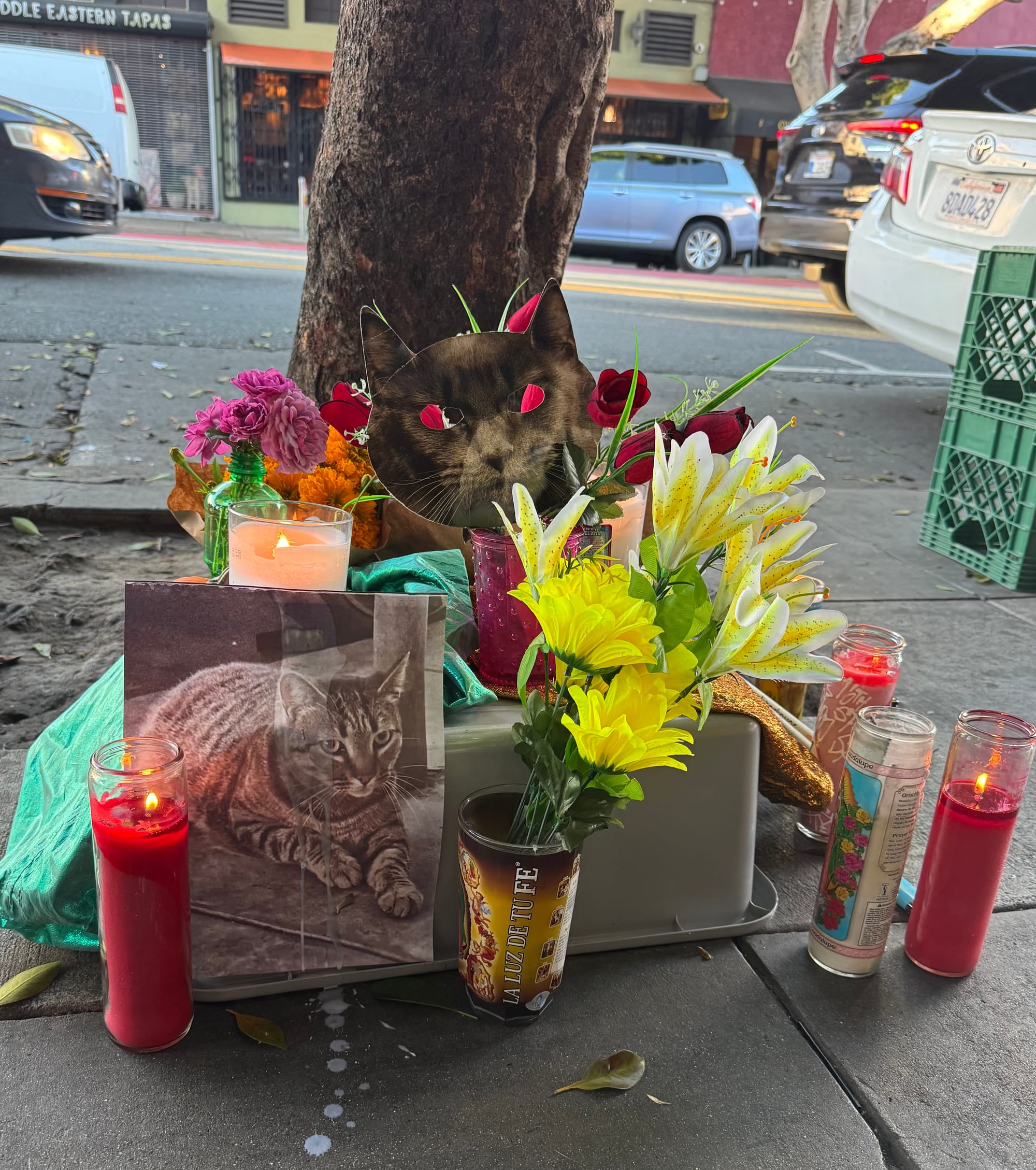
What I can do is attempt to make choices that feel the least bad, for me. So as of now, I have yet to take a Waymo. My resolve was strengthened this week after Kit Kat, the beloved feline mayor of 16th Street, was killed by one. A neighbor who was there when it happened said no one could get the car moving off the cat.
When I stopped by the altar that sprung up outside Randa’s Market the next day, Mike — the most stoic corner store owner I’ve ever met in my life — had tears in his eyes. “He was my baby,” he said.
“But Waymo has to take responsibility, right?” asked another neighbor, also in tears, as she delivered flowers. “What does that matter?” Mike said. “That won’t bring him back.”
It is actually too on the nose for the most beloved street cat in the Mission to get killed by a Waymo, I have decided. It’s a heartbreaking and deeply cliché entry in the annals of San Francisco gentrification commentary. Delete it, please, and try again.
Uber, meanwhile, finally launched its tool that allows women riders to request women drivers, so I used that last week when I went to my friend’s house for a birthday party up in Diamond Heights. When my driver arrived, a 60-something woman from Daly City, we chatted about her granddaughter. I’ve always liked talking to cab drivers. There was the time last year when a guy started spouting Trumpy bullshit at me and I asked to be dropped off nearly a mile early, but I guess I still think that’s the price you pay for existing in physical space with other human beings, an activity that’s not worth abandoning completely. I haven’t had to pay a worse price, personally, yet.
At my friend’s apartment, as a group of us smoked a joint on his patio overlooking the Castro, someone remarked how many goddamn Waymos we’d seen go by in five minutes. Really, I don’t know if it was the hilly area or what, but it was a ton.

“This is a great vantage point for throwing rocks at them,” one friend said. “Shh, that’s totally the lookout car,” another joked, pointing at one idling across the street, its camera whirring dumbly on top. “You know they can hear everything we’re saying.”
We laughed, but it wasn’t that funny. Who knows? This time next year there could be a model where that’s touted as a feature. People will be against it at first, of course, but then the wind will shift — there’s no telling what society will eventually accept. I thought: Forget it, Jake. It’s San Francisco. We’re all just along for the ride.
